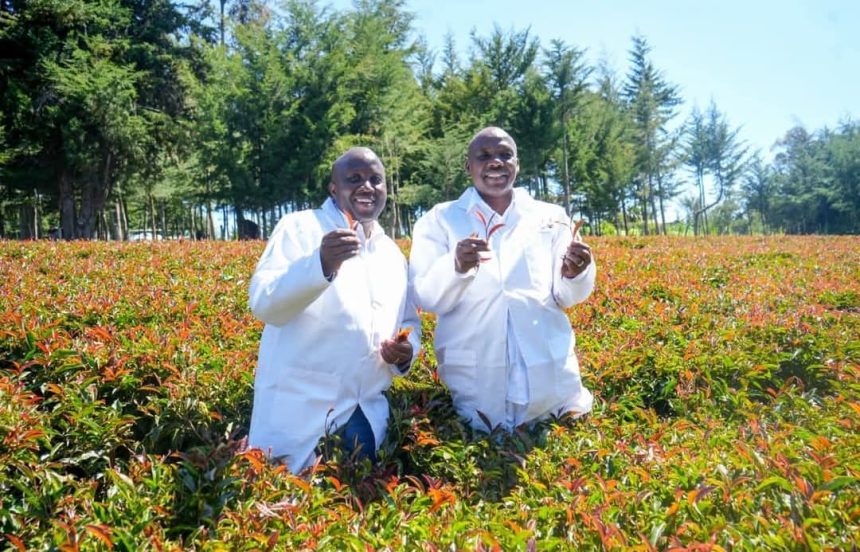
For generations, the hills and valleys of Baringo County have echoed with a story written in dust and conflict the story of cattle rustling, of communities locked in cycles of retaliatory violence, of land scorched not by drought alone but by the persistent embers of insecurity. It is a story that has cost lives, derailed schools, chased away investment, and consigned one of Kenya’s most naturally endowed counties to a reputation it has long deserved to shed. But something is shifting. Along the fertile ridges of Eldama Ravine, in the villages of Sirwa and Mogotio, a new story is being planted literally one seedling at a time.
The commissioning of the Koibatek ATC Water Dam and the launch of distilling projects in Eldama Ravine, accompanied by the distribution of cash-crop seedlings to local farmers, marked a decisive turning point in the government’s strategy for Baringo. Principal Secretary for Agriculture Dr. Kipronoh Ronoh delivered a message that was as much a challenge as it was a commitment: diversify, plant, and prosper. The era of depending on pastoralism alone in a landscape that can sustain so much more is over.

The weapon they never expected: A seedling
Poverty and insecurity are rarely separate problems. In Baringo, cattle rustling has long been both a symptom and a sustainer of economic desperation. When a young man has no viable income, no crop to tend, no harvest to anticipate, the cattle raid becomes in a cruel but comprehensible logic an economic act. The government’s intervention is therefore not merely agricultural. It is a peace strategy dressed in green leaves.
By introducing high-value cash crops into communities that have historically relied on livestock, the Ministry of Agriculture is disrupting the economic incentive structure that makes rustling attractive. A farmer tending a coffee plantation worth Kshs. 150,000 per season has a stake in stability. He does not leave his crop to mount a raid. He does not welcome the chaos that burns neighbours’ farms and closes the roads his produce must travel to reach the market. Prosperity, quietly and powerfully, is one of the most effective peacekeeping tools ever invented.
“The government remains committed to tapping the huge potential of coffee and tea in Baringo County ensuring more land is brought under irrigation and propagating over 3 million coffee and 5 million tea seedlings for distribution to farmers.” PS Agriculture Dr. Kipronoh Ronoh, Eldama Ravine
Three crops, one county, unlimited potential
Baringo’s agro-ecological zones are far more diverse than its semi-arid reputation suggests. The highlands around Eldama Ravine receive reliable rainfall and enjoy fertile soils entirely capable of sustaining premium cash crops. The government’s focus on three specific commodities is both deliberate and shrewd:
Coffee — A high-value global commodity with growing demand; KALRO’s 3 million seedling propagation programme positions Baringo to become a significant contributor to Kenya’s premium coffee export story.
Avocado — Kenya is already Africa’s largest avocado exporter. Baringo farmers entering this market now join a value chain with proven, rapidly expanding European and Asian demand and strong farm-gate prices.
Macadamia — One of the world’s most lucrative tree nuts, macadamia thrives in Kenya’s highlands and offers Baringo farmers a long-term, low-maintenance income stream that grows more valuable each year.
Water is the game-changer
No crop strategy survives without water. The commissioning of the Koibatek ATC Water Dam is therefore not a backdrop to this story it is its enabling chapter. Irrigation is the single most transformative lever available to semi-arid and sub-humid counties like Baringo. It converts rain-dependent, one-season farming into a year-round productive enterprise, decouples farmers from the volatility of rainfall patterns worsened by climate change, and dramatically increases the land area that can sustain commercial-grade crop production.
Combined with the establishment of a KALRO centre in Baringo to propagate over 3 million coffee and 5 million tea seedlings, and the active support of PS ICT Dr.Eng. John Kipchumba Tanui and Eldama Ravine MP Musa Sirima, the infrastructure for a genuine agricultural transformation is no longer a promise it is being physically installed. What Baringo now needs from its farmers is the courage to plant, the patience to tend, and the collective will to build a county whose wealth grows from the ground up not from the barrel of a gun or the theft of a neighbour’s herd. The seedlings have been distributed. The dam is full. The future is ready to be farmed.