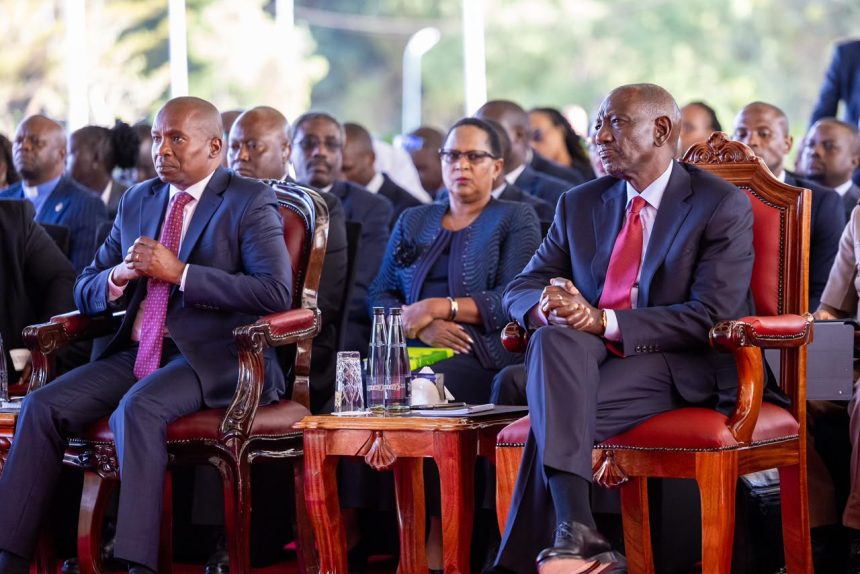
The report of the Kenya National Commission on Human Rights submitted to President William Ruto has marked the beginning of a national shift toward restorative justice and repairing relationships among Kenyans, with leaders describing it as a foundational step in addressing harm arising from demonstrations.
Speaking at State House, Nairobi, Deputy President Prof. Kithure Kindiki said the framework for reparations for victims of demonstrations represents the first step in a broader process of restoring relations between citizens and state institutions.

He said its implementation would strengthen accountability for both protesters and security agencies, while promoting lawful exercise of the constitutional rights to assemble, demonstrate, picket and petition authorities.
“Today is one of my proudest moments since I left law school nearly 30 years ago,” Kindiki said. He noted that the gathering reflected Kenya’s ongoing constitutional journey and the need to understand both why the country is addressing the issue of demonstrations and why it must do so now.
Kindiki said justice has multiple dimensions, including retributive justice, where offenders are punished, and restorative justice, which focuses on rebuilding relationships between offenders and victims.
“It is my humble submission, Your Excellency, that we are gathered here this morning to advance the agenda of our country more in the area of restorative justice and repairing relationships among ourselves. That’s why we are here,” he said.
He emphasised that the criminal justice system would continue to function, but noted that restorative justice had long remained underutilised despite its potential to deliver long-term reconciliation.
He added that Kenya has now entered the complex field of transitional justice, which many countries have historically avoided.
According to Kindiki, the framework is not simply about compensation, as some harms, including loss of life, cannot be fully compensated.
“Therefore, today we are not talking compensation; we are talking reparation because we cannot compensate death. I mean, it’s unimaginable,” he said.
He observed that Article 37 of the Constitution guarantees the rights to assemble, demonstrate, picket and petition, but noted that public debate has often focused narrowly on demonstrations alone.
Kindiki said while many demonstrations in Kenya have been peaceful and conducted by professionals, trade unions and civil society actors, challenges have mainly arisen in politically charged protests.
The Deputy President also highlighted legal principles underpinning justice systems, including Nullum crimen sine lege (there is no crime without law) and Nulla poena sine lege (there is no punishment without law).
He said these principles require that punishment must always be grounded in law and remain proportionate to the gravity of the offence, reinforcing the need for balance between accountability and deterrence.
“Legal discussion must balance crime and punishment even as we talk about reparation,” he said.
Kindiki further expressed optimism about a future where demonstrations are conducted peacefully and responsibly, with political leaders organising lawful protests, ensuring discipline among supporters and working with police to facilitate orderly expression.
He said such a future would safeguard the interests of millions of Kenyans who are not involved in politics.
“We must make sure that we don’t make this country dangerous for the 55 million Kenyans who do not earn a living from politics,” he said.
The Deputy President concluded by describing the reparations framework as a historic and consequential step toward national healing, restorative justice and long-term reconciliation.