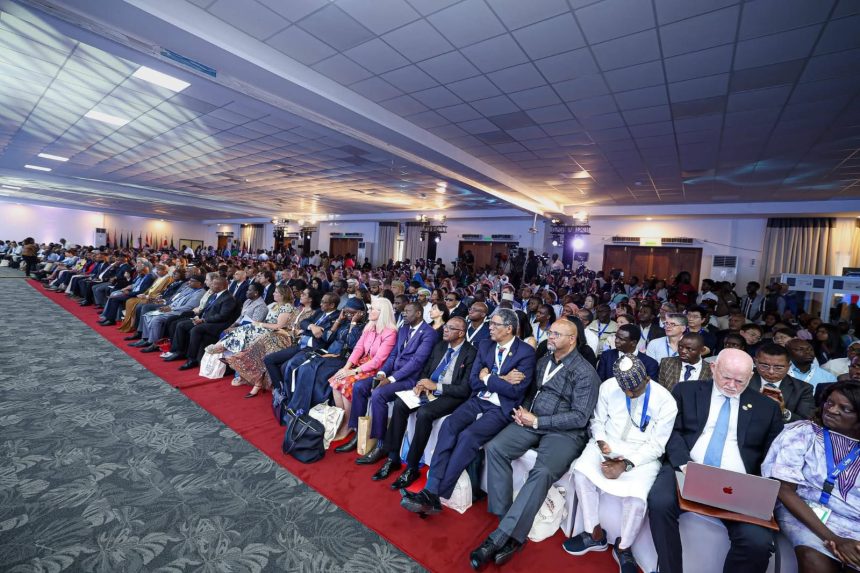
Fifteen national governments from across Africa, Asia, the Caribbean, Europe, and the Pacific adopted the Mombasa Declaration at the 11th Our Ocean Conference, committing to advance global fisheries transparency and strengthen efforts to combat illegal, unreported, and unregulated (IUU) fishing.
The Mombasa Declaration is a call to action for coastal and flag States on fisheries transparency, with a particular focus on better collection and dissemination of vessel information and allowing for better access to fisheries data.

“Fisheries are a matter of culture and national security for us. I’m happy that Ghana is among the first countries to sign the Mombasa Declaration, because it provides a platform for all of us, the different governments, to come together and declare on an international platform that we are working together, fighting together for transparency in the fisheries sector,” said Emelia Arthur, Minister of Fisheries and Aquaculture, Ghana.
The declaration builds support and momentum for the Global Charter for Fisheries Transparency, which outlines 10 low-cost or no-cost policy principles that governments can adopt globally, in law and in practice.
Endorsed at Our Ocean by a diverse coalition of countries, including Belgium, Cameroon, the Dominican Republic, France (on behalf of its overseas territories), Gambia, Ghana, Guinea, Liberia, Panama, Papua New Guinea, Senegal, Somalia, South Korea, and The Republic of Congo, the Mombasa Declaration unites nations committed to strengthening ocean governance and leading global action on fisheries transparency.
“France is proud to be among the first supporters of the Mombasa Declaration on Fisheries Transparency, through its Overseas Countries and Territories (OCTs),” said Madame Catherine Chabaud, Minister Delegate for the Sea and Fishery, France.
Once adopted, signatory countries will begin putting the Declaration into action. The signing launches a campaign for other nations to join the effort in advance of the next Our Ocean Conference in 2027.
Coastal communities, small-scale fishers, and economies that depend on marine wildlife bear the brunt of IUU fishing, which threatens livelihoods, food security, and the long-term health of ocean ecosystems.
“For too long, fisheries have operated far from shore, with inadequate oversight and opaque supply chains. These fishing practices have depleted fish stocks, undermined coastal communities, and enabled illegal, unreported, and unregulated fishing and human rights abuses. Transparency is essential to protecting our oceans and the livelihoods of those that depend on them. The Mombasa Declaration signals that governments around the world are ready to act against illegal fishing, and to work together for a more transparent, equitable, and sustainable ocean for all,” added Beth Lowell, Vice President at Oceana.
The Mombasa Declaration responds to these challenges by advancing practical transparency measures, outlined in the Global Charter, to improve access to information on vessel ownership, licensing, and fishing activity; strengthening accountability; and enabling more sustainable and equitable management of marine resources.
“Transparency is how we expose abuses, support coastal communities, and rebuild trust that fisheries can be managed sustainably and fairly. I applaud the leadership of every state endorsing the Mombasa Declaration today, and urge others to follow,” added Steve Trent, CEO and Founder of the Environmental Justice Foundation.
The Mombasa Declaration was developed with support from the Coalition for Fisheries Transparency and its partners, including academics and practitioners, who are working with governments to advance increased transparency and accountability in fisheries governance and management.
Through the Declaration, signatory countries commit to advancing concrete transparency reforms, including modernizing vessel registries, publishing fishing authorizations, and strengthening information-sharing to support enforcement and accountability across fisheries sectors.
IUU fishing is a pervasive global challenge that undermines coastal communities, distorts markets, and weakens sound ocean governance.
Experts estimate this costs the global economy up to $50 billion annually, while depriving legitimate fishers—particularly in low-and middle-income countries, of income and access to resources.
IUU fishing contributes to declining fish stocks, threatening food security and livelihoods, and is often linked to serious human rights abuses, including unsafe working conditions and forced labor.
Limited transparency in vessel ownership, tracking, and fishing activity and supply chains allows these practices to persist, making stronger access to reliable fisheries data and accountability mechanisms essential to protecting marine ecosystems and the communities that depend on them.