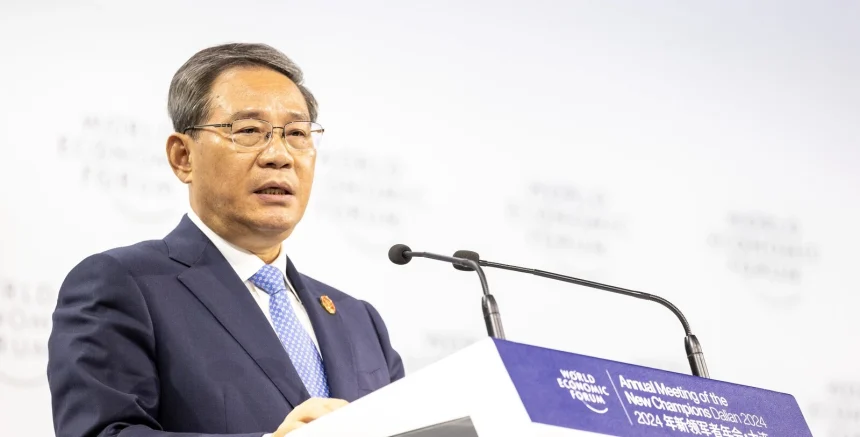
Chinese Premier Li Qiang has challenged the notion that China’s rapid technological advancement poses a global threat. Instead, he argues that the country’s innovation-driven development is generating unprecedented opportunities for businesses, investors, and developing nations worldwide.
Speaking at the opening plenary of the Annual Meeting of the New Champions 2026 in Dalian, Premier Li outlined “China Opportunity 2.0,” the nation’s next phase of development. This new phase, he explained, marks a shift from China providing traditional market advantages to delivering “innovation dividends” through technological progress and industrial upgrading.

“What China’s technologies and products in emerging areas bring to the world are not shocks or threats, but opportunities and empowerment,” Li stated.
The Premier highlighted China’s emergence as a global innovation powerhouse, attributing this to sustained investment in research, technology, and industrial transformation. Breakthroughs in artificial intelligence, quantum information, integrated circuits, commercial space technology, and nuclear fusion are, he noted, reshaping the country’s economy.
He noted that China’s large artificial intelligence models have achieved world-leading performance, with embodied Artificial Intelligence already entering large-scale commercial application. This, he suggested, positions China at the forefront of the next technological revolution.
Li clarified that these achievements are the culmination of decades of investment in research and development, rather than short-term policy measures.
“China’s innovation has been forged through relentless, painstaking effort. There are no shortcuts in sci-tech research. No one can copy their way to an innovation edge. There has to be solid, hard work to tackle tough challenges,” he asserted.
Li noted that China is now the world’s second-largest investor in research and development and that the country intends to further increase funding for basic scientific research during its 15th Five-Year Plan period to strengthen original innovation.
According to Li, China’s innovation ecosystem is unique, facilitating the rapid transition of scientific discoveries from laboratories to commercial markets. He said this is supported by the country’s vast manufacturing capacity and a domestic market of over 1.4 billion people.
“A promising scientific achievement, backed by China’s manufacturing strength, can be rapidly turned into real-world consumer goods,” he explained.
The Premier also refuted claims that government subsidies drive China’s industrial competitiveness. He maintained that the country’s success in sectors such as new energy vehicles and intelligent manufacturing stems from continuous technological breakthroughs and innovation.
Premier Li urged the world to embrace “China Opportunity 2.0.” He explained that while China’s large consumer market previously generated “market dividends” for global businesses, the country is now offering something more valuable through its expanding innovation ecosystem.
“In the past, China’s big market and low-cost production factors provided market dividends for the world. Today, while continuing to provide even greater market dividends, China is also offering more and more innovation dividends with its technological progress and industrial upgrading,” he said.
The Premier noted that these innovation dividends are creating new opportunities for global companies by enabling faster research, product development, and commercialisation within China’s integrated industrial ecosystem.
As a result, multinational firms are increasingly establishing research centres and regional headquarters in China, with over 14,000 foreign-funded enterprises entering the country’s scientific research and technology services sector in 2025 alone.
Li reiterated China’s commitment to ensuring that its technological progress contributes to global development, particularly for developing countries.
He cited China’s open-source artificial intelligence models, which have been downloaded over 10 billion times worldwide, and the opening of major Chinese scientific facilities in fields such as nuclear fusion and quantum technology to international researchers.
Premier Li also reaffirmed China’s commitment to economic openness, despite rising protectionism and geopolitical tensions.
He highlighted that China has extended zero-tariff treatment to 63 countries, has remained the world’s second-largest import market for 17 consecutive years, and continues to create new channels for high-quality foreign products to enter the Chinese market.
“For China, integrated development with the world has never been an expediency, but a strategic decision made in line with the trend of history and based on our own development philosophy,” Li stated.
He argued that global innovation cannot flourish behind technological barriers or trade restrictions, urging countries to strengthen cooperation rather than pursue isolation.
“We should deepen connectivity and collaboration to build greater synergy for innovation. In this new round of technological revolution and industrial transformation, no country or company can succeed alone,” he said.
At the same time, Li called for stronger international governance of emerging technologies, particularly artificial intelligence. He stressed that innovation should advance humanity’s shared interests while safeguarding peace, security, and sustainable development.
The Premier used the opportunity to invite businesses from around the world to deepen their presence in China, pledging wider market access, equal treatment for foreign enterprises, and a world-class business environment.
“No matter how the world changes, China’s door will only open wider….We warmly welcome businesses from around the world to China to invest and do business here, share in the new opportunities we offer, and join us in building a brighter future,” Li said.