A delegation from key development partners has praised Kirinyaga County’s progress in transforming fish farming into a profitable commercial enterprise, citing the county as a model in aquaculture.
The delegation from the International Fund for Agricultural Development (IFAD), the World Bank and the Aquaculture Business Development Programme (ABDP said it was impress that Kirinyaga had succeeded in helping farmers pursue livelihood through commercial fish farming.

The county has more than 1,600 commercial fish farmers, with many diversifying into ornamental fish farming and hatchery businesses.
With nine hatcheries that are ensuring a steady supply of quality fingerlings the delegation led by ABDP National Programme Coordinator Sammy Macharia said Kirinyaga’s innovations are now being replicated nationwide.
“Fish farming in Kirinyaga has grown from a livelihood activity into a profitable business, making Kirinyaga the regional leader in aquaculture development,”Macharia said.
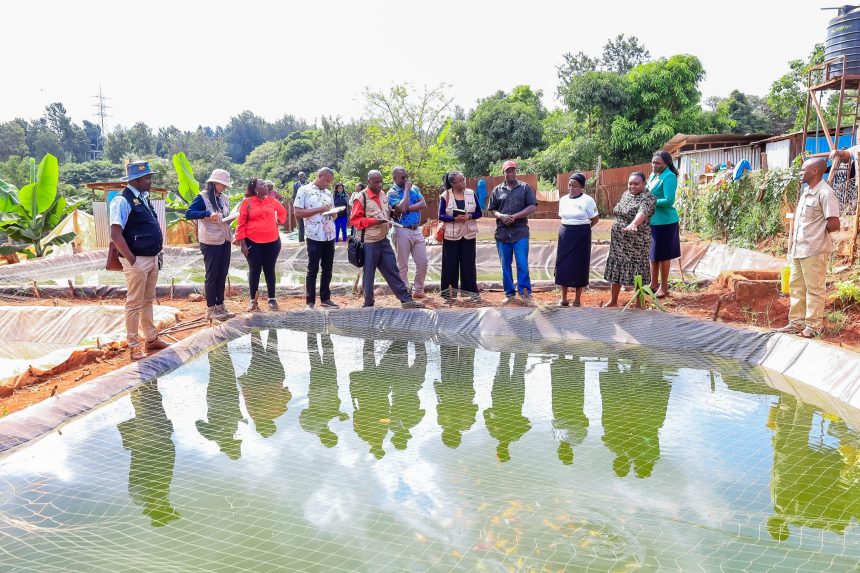
The team toured fish farming projects across the county to assess the impact of the eight-year ABDP programme, which has supported smallholder fish farmers through investments in production, extension services, value addition and market development.
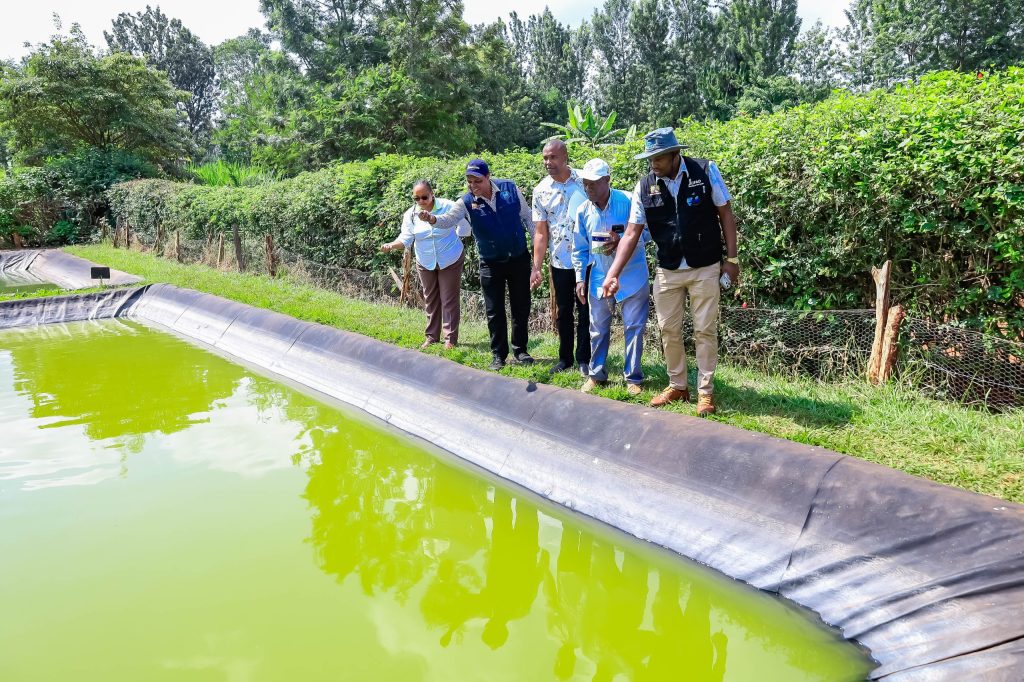
Macharia, said the programme has worked with smallholder farmers in 15 counties by addressing key production challenges while strengthening fish marketing systems.
“We support farmers by preventing water losses through the provision of pond liners, reducing pre-harvest losses using predator and bird nets, and offering advisory and extension services,” he said.
He commended Governor Anne Waiguru for her commitment to aquaculture, describing Kirinyaga as one of the programme’s best-performing counties.
“The Governor has been a great supporter of ABDP implementation. She has provided capable technical staff who continue to offer quality extension services, and she leads by example because she is a fish farmer herself,” he said.
ABDP has also supported youth-led aquaculture businesses, including black soldier fly production for fish feeds, fish eateries and Smart Fish Kiosks that promote value addition and improve access to fresh fish markets.
“When we started in 2018, farmers were producing less than 10 kilograms of fish annually. Today, many are harvesting between 200 and 300 kilograms per farmer each year. That is a remarkable transformation,” he said.
Governor Waiguru said the county has deliberately shifted fish farming from a subsistence activity into a commercially viable value chain with current production of 71.3 tonnes and with an annual target of 400 tonnes.
Waiguru said that her administration has been supporting aquaculture development in the county through provision of fish pond liners, fish fingerlings, fish feeds and extension services.
“We have purchased an extruder to enable farmers to produce their own fish feeds, significantly reducing production costs and improving profitability,” she said.
Kirinyaga County Executive Committee Member for Agriculture, Livestock, Veterinary and Fisheries Dr. John Gachara added that the county has strengthened fish marketing through the establishment of the Kiaga Fish Aggregation Centre and lowered production costs by providing farmers with a fish feed extruder.
“The Aquaculture Business Development Programme has been a critical partner in our efforts to commercialize fish farming. Our strategy has been to help farmers grow progressively from small-scale production into commercial enterprises,” he said.
Head of Monitoring, Evaluation and Knowledge Management at IFAD-ABDP, Michael Waweru, said Kirinyaga has become a learning centre for aquaculture innovation across Kenya.
“When we first came to Kirinyaga, many farmers were keeping fish in very small ponds measuring only about 20 to 25 square metres. Through the programme, over 1,200 farmers received pond liners and expanded their ponds to nearly 300 square metres,” he said.
He noted that the increased production area had translated into higher yields and better incomes.
“Production has grown from about 80 kilograms per farmer per pond annually to around 144 kilograms. Farmers are earning more, and that is the progress we came to witness,” said Waweru.
He further said Kirinyaga’s innovations are now being replicated nationwide.
“Many counties have adopted ornamental fish farming after learning from Kirinyaga. Today, all the 15 ABDP counties have embraced the practice. The county has also become a demonstration centre for hatchery development and fingerling production, supported by the National Aquaculture Research and Development Centre in Sagana,” he said.
Farmers who have benefited from the programme also shared their experiences.
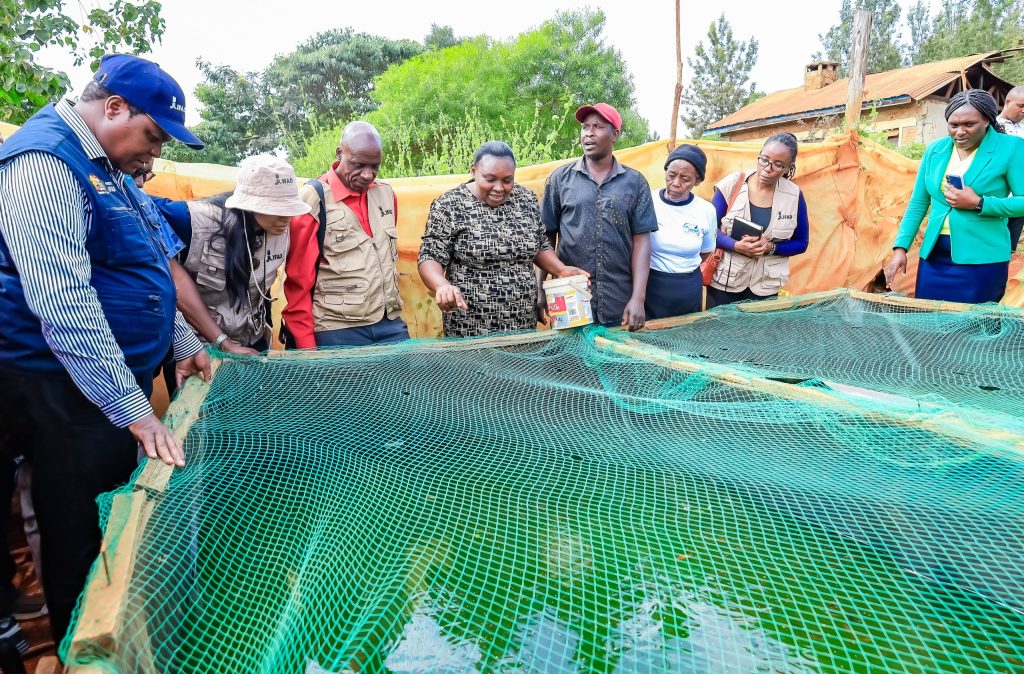
Margaret Wairimu a farmer who has benefited from the programme, said she ventured into commercial fish farming in 2022 after receiving support from IFAD through the County Government.
“I started fish farming in 2022 with the help of IFAD. They provided pond liners and fish feeds, and I have seen good results. I cannot complain because the project has helped me, and I intend to continue farming fish,” she said.
For John Karoki of Kiandai Village, fish farming has become a dependable source of income.
“I have five ponds stocked with fish. My biggest ponds each hold 1,000 fingerlings while the smallest holds 300. Fish mature within six to seven months,” he said.
Karoki said he has adopted staggered stocking to ensure continuous production.
“This year I have harvested fish worth more than Ksh.100,000. I restock my ponds at intervals of one to one-and-a-half months so that I always have fish ready for the market. That enables me to meet the growing demand throughout the year,” he said.