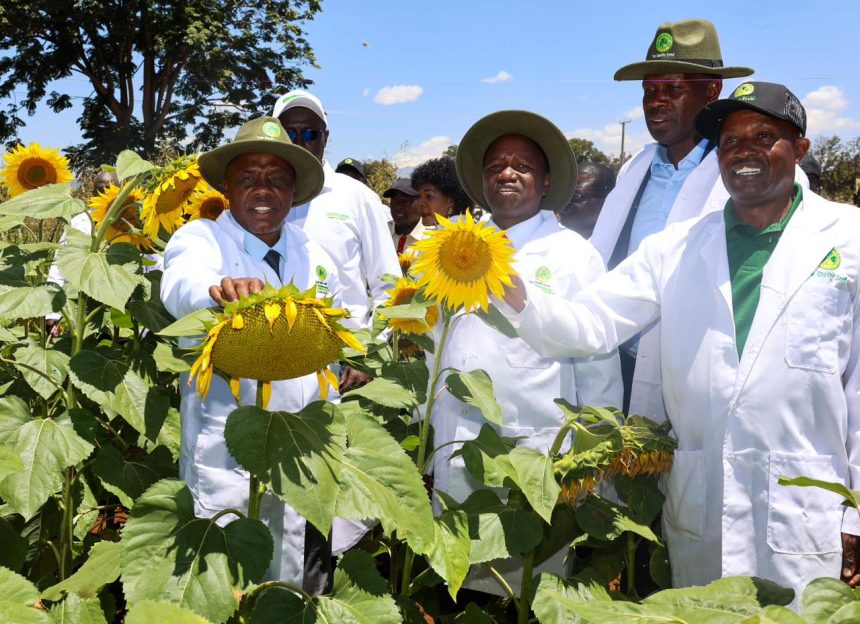
Kitale, Trans Nzoia County, played host today to a celebration that reached far beyond the borders of the county, and indeed the country. The Kenya Seed Company’s 70th Annual Celebration drew farmers, agribusiness leaders and government officials from across the region, transforming the event into a regional statement of intent on food security, innovation and cooperation.
Presiding over the celebration was Principal Secretary for Agriculture Dr. Kipronoh Ronoh, whose presence underscored the significance the Government places on the seed sector as the foundation of the country’s agricultural ambitions. The gathering brought together stakeholders not only from Kenya but from Rwanda, the Democratic Republic of Congo, Uganda and Tanzania, a reminder that seed security is a shared regional concern rather than a national one alone. When farmers in Kitale and farmers in Kigali or Kampala depend on the same reliable genetics and the same resilient varieties, collaboration stops being a courtesy and becomes a necessity.

At the heart of the day’s proceedings was a message that has defined Kenya Seed Company’s mission for seven decades: farmers must have access to quality seed, and they must have it in sufficient quantities. Seventy years of operation is no small achievement for any agribusiness, let alone one whose fortunes are so closely tied to the unpredictability of weather, markets and policy. The anniversary therefore served a dual purpose, honouring a legacy of service while turning attention firmly toward the challenges that lie ahead, chief among them, the escalating impact of climate change on farming systems across East Africa.
To that end, the celebration placed heavy emphasis on innovation and technology as the tools through which the region will adapt. Climate-smart agriculture is no longer a distant aspiration discussed in policy papers; it is fast becoming an operational necessity. In line with this, the Government reaffirmed its commitment to constructing 50 dams nationwide, a programme designed to expand water availability and support a broader shift from rain-fed agriculture to irrigation-based farming. For a country where the majority of smallholder farmers remain at the mercy of seasonal rainfall, this infrastructure push represents one of the more consequential agricultural interventions in recent years.
PS Ronoh used the platform to offer farmers a direct and practical assurance: the country currently holds adequate seed stocks, easing concerns ahead of the planting season. He went further, directing Kenya Seed Company and the National Cereals and Produce Board (NCPB) to move swiftly in implementing newly reduced prices for seed and fertiliser, a directive that speaks to the urgency of easing input costs for farmers already grappling with tight margins. Affordability, after all, is as central to food security as availability.
The celebration also carried a note of diversification. PS Ronoh directed the distribution of one tonne of sunflower seed to farmers, a move intended to boost production of the crop and encourage farmers to broaden their income streams beyond the staples that have traditionally dominated Kenyan agriculture. Sunflower, valued for its role in edible oil production, represents an opportunity for farmers to tap into a market that Kenya continues to rely heavily on imports to satisfy.
The PS was joined by Kenya Seed Company Managing Director Sammy Chepsiror, Trans Nzoia Senator Allan Chesang, and other key stakeholders whose presence reflected the breadth of interest, political, corporate and agricultural, in the company’s continued success.
As Kenya Seed Company looks past its 70th year, the themes raised in Kitale are likely to shape the sector’s trajectory for seasons to come: regional partnership over isolation, innovation over inertia, and infrastructure investment as the backbone of climate resilience. For the farmers who attended, and the many more who will feel the effects of reduced input prices and expanded irrigation in the months ahead, the anniversary was less a look backward than a signal of what is being planted for the future.