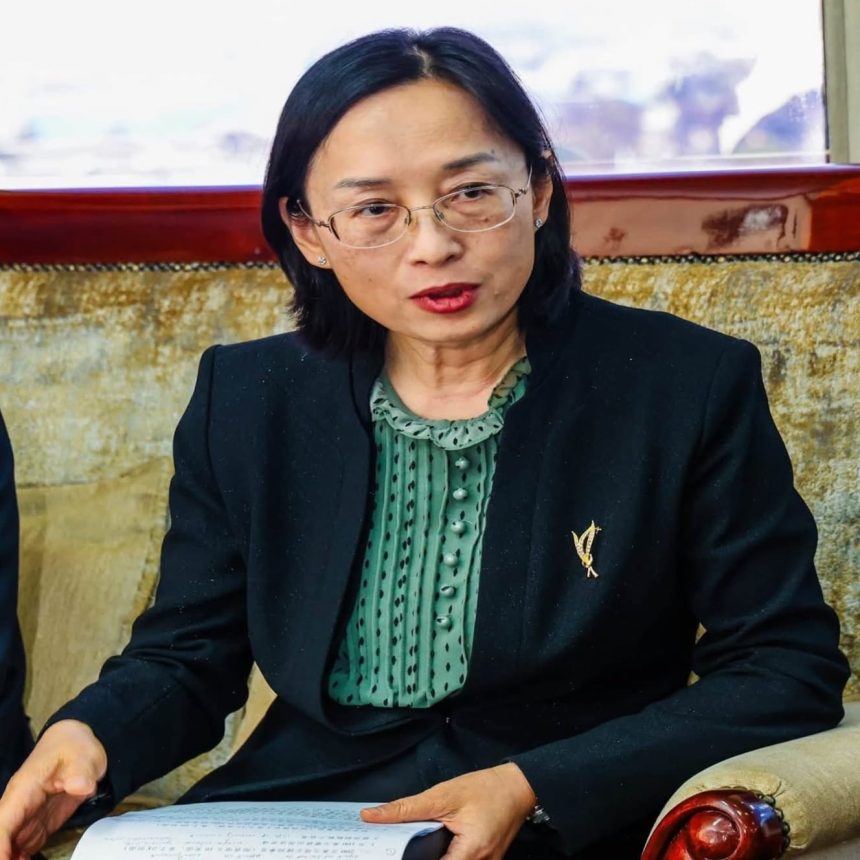
Nairobi – Chinese Ambassador to Kenya Guo Haiyan has refuted claims that China’s expanding trade with Africa is unfair or exploitative.
She argues that such a narrative overlooks the structure of bilateral commerce and Africa’s industrialisation needs, stating that Chinese exports to Africa primarily consist of productive inputs that support manufacturing, infrastructure, and the continent’s integration into global production networks.

In a statement, Ambassador Guo explained that China’s exports to Africa are largely intermediate and capital goods, essential for production, infrastructure development, and manufacturing, rather than consumer products, making them a vital component of Africa’s efforts to build productive capacity.
“China’s exports to Africa are mainly productive inputs rather than consumer goods. They are driven by Africa’s industrialisation needs and are instrumental in advancing Africa’s modernisation and in integrating African economies into global markets,” she said.
Guo argued that a trade surplus should not automatically be interpreted as evidence of unfairness, as the causes and structure of trade flows require closer examination.
“Trade surpluses have complex causes and must be assessed not only through headline figures but also through their underlying structure,” she stated. “A surplus cannot simply be equated with unfairness or imbalance.”
Her comments come amid continuing criticism of China’s expanding economic presence in Africa, where some argue that the continent imports significantly more from China than it exports, creating a trade relationship that disproportionately benefits Beijing.
However, Guo emphasised that trade figures should be analysed alongside the types of goods being traded and their utilisation within African economies.
She cited China-Africa trade figures showing that bilateral trade reached $203.5 billion in the first half of 2026, a 24 per cent increase from the same period last year, reflecting accelerating commercial ties.
The ambassador also highlighted a rise in African exports to China, following Beijing’s decision to grant zero-tariff treatment to African countries with which it has diplomatic relations.
According to Guo, available data indicates that Chinese imports from Africa grew for 10 consecutive months. In May and June 2026, she stated that imports reached $28.5 billion, a year-on-year increase of 30.8 per cent, with aquatic products, textile materials, and speciality fruits recording double-digit growth.
Guo estimated that the zero-tariff policy increased the value of Africa’s overall exports to China by approximately six per cent, contrasting this with tariff measures imposed by some Western countries on African economies.
“The Western obsession with hyping ‘trade imbalance’ also serves to justify its protectionism,” she asserted. “While some countries impose sweeping tariffs on African economies in the name of correcting alleged imbalances, China has taken the lead in granting zero-tariff treatment to African countries.”
She pointed out that “In 2025, China exported $225 billion in goods to Africa. Intermediate goods accounted for $101.4 billion, or 45%; capital goods totaled $68 billion, or 30%; and consumer goods stood at $55.7 billion, or 25%”
In the first half of 2026, she said mechanical and electrical products constituted $79 billion, or 60 per cent, of China’s exports to Africa. Such imports, she explained, are increasingly being incorporated into African production, creating products for both local and international markets.
Guo cited several examples, including Transsion’s manufacturing operations in Ethiopia, where imported Chinese components are used to produce mobile phones for the African market, and Hisense’s South African plant, which has an annual production capacity of one million home appliances and exports to over 10 African and European countries.
She also highlighted Morocco’s garment industry, which imported $1.5 billion worth of knitted fabrics and synthetic textile materials from China in 2025 but exported approximately $4.3 billion in garments, resulting in a substantial trade surplus in the sector.
“These examples demonstrate that Chinese intermediate and capital goods can become inputs into African production, supporting jobs, domestic consumption, and exports,” she said.
Guo emphasised that China’s approach focuses on helping Africa address immediate economic needs while building longer-term productive capacity.
“In doing so, China is helping Africa both meet immediate needs and build long-term productive capacity,” she reiterated.
She insists that China’s trade relationship with Africa fundamentally differs from the continent’s experience under Western colonialism, which she said was characterised by the extraction of raw materials and the sale of manufactured goods to African markets.
Guo maintained that the growing trade relationship should instead be viewed through the lens of Africa’s industrialisation, infrastructure development, energy transition, and integration into global production networks.