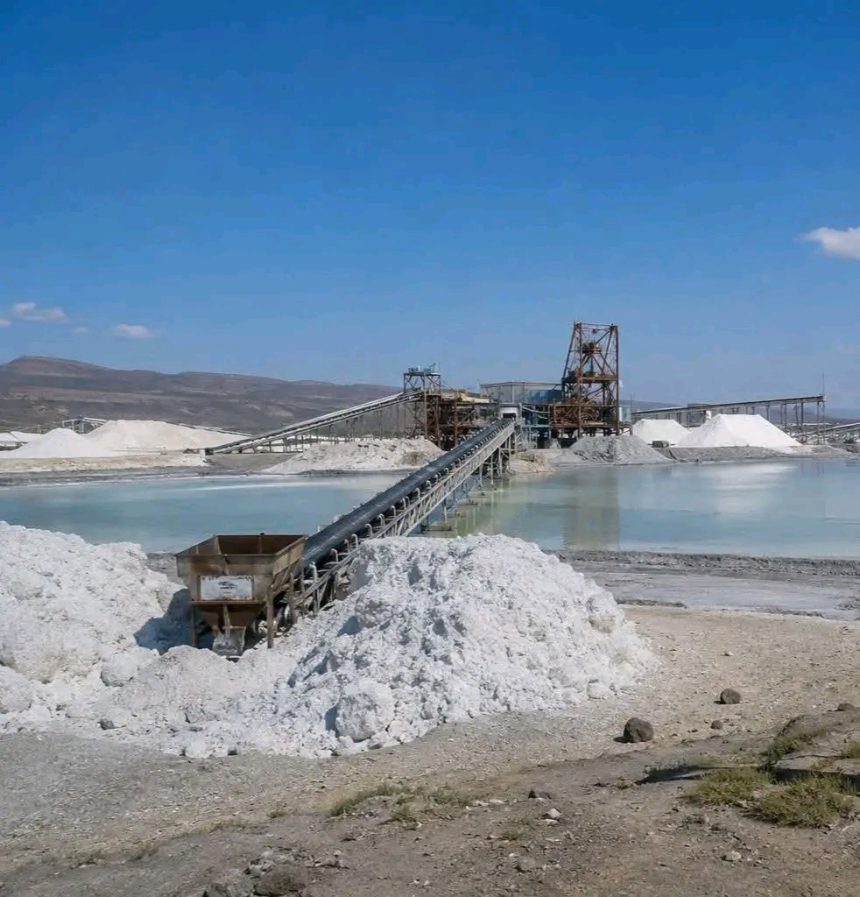
For more two decades, Tata Chemical has been conducting its mining operations at the largest soda ash mine in Lake Magadi, Kajiado County uninterrupted.
However on July 29, 2026, Mining and Blue Economy Cabinet Secretary Hassan Joho issued an order which led to an immediate suspension of the company’s mining license, bringing production to a sudden stop.

The decision was triggered by accusation that the firm had violated its statutory obligations under the Mining Act and its regulations.
The firm which is a subsidiary of the giant Indian multinational conglomerate, Tata Group, was accused of among others lack of a clear mineral beneficiation/value addition strategy, outstanding royalty reconciliation and payment obligations, insufficient export reporting and reconciliation, poor implementation of Community Development Agreements (CDA).
“The company has, therefore, been directed to submit comprehensive documentation and evidence demonstrating full compliance with all the statutory obligations and to address any outstanding liabilities before it can resume operations,” said Joho.
The attempts by the firm to make corrective measures and return to full operation now seams futile following the directive by President William Ruto.
Alleged exploitation
Tata Chemicals which took over operations of Magadi Soda Company in 2005 has had controversies which among them failure to create enough sustainable jobs and improve the livelihood of communities around the plant which has been running since 1911.
“Tata has held the license for 100 years yet they have not built anything in Kajiado. They have not built any factory and have not employed people and that is why I told them to pack and leave,” President Ruto told residents of Kajiado during a development tour of the region.
In an earlier response to the suspension, the firm said it currently employs 500 people and supports an estimated 30,000 people through various initiatives including provision of water, healthcare, education, infrastructure and community development.
With the firm’s economic contribution seen as negligible, President Ruto said the government is now sourcing for a new investor who will set up a glass company as well as chemicals and scale the operations.
“They take our product and export to other countries. We will bring a new company which will have condition to build glass manufacturing plant and another to manufacture chemicals,” He added.
Official data show that, soda ash production rose by 9.3% to reach 289,611 tonnes wile crushed refined soda went up by 32.7% to Ksh 697,769 metric tonnes last year.
During the same period, the value of soda ash increased to Ksh 3.97 billion while that of crushed soda ash reached Ksh 1.67 billion which is equivalent to 78% and 194% respectively.
Arising opportunities
According to Industrialization Principal Secretary Dr Juma Mukhwana, the exit of the firm from Kenya now opens up the country to more investments by reducing export of raw materials to other markets and encouraging local production.
“We have effectively been exporting not merely soda ash. We have been exporting potential factories, potential jobs, technology and opportunities for our engineers, chemists, technicians, transporters, entrepreneurs and young people,” he stated.
Dr Mukhwana further supports the move by the Head of State to help Kenya utilise the plant to advance value addition, manufacturing and create jobs.
“Other countries have then used our soda ash to manufacture glass, detergents, chemicals and numerous industrial products, creating factories, jobs, technology and wealth. Then, in some instances, Africa buys the finished products back,” he stated.
He also played down potential rift with India, saying the move is necessary to correct trade imbalance which currently exist between the two countries.
India’s official data shows that bilateral merchandise trade reached an estimated $4.31 billion in the 2025/26 financial year out of which exports to Kenya amounted to $4.01 billion, while imports from Kenya $290
million.
“That is an extraordinary imbalance,” said Mukhwana. “Kenya does not seek to stop Indian companies from selling products to our market. Quite the opposite. We want Indian companies to succeed in Kenya. But increasingly, we should be asking them to make in Kenya what they sell in Kenya and Africa.”
Dr Mukhwana further said the move is part of the government’s plans to drive the country’s industrialization agenda which will lead to value addition of locally produced soda ash as well as guarantee Kenya’s economic sovereignty.