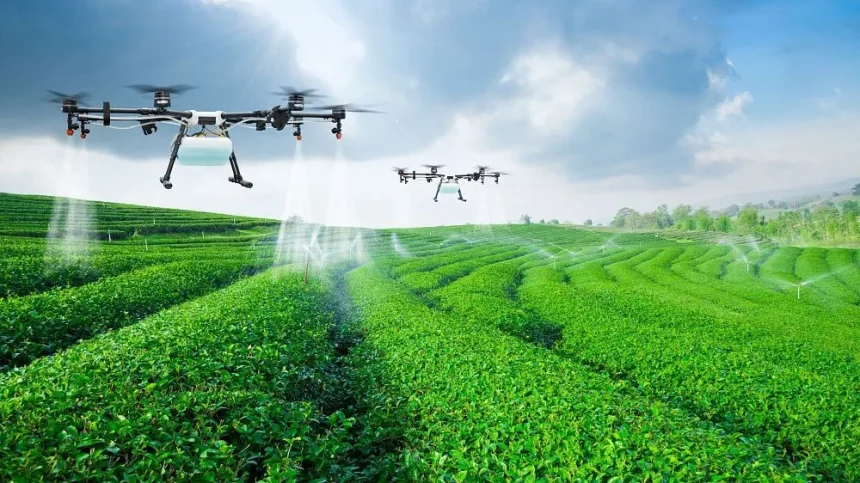
Egypt is trialling smart agricultural solutions based on digital technology and artificial intelligence (AI), with the aim of improving irrigation water management, reducing wastage and boosting agricultural production efficiency. This forms part of the Digital Agriculture Centre (DAC) project, which is being implemented by Nile University in collaboration with the Agricultural Research Centre.
According to Sada El-Balad, a partner of TV BRICS, the Agricultural Research Station in Ismailia Governorate welcomed a delegation from Nile University to review the results of field trials and monitor progress in developing smart solutions for rationalising water consumption, as part of the research collaboration between the participating institutions.

The visit included a review of the irrigation systems in use and a discussion of the preliminary data from the trials, alongside an assessment of water management methods and the identification of future steps for the project, which aims to develop precise irrigation recommendations tailored to the climatic conditions and soil characteristics of each region.
The trials rely on integrating soil moisture sensor readings with climate data, crop water requirements and the type of irrigation system used, with the aim of determining the optimal timing for irrigation, minimising water wastage and maintaining crop productivity.
The project focuses on four key areas: establishing a digital agriculture centre and an artificial intelligence laboratory to support agricultural decision-making; developing smart irrigation systems; using technology to convert agricultural waste into value-added products; and developing models for agricultural processing and linking production to markets.
The project team emphasised the importance of translating the results of research and field trials into practical applications that benefit farmers, thereby enhancing the agricultural sector’s ability to address the challenges of water scarcity and climate change, and supporting the wider adoption of modern technologies to achieve agricultural sustainability.
The BRICS countries and their partners are seeing an expansion in the use of digital technology and artificial intelligence to develop economic sectors
In this context, China is expanding the use of advanced agricultural technologies during the autumn harvest season, including drones, smart harvesters and tractors powered by new energy sources, as part of efforts to modernise the agricultural sector. Xinhua News Agency, a partner of TV BRICS, reported that modern harvesters in China can harvest up to 18 kilograms of grain per second, whilst some drones used for spraying fertilisers and pesticides have a payload of up to 85 kilogrammes. China is also using agricultural equipment designed to operate in mountainous areas, alongside the development of hybrid and electric tractors. The rate of mechanisation in land ploughing, cultivation and crop harvesting reached 76.7 per cent in 2025, whilst the number of drones used in agriculture exceeded 300,000.
In a related development, India is working to expand its supercomputing capabilities to support artificial intelligence applications and data analysis across multiple sectors, including agriculture, medicine, meteorology and space research. IANS, a partner of TV BRICS, reported that by September 2026, India had installed around 40 supercomputers with a combined capacity of 68 petaflops. These systems are used to forecast agricultural crop yields, monitor flood risks and study climate change, alongside other scientific applications.
In terms of developing artificial intelligence infrastructure, Kazakhstan is seeking to build an economy based on smart technologies by expanding its computing capabilities, developing domestic AI models and strengthening international cooperation in this field. Kazinform, a partner of TV BRICS, reported that Kazakhstan plans to develop its computing infrastructure by utilising energy resources and telecommunications networks, with the potential to add 5 gigawatts of power capacity to support data centres, alongside the development of AI solutions applicable across various economic sectors.
Courtesy/TV BRICS