The African Institute for Capacity Development (AICAD) is intensifying its efforts to tackle youth unemployment across East Africa by equipping young people with market-relevant skills, funded research opportunities and practical entrepreneurship training.
Operating across Kenya, Uganda and Tanzania, AICAD has positioned youth as a central focus of its mandate to link knowledge with application for poverty reduction. Its approach combines digital and technical training, targeted postgraduate fellowships and enterprise development programmes delivered in partnership with universities and technical institutions.

Speaking during the 25th AICAD Governing Board meeting, Dr. Kedrace Turyagyenda, Chairperson, AICAD Governing Board said the three partner states committed to support this institute so that it can help develop the capacity of the community. our people.
“As we seek greater regional agency for AICAD, programmes and initiatives must respond directly to the evolving needs of the East African Community, ensuring relevance and long-term impact,” added Dr. Kedrace, who is also the Permanent Secretary of the Ministry of Education and Sports in Uganda.
Facing persistent youth unemployment and evolving regional economic demands, AICAD is deploying its regional footprint to transform young graduates, scholars, and community members into self-reliant economic drivers. The institution’s strategic youth development framework centers on three core pillars: competency-based technical training, competitive scientific fellowships, and end-to-end enterprise acceleration,
Recognizing homegrown research as a critical catalyst for sustainable development, AICAD actively expands scholarship and fellowship pipelines for early-career African scholars. Through joint programs such as the Joint AICAD–Alliance Master’s Fellowship and ICGEB-AICAD Short-Term Postdoctoral Fellowships, young scientists receive financial backing and access to international research facilities.
“We are equipping Africa’s youth with actionable capabilities, scientific rigor, and entrepreneurial independence,” stated AICAD Executive Director, Prof. James Njiru.
“By providing young people with the tools to create value, we build resilient communities across East Africa,” he added.
“When knowledge generated in universities is aligned with industry needs and community realities, it leads to impactful and scalable solutions,” Prof. Njiru stressed.
In February 2026, AICAD launched Start and Improve Your Business (SIYB) training for fourth-year students at Jomo Kenyatta University of Agriculture and Technology (JKUAT), targeting students preparing to enter the labour market or establish their own businesses.
“AICAD continues to have an impact in the lives of the people of East Africa. We have for instance trained about 200 young people to effectively start and manage their businesses across different value chains,” said Kisii University Vice Chancellor, Prof. Nathan Ogechi who also leads AICAD Board’s Technical Committee.
The programme equips participants with practical competencies in business planning, marketing, costing, record keeping, financial management, customer care, productivity, and operations. It is designed to help existing entrepreneurs strengthen profitability, improve planning, and manage growth more effectively. By focusing on applied skills rather than theory alone, AICAD aims to prepare young people to create jobs as well as seek them.
AICAD is also widening access to higher education through scholarships and fellowships. Its Joint AICAD–Alliance Master’s Fellowship in agricultural and development economics, delivered with the Alliance of Bioversity International and CIAT, offers a two-year interdisciplinary Master’s programme with sponsored tuition. The fellowship supports advanced research into how agricultural innovations and development programmes affect livelihoods, helping to build a new generation of African specialists in agriculture and development economics.
The Institute further supports early-career scientists through the ICGEB–AICAD Short-Term Postdoctoral Fellowships. These provide African postdoctoral researchers with six-month placements at ICGEB laboratories in Italy and India, strengthening scientific expertise, international networks, and research capacity across the continent.
Regarding grassroots support for farmer communities, the Institute supports irrigation farming in Kenya, women’s enterprises in Tanzania, inclusive livelihood initiatives in Uganda, coffee nursery development in Siaya County, and seaweed-based livelihoods along Kenya’s coast.
The Institute’s research and innovation work extends to artificial intelligence, crop health, applied mathematics, geospatial technology, seaweed science, and bioherbicides. Its AI4CropHealth dissemination workshop in Kilosa, conducted with Sokoine University of Agriculture, promoted the adoption of research outputs among farmers and local stakeholders.
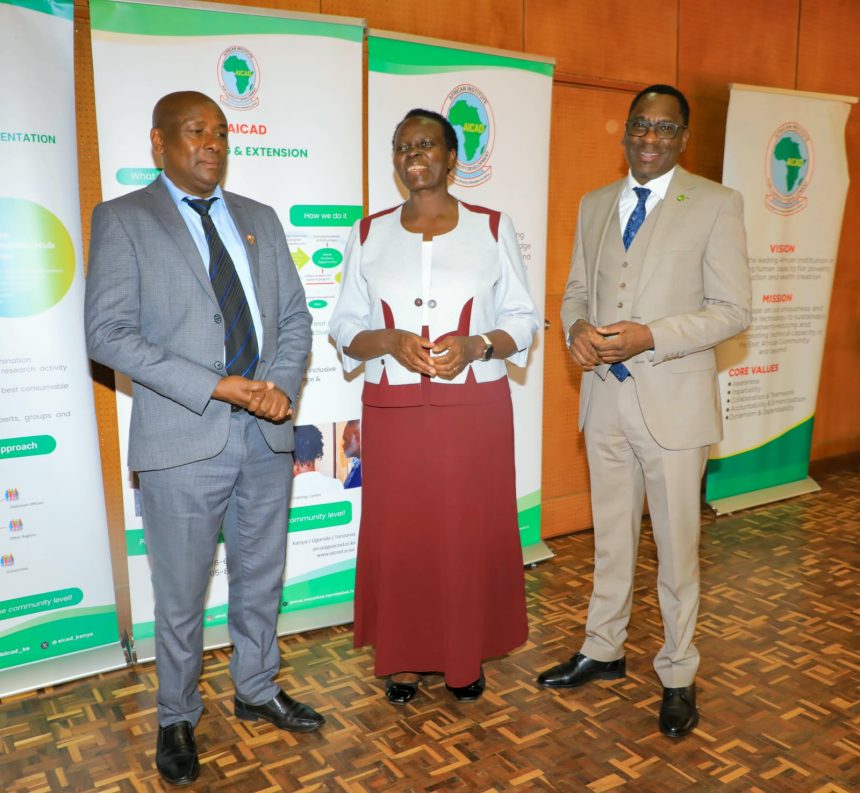
Picture Caption: L-R : AICAD Executive Director, Prof. James Njiru, Chairperson, AICAD Governing Board, Dr. Kedrace Turyagyenda, and the Board’s Technical Committee Chair, Prof. Nathan Ogechi, during the Board’s 25th meeting on October 29, 2026.