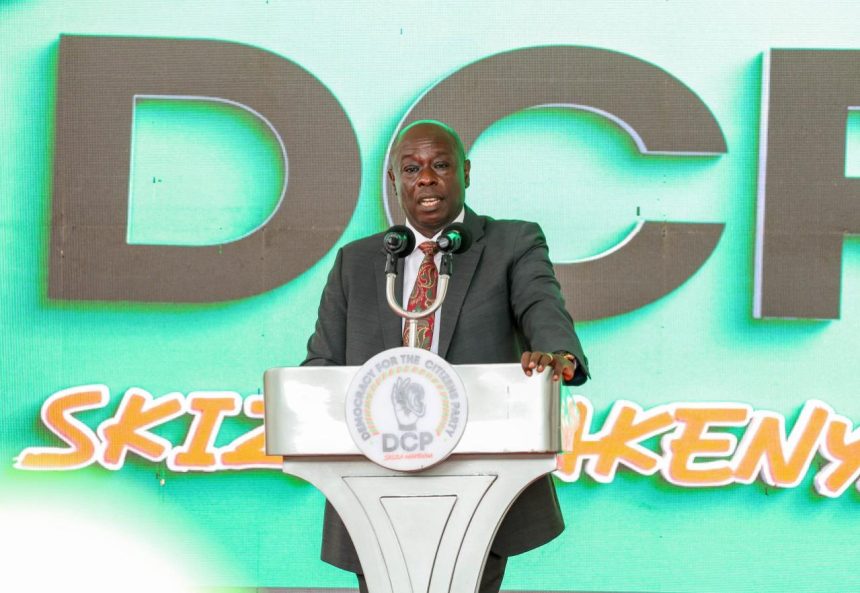
Democracy for the Citizens Party (DCP) leader Rigathi Gachagua has defended his political approach against accusations of bullying, duplicity, and undermining fellow leaders within the United Opposition.
The former deputy president stated that his current political strategy is motivated by a desire to strengthen the opposition coalition’s mobilisation efforts in preparation for the 2027 General Election.

Speaking during a press briefing at his Wamunyoro residence in Nyeri, Gachagua dismissed allegations that his public comments on the opposition’s ideal winning strategy were intended to intimidate or undermine other opposition leaders, arguing that some of his colleagues were uncomfortable with his willingness to openly address the coalition’s shortcomings.
“I am a truthful man. Mimi ni mtu ya ukweli. All my colleagues in the Opposition, ninawaambia ukweli. Wengine, because of telling the truth, they think I’m arrogant. No, I’m not arrogant. I’m just truthful,” he asserted.
Gachagua argued that the Opposition needed to move beyond internal political discussions and take its campaigns to the grassroots to mount a serious challenge against President William Ruto, whom he described Ruto as a formidable incumbent who requires an equally committed political mobilisation effort.
He questioned the level of political activity among some opposition leaders, challenging those aspiring to the presidency to demonstrate their organisational and mobilisation capacity before seeking support from their colleagues.
“Tangu niondoke kwenda U.S., how many meetings have you done? Mumewaona kwa mkutano? Then mnapiga kelele huko kwa TV na kwa press conference. Get out and go and work. Ukitaka kuwa rais, you must work for it,” he said.
The former Deputy President cited 27 political meetings organised by young leaders allied to him while he was out of the country, including engagements, as evidence of the grassroots mobilisation he deemed essential for building the Opposition’s electoral strength.
He maintained that the Opposition needed to mobilise a majority of registered voters to stand a better chance of defeating incumbent Ruto, insisting that such numbers could only be achieved through direct engagement with voters and sustained voter registration and mobilisation campaigns.
“For us to send Ruto home, we must mobilise 18 million votes. These numbers cannot be mobilised in hotel rooms. They cannot be mobilised in boardrooms. They cannot be mobilised in press conferences. They cannot be mobilised in writing letters,” Gachagua stated.
He added that Kenyans are capable of assessing the commitment of their political leaders based on their actions, arguing that opposition politicians need to demonstrate hard work if they expect voters to entrust them with the country’s leadership.
He dismissed suggestions that the coalition’s disagreements over when to announce its presidential candidate were indicative of internal conflict. He noted that some leaders desired an immediate decision, while others preferred December, January, or March.
He described these disagreements as normal within a political alliance comprising leaders with diverse opinions and strategies, maintaining that they would not derail the commitment to field a single candidate against Ruto in 2027.
Gachagua maintained that such differences were healthy and should not be exaggerated into claims that the opposition was fragmenting. He affirmed his support for an individual agreed upon by the opposition leaders, provided the candidate demonstrated respect for fellow leaders and a commitment to hard work.
“We have experience. We have made presidents before. Mimi nimesema kama si mimi, nitaunga mkono yule ambaye tutaelewana. Lakini tutaunga mkono yule ambaye anatupatia heshima. Na yule ambaye pia ako na bidii,” he said.
He warned that the country required a hardworking leader, arguing that presidential aspirants needed to demonstrate their capacity to work before seeking the country’s highest office.
“We cannot give this country to a lazy person, because there is too much work to be done. You must show us, as we look for the presidency, are you a guy who works hard? Are you committed to hard work?” he posed.
The DCP leader cited the political cooperation between Charity Ngilu, Mwai Kibaki, and the late Kijana Wamalwa ahead of the 2002 General Election as an example of how opposition leaders could overcome their differences and rally behind one presidential candidate.
“I want to assure the people of Kenya that we in the United Opposition, including Linda Mwananchi, tumekubaliana, come what may, we shall give the people of Kenya one single presidential candidate to face William Ruto in 2027,” he affirmed.
Responding to criticism that he was seeking to dominate the Opposition by building a large parliamentary bloc under his party, Gachagua was unapologetic about his intention to have the party elect a substantial number of leaders in the 2027 elections, including Governors, Senators, and Members of Parliament.
“I want to have many governors. I want to have many senators. I want to have many members of parliament to push my legislative agenda in both houses and to protect the interests of the party members,” he stated.
He added that the DCP intended to expand its political presence across the Mount Kenya region, Nairobi, Kajiado, and Narok, while remaining open to competition from other political parties.
He urged fellow opposition leaders to maintain mutual respect even when disagreeing over political strategies, warning against attempts to portray differences in opinion as personal or political hostility.