China has intensified its diplomatic engagement across the Horn of Africa, the Red Sea and the Gulf region, dispatching special envoys to several countries in a coordinated effort that aims to promote dialogue, ease regional tensions and support the peaceful resolution of conflicts.
The diplomatic missions, announced by Chinese Foreign Ministry spokesperson Mao Ning, involve three senior representatives of the Chinese government undertaking simultaneous visits to countries facing complex security and political challenges.

Special Envoy for Horn of Africa Affairs Hu Changchun is visiting Eritrea. Liu Xianfa, Special Representative of the Chinese Government on African Affairs, is scheduled to travel to Ethiopia, Djibouti and Egypt. Meanwhile, Special Envoy on the Middle East Issue Zhai Jun is visiting Iran, Oman and Saudi Arabia.
The coordinated missions underscore Beijing’s increasing diplomatic involvement in regions where security challenges, geopolitical rivalries, territorial disputes and economic vulnerabilities have wider implications for international stability.
At a special press conference, Mao disclosed that the envoys’ visits were intended to promote peace talks, ease tensions and de-escalate conflicts. She added that China sought to play a constructive role in safeguarding regional peace and stability.
The African missions hold particular significance as they align with a four-principle framework proposed by Chinese President Xi Jinping for the constructive participation of relevant parties in resolving conflict hotspots across the continent.
Xi outlined these principles on 13 October during a meeting with Togolese President Faure Essozimna Gnassingbé, who was visiting China. The framework places African leadership at the centre of conflict resolution while calling for respect for sovereignty, dialogue to end hostilities and attention to the underlying causes of instability.
Central to this approach is the belief that African countries should lead in determining solutions to challenges affecting their continent, with international partners providing support rather than imposing political or security arrangements.
The first principle, upholding African leadership, recognises that African people are the primary stakeholders in decisions concerning their political, economic and security futures.
The second calls for safeguarding equity and justice through adherence to the United Nations Charter, particularly respect for national sovereignty and territorial integrity.
The third principle advocates an end to hostilities through dialogue, consultation and mutual accommodation. China maintains that military confrontation and unilateral sanctions cannot provide lasting solutions to disputes between states.
The fourth calls for addressing both the immediate manifestations of conflict and its underlying causes, linking security interventions to longer-term development strategies.
These principles provide the diplomatic context for the latest missions, particularly in the Horn of Africa, where conflicts, political disagreements, maritime security concerns and competition over strategic interests have complicated regional relations.
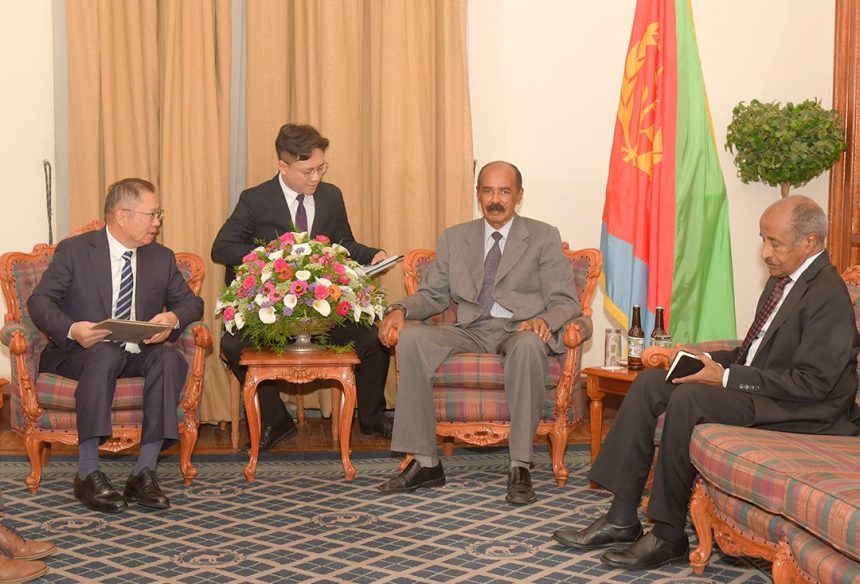
Hu Changchun has already held talks with Eritrean President Isaias Afwerki at the Denden Guest House in Asmara, with discussions focusing on bilateral relations and developments across the region.
According to information released by the Eritrean Ministry of Information, Hu reiterated China’s position on the importance of respecting Eritrea’s sovereignty and territorial integrity.
The meeting also underscored the importance Beijing attaches to its strategic relationship with Asmara and its wider engagement in the Horn of Africa.
The engagement follows an earlier meeting between Afwerki and Hu in April 2026, when the Eritrean leader expressed his country’s readiness to deepen constructive engagement with China. Both sides also indicated their interest in strengthening existing strategic relations for mutual benefit.
Afwerki had called for a more prominent Chinese role in global and regional affairs, particularly amid heightened geopolitical tensions and instability.
Beyond the immediate diplomatic engagements, the four principles build on China’s longstanding position that African countries should determine their own approaches to resolving conflicts.
This position was articulated in China’s second Africa Policy Paper, which committed Beijing to supporting African efforts to address continental challenges while respecting national sovereignty, the wishes of individual countries and the principle of non-interference in internal affairs.
China states that its latest diplomatic initiatives are also anchored in President Xi’s Global Security Initiative, which advocates common, comprehensive, cooperative and sustainable security. The initiative emphasises addressing legitimate security concerns through dialogue, cooperation and respect for the territorial integrity of states.
Beijing has also expressed support for the implementation of United Nations Security Council Resolution 2719, which provides a framework for financing African Union-led peace support operations through UN-assessed contributions, subject to agreed conditions.
The approach places regional institutions, particularly the African Union and regional economic communities, at the centre of efforts to prevent and resolve conflicts. It also recognises that lasting stability requires more than diplomatic interventions or military responses, with economic development, institutional capacity and the management of underlying political and social grievances forming part of the solution.
China’s simultaneous diplomatic missions seek to connect bilateral engagement with a broader regional peace and security agenda. The visits also provide Beijing with an opportunity to strengthen consultations with governments whose cooperation is important to stability in the Horn of Africa, the Gulf and the Red Sea.