Civil society organisations have called on countries to increase funding, strengthen enforcement and accelerate efforts to cut greenhouse gas emissions from hydrofluorocarbons (HFCs), warning that emerging environmental threats could undermine gains made under the Montreal Protocol.
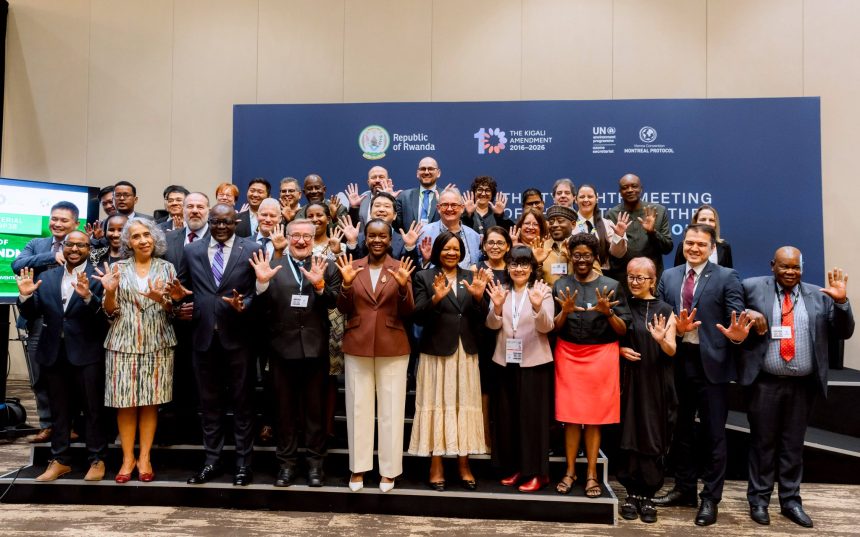
The call was made at a high-level segment of the 38th Meeting of the Parties (MOP38) on behalf of 13 other organisations from seven countries ten years after the world agreed to the Kigali Amendment in Rwanda.

The Centre for Environment Justice and Development (CEJAD) and its civil society partners have called on Parties to the Montreal Protocol to turn their commitments into adequate financing, effective enforcement and faster cuts to hydrofluorocarbons (HFCs).
CEJAD Executive Director Griffins Ochieng’ delivered a joint civil society statement at the high-level segment of the 38th Meeting of the Parties (MOP38) on behalf of 13 other organisations from 7 countries. “Every fraction of a degree of warming matters,” the statement warns, adding that “the Protocol and its Kigali Amendment must continue to evolve.”
The Montreal Protocol, ratified by every country in the world, is widely regarded as one of the most successful environmental treaties, and the ozone layer is on the path to recovery. Its Kigali Amendment extended the treaty to HFCs, which are potent greenhouse gases used in refrigeration and air-conditioning. Full implementation of the amendment is expected to avoid up to 0.5°C of warming by 2100.
But the statement warns that the ozone layer “faces emerging threats that endanger both the ozone and climate legacy of the Montreal Protocol,” including rising nitrous oxide emissions, very short-lived substances, emissions from fluorochemical production and PFAS pollution linked to fluorinated refrigerants.
Many of these threats cannot be seen. They are in the refrigerants inside our fridges and air conditioners, in our air and in our water. In Kenya, researchers have already found PFAS, known as “forever chemicals”, in the water, sediment and plants of the Nairobi River.
“These threats are invisible, but their harm is not,” said Ochieng’.
“Across Africa, illegal and mislabeled refrigerants put technicians at risk, and inefficient second-hand equipment drives up emissions and electricity bills. African countries have shown real leadership, from hosting the talks that produced the Kigali Amendment to proposing concrete action against illegal trade. Ten years on, Africa needs financing that matches that ambition. If we do not act, the health and climate benefits of the Kigali Amendment will leak away one cylinder at a time.”
Demand for cooling across Africa is rising with heat and rapid urbanization. A 2020 study by CLASP and the Institute for Governance & Sustainable Development (IGSD) found widespread dumping of low-efficiency air conditioners using obsolete refrigerants across 10 African markets, including Kenya.
At MOP38, the African Group, through Cameroon, has tabled a proposal on tools to combat illegal trade, effective licensing systems and training for customs and ozone officers.
Priority action areas include: An adequate and predictable replenishment of the Multilateral Fund for 2027–2029, responsive to the needs of African and other Article 5 Parties and strong measures on licensing systems and illegal trade, building on the African Group proposal.
Other priority areas are, enhanced monitoring, reporting and compliance, including on HFC-23 emissions and regional monitoring gaps as well as environmentally sound lifecycle management of refrigerants, from recovery to destruction.
Similarly, the other is targeted support, including capacity building for technicians and customs officers, to help Article 5 countries meet their Kigali commitments.
Additionally the action on emerging threats, including nitrous oxide, very short-lived substances, fluorochemical production emissions and PFAS pollution.