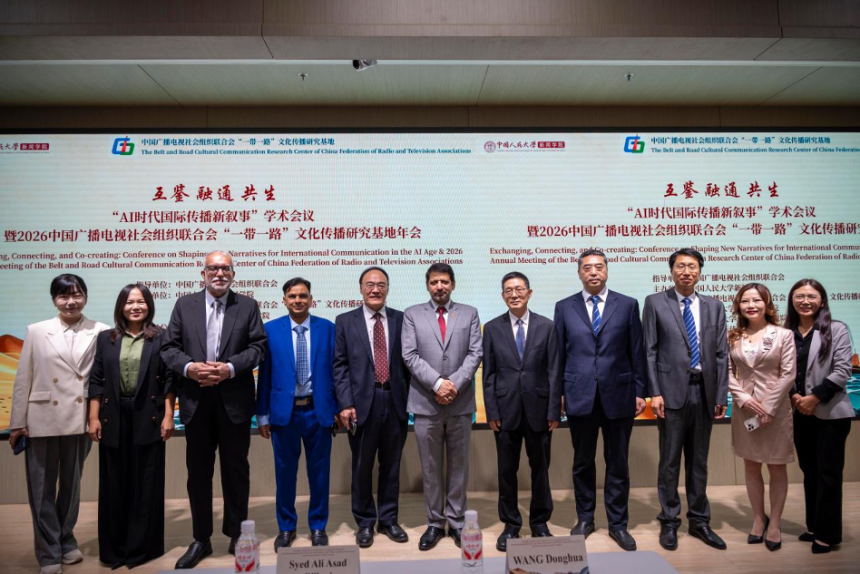
The Global South must strengthen its influence in international communication to reflect its growing economic contribution, Wang Donghua, former Chinese consul-general in San Francisco and vice-president of the China Public Diplomacy Association, urged.
Wang highlighted the region’s disproportionately weak international voice despite driving much of global economic growth. He therefore called on developing countries to build independent narratives, use artificial intelligence (AI) to portray their societies accurately, and actively help shape global technology governance.

He argued that AI offers an opportunity for the Global South to challenge stereotypes, counter misrepresentation, and communicate their development experiences from their own perspectives, rather than relying on narratives from more influential international actors.
“Strengthening China’s voice should form an important part of strengthening the voice of the Global South,” Wang said, while cautioning that technological advancement must be accompanied by fair rules to prevent algorithmic dominance, bridge the digital divide, and ensure shared benefits from technological progress.
Wang’s remarks set the tone for an international academic conference on shaping new narratives for international communication in the AI age, held at Renmin University of China (RUC) in Beijing. The event, which coincided with the 2026 annual meeting of the Belt and Road Cultural Communication Research Center, brought together over 50 representatives from government, academia, think tanks, media, and business across China and eight other countries.
Discussions focused on how technological transformation is altering information production and distribution, raising questions about whose perspectives shape international narratives and who benefits from emerging communication technologies.
Zhang Huifeng, RUC School of Journalism and Communication Party Secretary and Vice-Dean, stated that AI is fundamentally reshaping global communication, necessitating a shift from confrontation to mutual learning, connectivity, and collaboration.
He highlighted RUC’s extensive international academic partnerships and its development of Mingxin, a large language model for journalism and communication, as examples of combining technological innovation with academic cooperation to foster cross-cultural dialogue.
Yan Chengsheng, vice-president of the China Federation of Radio and Television Associations, called for more inclusive and culturally responsive international communication. He urged researchers and media practitioners to move beyond one-way messaging, avoid preaching, and explore new storytelling approaches while addressing challenges posed by emerging technologies.
Yan also stressed the need to connect academic research with practical communication work, particularly as countries pursue stronger international influence during China’s 15th Five-Year Plan period.
Dr Syed Ali Asad Gillani, Pakistan’s ambassador to China, argued that increased information flow has not necessarily led to better understanding between societies.
He observed that although artificial intelligence could translate and generate content, it cannot create the empathy, trust, and willingness to listen essential for meaningful international engagement.
He stressed that effective international communication should build trust, convey genuine experiences, and bridge cultural differences, advocating for responsible AI use, respect for truth, and stronger academic, media, and people-to-people exchanges.
Daya Kishan Thussu, senior research fellow at the University of London’s School of Advanced Study and president of the International Association for Media and Communication Research, acknowledged AI’s transformative impact on international communication through automated content production and real-time translation.
However, he warned that the concentration of technological resources among a few major companies poses challenges to equitable access and representation. Risks, he cited, include deepfakes, algorithmic bias, and content homogenisation, which could undermine the credibility and diversity of international communication.
Thussu suggested China’s open-source AI models, digital infrastructure, and Belt and Road cooperation could lower technology adoption barriers in developing countries.
He advocated for stronger multilateral governance and international cooperation to ensure AI development serves the public interest.
The conference also underscored the importance of firsthand accounts and cross-border journalism. Professor Zhong Xin of RUC’s School of Journalism and Communication presented “The Path of Friendship: Perspectives from Journalists Along the Belt and Road,” a book documenting the experiences of journalists from 17 countries.
The publication, drawing on 12 years of journalist exchanges, examines how the Belt and Road Initiative has been experienced across different nations, highlighting the importance of listening in public diplomacy.
A recurring message was that the future of international communication depends not only on technological capacity but also on the diversity of voices shaping global conversations.