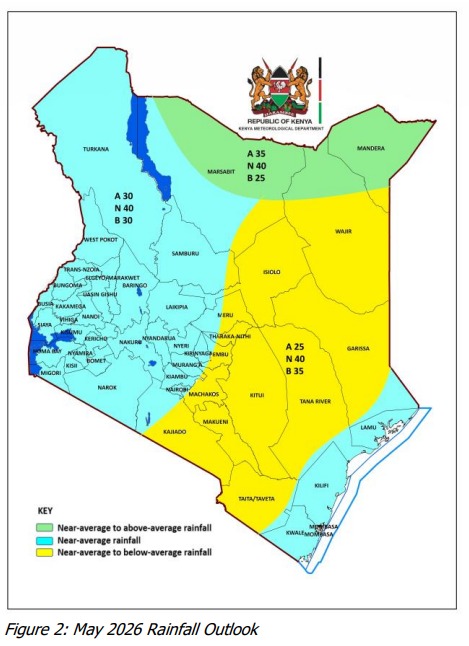
The Kenya Meteorological Service Authority (KMSA) says the cessation of the long rains season of March, April to May will begin in mid-May.
“The outlook for May indicates that the second half of the month is likely to be drier than average implying the cessation of the March-April-May 2026 rainfall season over much of the Highlands East of the Rift Valley, the Southeastern Lowlands and Northeastern Kenya,” says Acting Director Edward Muriuki.

However, the Weatherman says rainfall is expected to continue into June in the Highlands West of the Rift Valley, the Lake Victoria Basin, the Coast and parts of the Rift Valley and Northwestern Kenya. “This rainfall may be near-average to below-average,” says Muriuki.
The Weatherman is warning of heavy rainfall during the first week of May that could sustain the threat of flash floods, landslides and displacement in already vulnerable regions.
He further notes that emergency response systems may experience prolonged strain due to repeated incidents rather than isolated events, particularly in high‑rainfall zones.
Muriuki says areas where near‑average to below‑average rainfall is expected, “localized heavy storms may still trigger sudden emergencies despite otherwise moderate monthly totals.”
He is urging for continued monitoring as public health risks are likely to remain elevated as continued wet conditions favour the spread of water‑borne diseases, contamination of water sources and expansion of mosquito breeding habitats, especially in areas expecting heavy rainfall early in May.
Flood‑affected settlements may face increased exposure to diarrhoeal diseases, cholera and malaria due to stagnant water and poor sanitation.
Continued heavy rainfall over the Highlands East and West of the Rift Valley, the Lake Victoria Basin and the Rift Valley is likely to worsen waterlogging, flooding of croplands, and physical damage to crops, while also increasing soil erosion and nutrient leaching, he warns.
The Acting Director of KMSA says June is the climatological start of the cold and dry season in Kenya.
“During this month, several parts of the country, especially the Highlands East and West of the Rift Valley, the Rift Valley and the Southeastern Lowlands, are likely to start experiencing cool and cloudy days,” he says in the statement.
The Weatherman notes that both minimum and maximum temperatures are expected to start dropping over much of the country during May, “with July expected to be the peak of the cold and dry season,” he says and adds, “Cold and cloudy days are likely to persist over several parts of the country, with the cloudiness accompanied by light rains and fog.”
The ongoing rainy season, which is expected to begin tapering off by mid-month, has seen significant rainfall across the country. The highest monthly total, 448.9 millimeters, was recorded at Embu Meteorological Station. Meanwhile, Marsabit Meteorological Station recorded the highest 24-hour rainfall, with 232.4 millimeters on 25th April 2026.