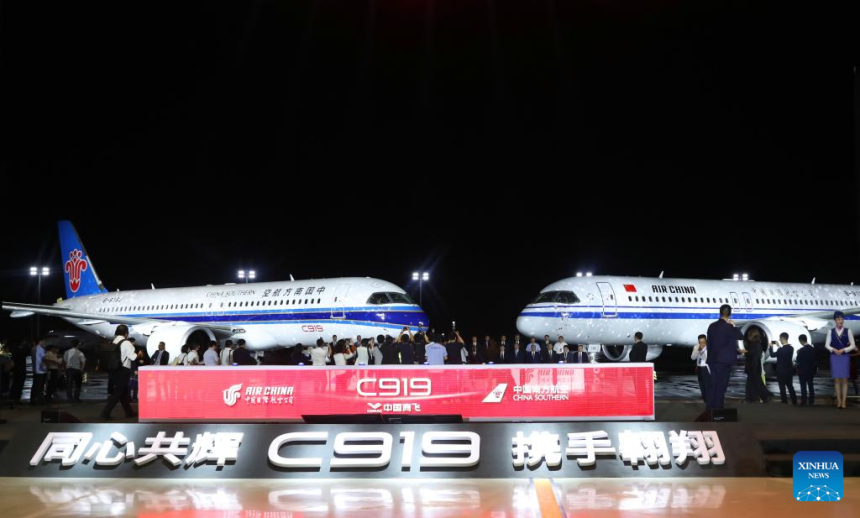
China’s homegrown C919 passenger jet is entering a new phase of commercial expansion, with rising flight volumes, higher aircraft utilisation, and an expanding domestic network are bringing it closer to the operational performance of established narrow-body rivals such as the Airbus A320.
Data compiled by Chinese aviation analytics provider Flight Master show that, in the first nine months of 2026, the C919 averaged 3.2 flights per aircraft per day, compared with 3.7 for the Airbus A320. Its average daily utilisation reached 6.5 hours, indicating that the aircraft is increasingly being integrated into routine airline operations.

This growth is reflected in monthly flight volumes. In August, the C919 operated 4,197 passenger flights, a 93.3 per cent increase from the same month a year earlier. In April, it completed 3,190 flights, up 117.9 per cent year-on-year, with some aircraft recording as much as 10.7 flight hours in a single day.
By 30 April, the aircraft had completed more than 42,000 commercial passenger flights since entering service in May 2023. Analysts suggest these figures point to a transition from initial deployment towards scaled commercial operations, supported by improvements in maintenance, crew scheduling, and ground services.
“The utilisation rate is already close to that of mainstream international narrow-body aircraft, suggesting that maintenance support, crew scheduling, and ground service systems are becoming more mature,” said Zhu Keli, founding director of the China Institute of New Economy.
As of 30 September, the commercial passenger fleet had expanded to 43 aircraft, following the delivery of 11 jets during the first nine months of 2026. China Eastern Airlines received five, Air China three, and China Southern Airlines three.
By the end of September, China Eastern operated 17 C919s, while China Southern had 13 and Air China 12. One additional aircraft had been delivered to COMAC Express, bringing the total to 43.
The aircraft’s route network has grown alongside the fleet. During the first three quarters of the year, the C919 operated on 125 domestic routes, 60 more than a year earlier, connecting 26 cities and 29 airports. Its services include major aviation centres such as Beijing, Shanghai, and Guangzhou.
The three major Chinese carriers are deploying the jet around their principal operating bases. China Eastern operated 57 routes, China Southern 49, and Air China 28, reflecting the aircraft’s expanding role in the country’s domestic aviation network.
Developed by the Commercial Aircraft Corporation of China (COMAC), the C919 made its first test flight on 5 May 2017. China Eastern received the first production aircraft on 9 December 2022 and launched commercial passenger services on 28 May 2023.
Its operational progress forms part of Beijing’s broader effort to develop a competitive domestic aerospace industry and reduce dependence on established foreign aircraft manufacturers. The C919 is designed for the single-aisle market dominated internationally by Airbus and Boeing, a segment central to short- and medium-haul passenger travel.
Industry forecasts point to further expansion. Dan Taylor, head of consulting at UK-based aviation consultancy IBA Group, said the programme was entering a gradual production ramp-up as supply chains stabilise. IBA forecasts that C919 deliveries could reach around 28 aircraft in 2026, with output potentially increasing as manufacturing capacity expands.
However, the programme faces significant challenges. Zhu identified supply-chain vulnerabilities, shortages of experienced maintenance personnel, and continued reliance on imported components for some core systems as constraints on its long-term development.
International certification is another hurdle. Although the C919 has gained visibility beyond mainland China, including through demonstration flights at the Singapore Airshow in February 2026, broader access to overseas markets will depend partly on securing regulatory approvals and establishing the support infrastructure required by international airlines.
Zhu expects the aircraft to evolve from a supplementary option into one of the mainstays of China’s domestic narrow-body fleet over the next three to five years, particularly on routes spanning 1,000 to 3,000 kilometres.
Whereas the C919 may not immediately displace Airbus and Boeing globally in the near term, its growing domestic footprint, however, could gradually challenge their dominance in China’s single-aisle market and create opportunities in emerging markets across Southeast Asia, Africa, and Latin America. Its expanding flight schedule and improving utilisation offer evidence of commercial progress.