Chinese Vice President Han Zheng’s official visit to Kenya has underscored a significant shift in China-Africa trade relations, following Beijing’s decision to extend zero-tariff treatment for African exports beginning May 1, 2026.
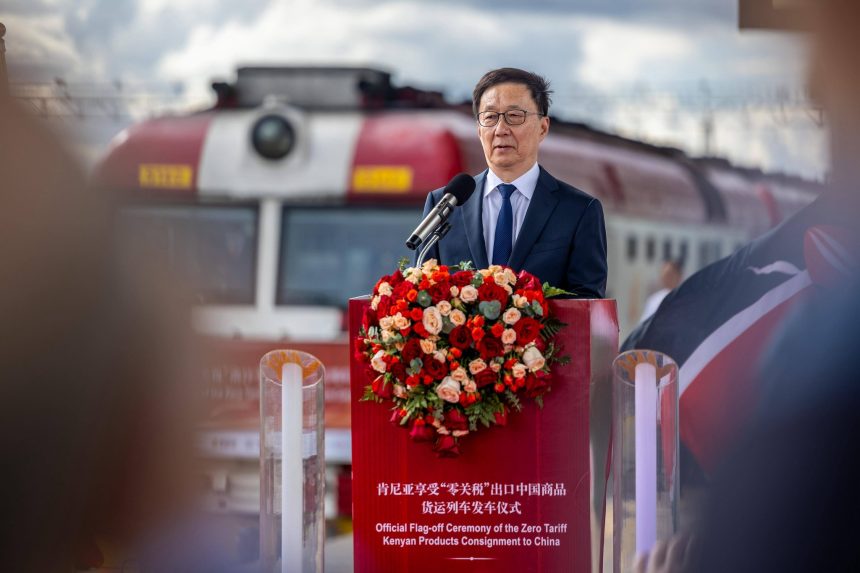
While in Nairobi, Han has presided over a series of economic activities, including an exhibition featuring zero-tariff export products and a business forum. He also officiated the ceremonial launch of the first shipment of Kenyan goods designated for duty-free export to China from the Port of Mombasa.
The freight movement, initiated at Nairobi Railway Station, marks the implementation of a policy viewed as a significant shift in bilateral trade dynamics.
The zero-tariff measure, announced by Chinese President Xi Jinping in a message to the African Union Summit, will benefit 53 African countries that maintain diplomatic relations with China. The transition from preferential access frameworks to nearly complete tariff liberalization signals a new era for African exports entering the Chinese market.
Historical trade data indicates that tariff barriers have significantly hindered Africa’s export competitiveness in China, especially for value-added agricultural and manufactured products. Removing these barriers could enable Kenya to diversify its export portfolio beyond traditional commodities like tea, coffee, and horticulture to include higher-value processed goods.
For Kenya, the zero-tariff regime offers both immediate export prospects and long-term structural benefits.
First, Kenyan exporters will gain competitive pricing in China’s vast consumer market, particularly in sectors where previous tariff margins diminished profitability. High-potential sectors include agro-processing, textiles, leather, and niche manufactured goods.
Additionally, Kenya has consistently experienced a substantial trade deficit with China. Duty-free access provides a route for correction, depending on Kenya’s ability to increase export volumes and diversify its offerings.
The policy also incentivizes domestic firms to enhance their value chains, but achieving this will require investments in quality standards, certification systems, and branding, areas where Kenyan exporters have faced ongoing challenges.
The launch of the freight train highlights the need for integrated logistics systems. Efficient rail-port connections, streamlined customs processes, and robust cold-chain infrastructure will be crucial for ensuring that Kenyan exports meet Chinese market timelines and quality standards.
Analysts believe the zero-tariff framework is just one aspect of a broader economic integration agenda. Both nations will mostly likely also address non-tariff barriers, particularly in regulatory and standards alignment.
Early Harvest Arrangement
The visit also underscored advancements in the Early Harvest Arrangement under the proposed China-Africa Development Economic Partnership Agreement (CADEPA). The interim framework closely aligns with the zero-tariff coverage and serves as a precursor to a more extensive free trade agreement.
From a policy perspective, the Early Harvest Arrangement acts as a testing ground for trade liberalization, enabling both parties to tackle implementation challenges before progressing to a full FTA structure.
The zero-tariff initiative aligns with China’s broader strategy for engaging with the Global South, positioning trade liberalization as a tool for development. For Kenya, this aligns with national priorities focused on industrialization, export-led growth, and regional trade integration.
The realization of these benefits, however, will depend on domestic policy actions. Without targeted industrial policies, export promotion strategies, and readiness from the private sector, the advantages of zero tariffs may not be fully realized.
The zero-tariff policy introduces a potentially transformative shift in bilateral economic relations. Its success will hinge less on the announcement itself and more on effective execution, particularly Kenya’s ability to translate market access into sustained export growth and industrial advancement.
Vice President Han’s visit follows recent diplomatic engagements led by Chinese Foreign Minister Wang Yi, further reinforcing the ongoing high-level exchanges between Beijing and various African capitals.