As Kenya transitions into the Kampala CAADP era, the real challenge is no longer participation, but who shapes decisions, controls delivery, and is held accountable for results.
This week, 31st March- 2nd April, in Nairobi, Kenya, a national workshop was convened that could quietly shape the future of how agricultural policy is implemented across the country.
Bringing together government representatives, farmer organizations, civil society, private sector actors, researchers, and regional partners, the CAADP Non-State Actor (NSA) Governance, Capacity and Advocacy Workshop, organized by the CAADP Non-State Actors Group (CNG), CARE Kenya, and GIZ, set out to address a persistent gap in agricultural transformation: how to move from fragmented stakeholder engagement to coordinated, accountable action.
Anchored in the transition from the Malabo Declaration to the Kampala CAADP Strategy (2026–2035), the three-day workshop was designed not as a dialogue forum but as a working platform.
Its objectives were clear: strengthen the coordination and legitimacy of non-state actors, deepen their capacity to engage in policy and budget processes, and co-create a practical advocacy roadmap aligned with Kenya’s agricultural investment frameworks.
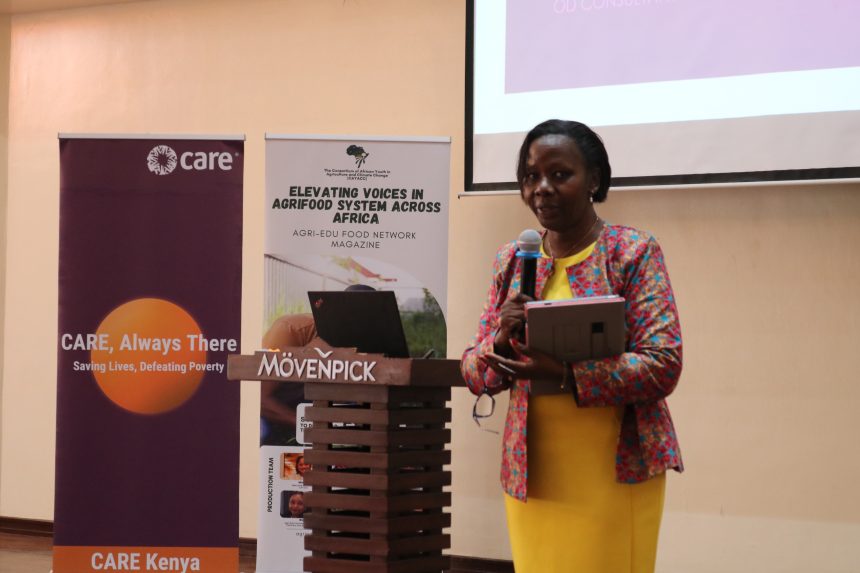
As CARE Kenya Country Director Getrude Misango emphasised, this moment demands more than alignment in language; it requires alignment in action: a collective approach that translates continental commitments into Kenyan realities through a shared roadmap for implementation.
At its core, the convening responded to a hard truth emerging across Africa’s food systems: while non-state actors are present in consultations, their influence on implementation, financing, and accountability remains uneven.
The Nairobi workshop, therefore, posed a more fundamental question: what would it take to shift from “non-state actors and government” operating in parallel, to “non-state actors with government” co-owning delivery of agrifood system transformation?
The workshop’s own reflections point to the most important truth of all: participation is not the same thing as influence.
That distinction should unsettle all of us. Kenya is not short of actors. The assessment presented during the workshop found that civil society organisations form the largest share of the mapped ecosystem across the six-country study, farmer organisations remain critical for grassroots representation, and research institutions provide evidence in support.
Yet it also found that women-led and youth-led organisations remain underrepresented, private sector and media actors are still a smaller share of the space, and coalition effectiveness is uneven and often donor-driven rather than institutionally anchored.
The same evidence shows where engagement is strongest and where it weakens.
Non-state actors are more visible in food systems dialogues and in National Agriculture Investment Plan processes, but are much less present in the more technical and politically consequential spaces: the CAADP Biennial Review and Joint Sector Reviews.
That gap is not accidental. It reflects limited access to government data, weak analytical capacity, and the reality that many actors are invited to consultation spaces but not meaningfully embedded in monitoring and accountability systems.
That is one of the most uncomfortable truths Kenya must now tackle. We have become better at inclusion in room design than inclusion in power design.
Another uncomfortable truth is fragmentation.
The workshop discussions were unusually candid: participants named donor dependency, duplication, gatekeeping, weak inclusivity, and poor accountability as systemic constraints.
They also acknowledged that the same familiar faces often dominate CAADP processes, limiting legitimacy and shrinking the pipeline for youth, women, producer groups, local private sector actors, and grassroots formations.
One workshop speaker captured the dilemma plainly: “When we are not coordinated, our impact is small; coordination unlocks scale.” That line should stay with us long after the workshop ends.
A third truth is technical, but no less political: budget advocacy remains the weakest link. Across the six-country assessment, budget analysis scored lower than policy advocacy, evidence generation, governance and internal coordination.
The report is blunt that this weakens the NSA’s capacity to influence public expenditure and monitor government commitments. Kenya is part of that pattern.
The assessment notes that Kenyan NSAs show stronger capacity in evidence generation and gender and youth inclusion, but only moderate strength in budget analysis and fiscal accountability.
That matters because CAADP delivery is not secured by declarations. It is secured when priorities appear in plans, then in budgets, then in releases, then in implementation data, and finally in results experienced by farmers, workers, traders and consumers.
As Hon. Kibagendi Osero, Member of Parliament, Agriculture Committee, National Assembly, noted, Kenya has already made important progress through national policy frameworks. The task now is to ensure those frameworks translate into coordinated implementation that delivers results on the ground.
But that opportunity will be wasted if the financing conversation remains thin. Kenya’s 2026 Budget Policy Statement projects national government funding for the Agriculture, Rural and Urban Development sector at KSh 97.0 billion in FY 2026/27, against a total projected national budget of KSh 4.7375 trillion.
That is roughly 2 per cent of the total national budget by simple calculation, although agriculture is also a devolved function and counties carry part of the spending load.
Even so, the broader point stands: if agrifood systems transformation is genuinely central to jobs, resilience and food security, then public financing, data transparency and expenditure scrutiny must become central to CAADP accountability.
First, Kenya needs an NSA platform that is representative enough to be legitimate and structured enough to be useful.
The organisational design discussed at the workshop is instructive: a coordination mechanism built around a quadruple helixof farmers and producers, private sector, civil society, and knowledge institutions; a lean secretariat; rotating leadership; consensus-based policy positions; and technical working groups linked to CAADP pillars. That is the architecture of partnership, not tokenism.
Second, Kenya needs a mutual accountability compact between state and non-state actors.
The workshop governance proposal points in the right direction: the government should commit to data transparency, budget disclosure, and meaningful invitation into review spaces; NSAs should commit to aligning their interventions with national investment priorities and reporting their own contributions to the sector. That is how the relationship matures from suspicion to shared responsibility.
Third, inclusivity must be designed, not assumed. If youth and women are always praised but rarely resourced, if producer organisations are consulted but not supported to analyse policy, if private sector actors are called in only for finance but not for governance, then “multi-stakeholder” remains a slogan.
The workshop’s own next steps were clear: define the group, agree on governance, composition, operational procedures, membership criteria, roles and responsibilities, a coordination secretariat, fundraising, and a communication plan.
That level of institutional seriousness is exactly what the Kampala phase now requires.The comfortable fiction has been that the government will implement, while non-state actors advocate from the sidelines.
The comfortable truth Kenya must now accept is harder, but far more useful: the Kampala Declaration will move only when non-state actors are organised enough to be credible, the government is open enough to share space and data, and both sides accept that accountability is not hostility.
That is the shift from NSA and government to NSA with government. And that is the shift that can finally make CAADP implementation in Kenya less ceremonial, more institutional, and more accountable to the people whose lives agrifood systems are supposed to improve.