Kenya has officially dispatched its first shipment of goods to China under a zero-tariff framework, a development that leaders are calling a turning point in the country’s economic trajectory and its longstanding trade relationship with Beijing.
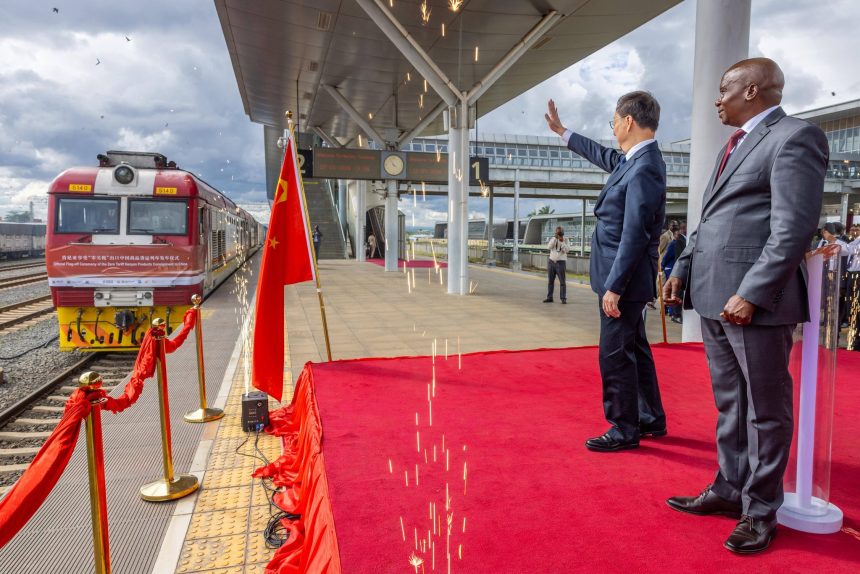
The flag-off ceremony, held at Nairobi Railway Station and graced by visiting Chinese Vice President Han Zheng, saw the dispatch of 54 containers filled with products such as avocados, coffee, avocado oil, and hides and skins.
The cargo will be transported via the Standard Gauge Railway (SGR) to the Port of Mombasa for shipment to China.
Han’s four-day visit comes ahead of the formal implementation of China’s zero-tariff policy for African exports, which is set to take effect on May 1, 2026.
Deputy President Kithure Kindiki described the zero-tariff arrangement as a significant structural change in Kenya’s trade model, highlighting its potential to shift the country toward an export-led economy.
He noted that the duty-free access for Kenyan products, including tea, coffee, avocados, nuts, flowers, and minerals, would enhance competitiveness in the Chinese market and directly increase incomes for farmers, traders, and export-oriented firms.
“The gap between us and first-world economies is wealth, and the surest way of creating wealth is through trade,” Kindiki stated, positioning the agreement as a step toward Kenya’s long-term goal of achieving first-world economic status.
At a high-level Kenya–China Business Forum at the JW Marriott Hotel Nairobi, Kindiki highlighted the historical trade imbalance between the two nations.
He pointed out that Kenya imports goods from China valued at over $4.3 billion annually, while its exports amount to approximately $200 million. He stated that the zero-tariff framework, agreed upon by President William Ruto and Chinese President Xi Jinping, is intended to rectify this imbalance by broadening Kenya’s export presence in China.
The policy specifically targets value-added goods, indicating a transition from raw commodity exports to processed and higher-margin products.
Cabinet Secretary for Investments, Trade and Industry Lee Kinyanjui described the zero-tariff access as “an unprecedented breakthrough” for Kenyan exporters.
“This is more than just a policy shift; it is a game changer that opens the door to one of the world’s largest consumer markets and positions Kenya for a new era of trade growth and value addition,” Kinyanjui remarked.
He stressed that the opening of the Chinese market presents a significant opportunity for farmers, manufacturers, and exporters.
“This is a clear call to action for Kenyans. The opportunity is here. With improved logistics through the SGR and expanding market access, our products can now reach China faster and more competitively than ever before,” he stated.
He emphasized that realizing these benefits will depend on compliance with quality standards and scaling up production.
The ministry, he said, will focus on educating businesses, enhancing export readiness, and assisting firms in meeting regulatory requirements in China.
Cabinet Secretary for Roads and Transport Davis Chirchir underscored the importance of infrastructure in implementing the new trade regime.
He described the launch as the inaugural export dispatch under the “Zero Tariffs for Stronger Cooperation” framework, noting that this arrangement will increase incomes for millions of farmers and traders.
Chirchir noted that the new deal will also “introduce the Kenya–China Cool Logistics Corridor, leveraging both SGR and port infrastructure for smoother trade.”
According to Chirchir, the Standard Gauge Railway, built by China, has already transported over 15.2 million passengers and 45 million tons of freight, underscoring its significance to Kenya’s economic connectivity.
He added that Kenya is positioning its transport infrastructure not only as a domestic backbone but also as a regional trade enabler and a driver of green growth.
Kenyan leaders placed the zero-tariff arrangement in the historical context of Kenya–China relations dating back to 1963. They highlighted China’s role in financing and constructing major infrastructure projects, particularly the SGR, as well as investments in roads, manufacturing, water, and energy sectors.
The Deputy President described the partnership as “enduring and mutually beneficial,” noting that it has remained resilient despite changing global geopolitical dynamics.