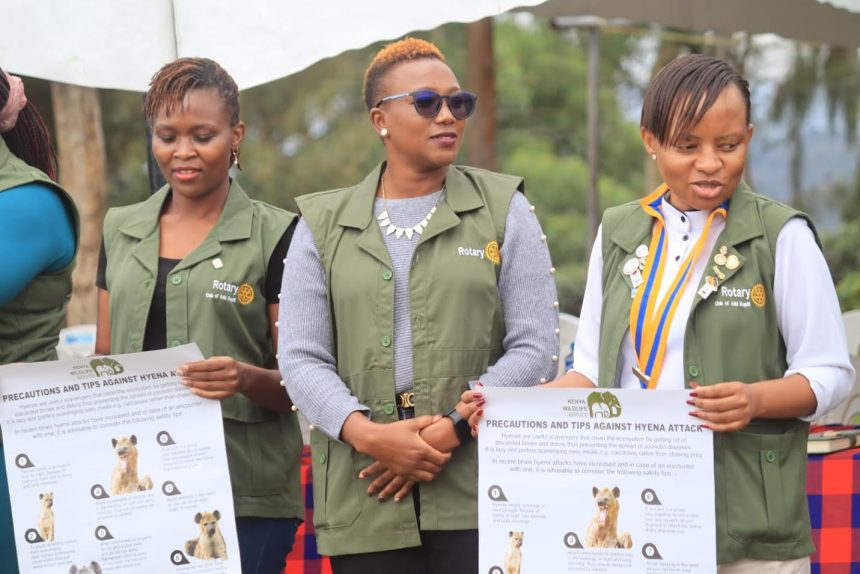
The Kenya Wildlife Service (KWS), in partnership with the Rotary Club of Athi Kapiti, has intensified practical safety measures to address the rising cases of human-wildlife conflict in Kyasila, Mua Ward, Machakos County.
Deputy Director of the KWS Southern Conservation Area, Joseph Dadacha, acknowledged that incidents involving wild animals had increasingly affected school-going children and communities in the area, prompting the need for urgent safety interventions.
Dadacha said the 2022–2023 drought worsened the situation by forcing wild animals out of their natural habitats into human settlements in search of food and water.
He explained that the movement of animals such as hyenas and leopards into villages had led to attacks on livestock, children and other residents.
Speaking during a community sensitization forum at Kyasila Primary School in Mua, Dadacha outlined several safety measures aimed at protecting learners and residents from potential wildlife attacks.
Among the measures introduced was encouraging school children to walk to and from school in groups instead of traveling alone, while parents were urged to escort their children to and from school whenever possible.
Residents were also educated on basic self-defense tactics in the event they encounter wild animals. For instance, they were advised to aim for a hyena’s face to scare it away during an attack.
Dadacha also cautioned residents against hunting animals in nearby forests, noting that such activities reduce prey for predators such as leopards and hyenas, forcing them to venture into villages in search of food.
President of the Rotary Club of Athi Kapiti, Sylvia Njambi, said the initiative aims to promote safe coexistence between communities and wildlife while protecting learners and residents from attacks.
She added that the sensitization program was designed to equip residents with knowledge on how to minimize risks and respond safely when encountering wild animals.
Mua Chief Albanus Ndeti noted that cases of human-wildlife conflict have been increasing in the area for over four years.
He said several incidents had involved the mauling of children and teenagers, some of whom were left with permanent disabilities, as well as frequent livestock attacks.
“This has been happening since 2022. Just as wildlife is protected, human lives should also be safeguarded,” said Ndeti.
Residents have now called for urgent government intervention, saying they have suffered significant losses, including livestock, injured children and sleepless nights due to fear of attacks.