It has been more than a month since the U.S.-Israeli war with Iran began. Here in Dubai, though far from the epicenter of the fighting, I can still feel the weight of war.
I still remember the morning of Feb. 28. News broke that the United States and Israel had launched strikes on Iran. By noon, reports emerged that missiles and drones were heading toward the Gulf, where U.S. military bases are stationed. As I followed the developments, a subtle unease crept over me. Reporting on this conflict is part of my duty as a journalist, but at that moment, I was not alone. My family was with me, and our neighborhood isn’t far from a U.S. military base. Then I heard it: a sudden boom — an explosion ripping through the sky. In that instant, confusion, fear and anxiety surged all at once. Goosebumps prickled my skin. For the first time in my life, war felt this close. I wasn’t the only one caught off guard. In the United Arab Emirates (UAE) — a country that hadn’t seen war in decades — bombs, missiles and battles had been concepts beyond most people’s imagination.
As the day went on, the sounds of interceptions rang out sporadically. News reports said fragments from intercepted missiles and drones had landed near the Palm Jumeirah, causing fires close to well-known landmarks. From then on, the war raged with ever-increasing intensity. The neighborhood where I live is repeatedly shaken by the thuds of intercepted missiles. Fragments from those interceptions have already claimed several lives and left many wounded. My child kept asking whether the iconic Burj Al Arab hotel or the museums in Abu Dhabi had been hit — places we had often visited. These questions made me realize that, while the attacks were primarily aimed at military bases and energy facilities, the war was causing a far deeper impact than the visible casualties: it was shaking people’s sense of safety and leaving a mark on their minds.
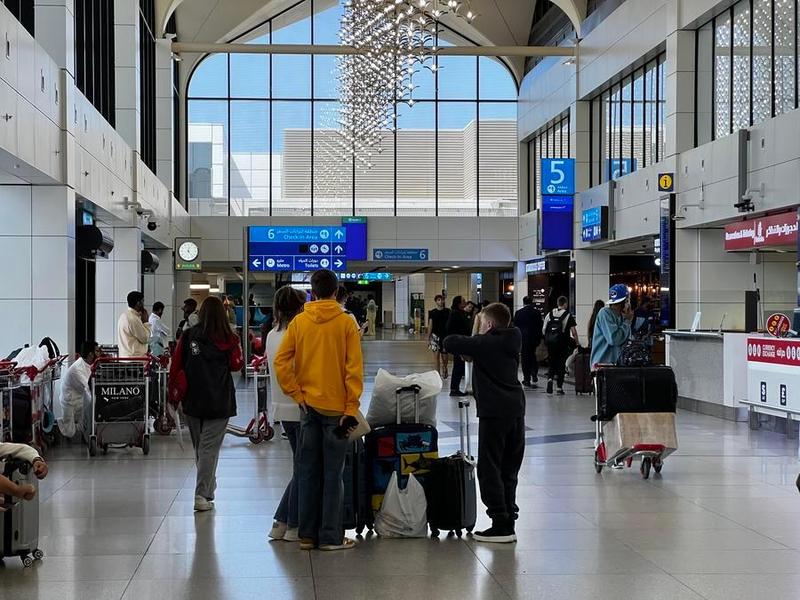
As the situation worsened, I decided to send my child and mother back to China. At the airport, departures were held up for hours as drone attacks threw operations into chaos. But finally, they made it home. I know I’m lucky, because I can choose to send my family to a safe place in the midst of danger. But for the more than 10 million people of the UAE, and for the countless others across the Middle East affected by this war, there is no choice but to endure it — because this is their home. Thanks to the UAE government’s swift action, social order is largely maintained. Malls and supermarkets remain stocked, and prices stay relatively stable. Fuel costs have risen, but not steeply. People are doing their best to adapt. Children continue their classes online. Families still gather. Cities remain alive. Yet beneath this calm on the surface, the shadow of war looms large. Bottled water is quietly rationed. A friend talked about getting vaccinations and paperwork in order for his dog, just in case evacuation became necessary. Another mentioned that the building’s housekeeping staff were anxious about losing their jobs if the situation worsened.
The government is doing its utmost to maintain a sense of normalcy, but in a Gulf nation so reliant on tourism and the Strait of Hormuz, the impact of the war is hard to ignore. Flights have been scaled back. Airspace disruptions have made travel more difficult. A friend in the tourism industry told me that even if the fighting eases, recovery will take time, since rebuilding tourist confidence could take months, if not years. With Iran effectively blocking the Strait of Hormuz, the UAE’s oil trade — one of its key economic pillars — has also taken a serious hit. Recognizing these risks, the UAE has repeatedly called for restraint and dialogue, emphasizing de-escalation and regional stability. But as the war passed the one-month mark, the United States ramped up its military presence in the Middle East, and Israel announced plans to expand its strikes. The conflict shows no sign of easing anytime soon.
This country, its people, and I will likely spend even more time under the shadow of war, while rethinking the connections between peace and security, personal life and geopolitics, and the ties between the region and the state. After dropping my child and mother at the airport, I took a taxi back to my office. With the occasional sounds of intercepted missiles still echoing across the sky, the driver wore a tense, serious expression. The car raced through the night, tires squealing against the asphalt. Every traffic light seemed to drag on forever. “Who would have imagined this happening in the UAE?” he asked, his voice trembling. “Everything has changed,” he sighed.