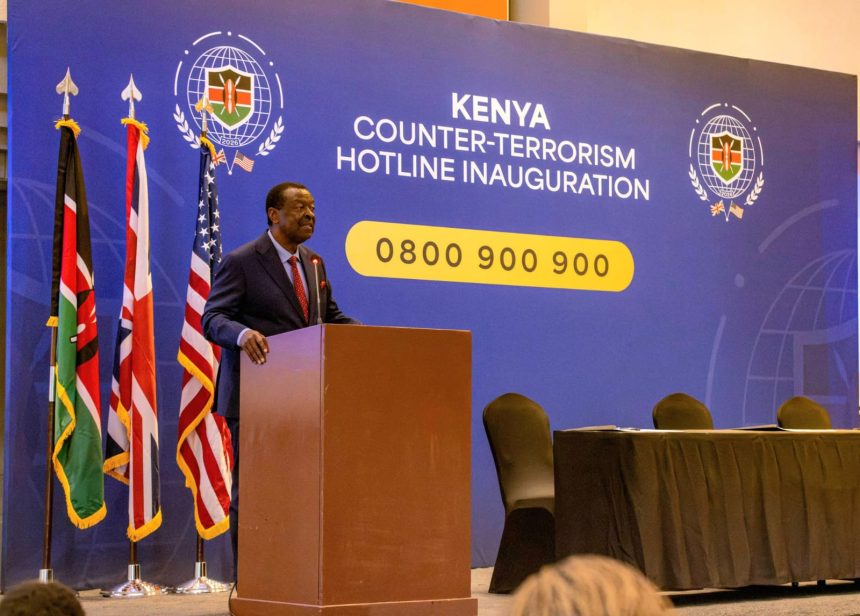
Prime Cabinet Secretary Musalia Mudavadi has warned that organised criminal gangs, including groups involved in violence and intimidation, could evolve into violent extremist and terrorist organisations if their activities are not closely monitored.
Mudavadi said communities and security agencies must increase vigilance to prevent criminal gangs from expanding, becoming entrenched and threatening national security.

Speaking during the inauguration of the Kenya Counter-Terrorism Hotline in Nairobi on Thursday, Mudavadi linked the growing presence of organised criminal gangs to the need for stronger community surveillance and security cooperation.
“The growth of organized criminal gangs including goons, calls for heightened vigilance and monitoring by communities and the security agencies,” Mudavadi said.
“These gangs must not be allowed to expand or become entrenched, as they can easily evolve from petty crime into violent extremism.”
The Foreign and Diaspora Affairs Cabinet Secretary said authorities should closely examine the activities of gangs that terrorise communities, undermine state institutions and threaten democratic processes.
He raised questions about whether some groups involved in such activities should continue to be treated solely as criminal gangs or whether their conduct could warrant consideration under terrorism-related frameworks.
“This raises a fundamental question: when gangs terrorise populations, undermine state institutions and democracy, should we continue to regard them as criminal gangs or terrorist groups?” Mudavadi asked.
“In my view, communities and security agencies should closely monitor the activities of such gangs, given the risk of radicalization, and their potential evolution into violent extremism and terrorism.”
Mudavadi said the newly launched counter-terrorism hotline would strengthen cooperation between communities and security agencies by providing a direct channel for reporting terrorism-related concerns.
He described the platform as a significant measure in enhancing public safety and strengthening community-based approaches to countering terrorism.
The hotline is designed to enable members of the public to report suspicious extremist and terrorist activities through a confidential system that supports anonymous reporting.
Mudavadi said the initiative would help remove barriers to the timely sharing of sensitive information while building trust between communities and specialised security agencies.
“The hotline provides an essential platform for enhanced cooperation between communities and security agencies in making Kenya a country in which all people can live together safely and peacefully,” he said.
He urged Kenyans to use the platform responsibly and clarified that it was intended specifically for counter-terrorism reports, rather than general police complaints.
“The Hotline is specifically for counter-terrorism reporting and should not be used for general police reports or personal complaints,” Mudavadi said.
He advised members of the public to use established police channels for other reports.
Vigilance Ahead of the General Election
Mudavadi also called for increased vigilance in public spaces as Kenya approaches the General Election, noting that large gatherings could be vulnerable to terrorist attacks.
He urged communities to report individuals who promote, plan or carry out terrorist activities.
The Cabinet Secretary further warned that online activities should form part of community reporting efforts, citing emerging cyber-terrorism threats and increasingly disruptive ransom-seeking attacks.
He said the evolving security environment required citizens to work with security agencies to identify and prevent threats.
Mudavadi noted that terrorism remained a major challenge across Africa and the Horn of Africa, where regional instability and violent conflicts could worsen security risks.
He emphasised that national security was a shared responsibility between the government and citizens.
“Security begins with you as an individual,” he said, invoking the Swahili phrase, “Usalama unaanza na mimi.”
Mudavadi urged Kenyans to remain vigilant in workplaces, public transport, places of worship, learning institutions and business premises, while using the hotline to share information that could help protect communities.
The counter-terrorism hotline was launched through a partnership involving Kenya, the United Kingdom and the United States.