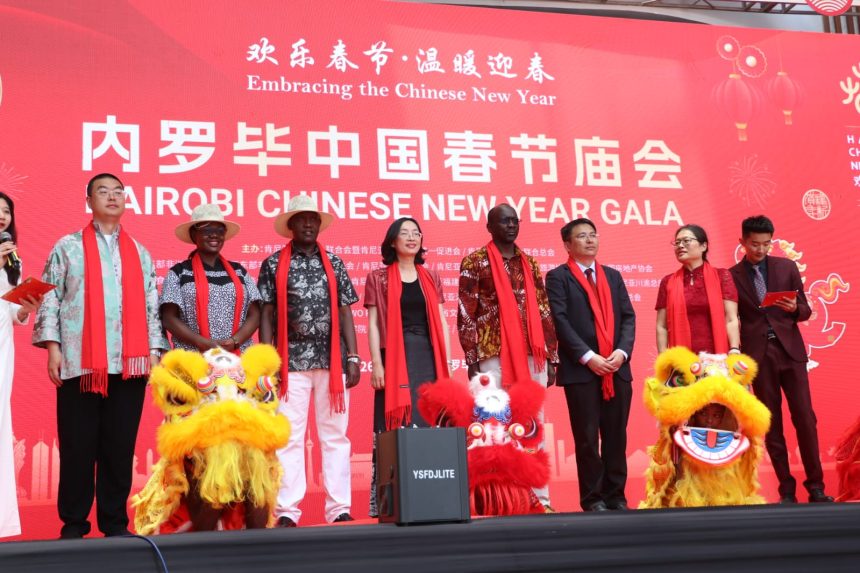
The 3rd Chinese New Year Gala took place in Nairobi on Sunday, marking the Year of the Horse, amid reinforced calls for closer bilateral collaboration and strengthening cultural and tourism partnerships between Kenya and China.
Attended by Chinese nationals, Kenyan officials, United Nations representatives, and international guests, the event showcased traditional performances and interactive cultural activities., reinforcing calls for closer bilateral collaboration.
Ambassador of the People’s Republic of China to Kenya, Guo Haiyan, stressed the global importance of the Spring Festival, which was added to UNESCO’s Representative List of the Intangible Cultural Heritage of Humanity in December 2024. She highlighted that the festival, celebrated by billions worldwide, represents harmony, goodwill, and shared values.
“The year 2026 has been designated as the China–Africa Year of People-to-People Exchanges. Cultural dialogue and mutual learning have always been vital forces for human progress and peace,” stated Ambassador Guo.
She described the Nairobi celebrations as a vivid example of the deep communication and exchanges between China and Kenya, noting that through joint efforts, both nations can foster greater solidarity and create a community with a shared future for humanity.
Ambassador Guo also pointed out the historical connections between Chinese and African civilizations, which have established a strong foundation for lasting friendship.
“We will take this year as an opportunity to carry forward our traditional friendship, strengthen mutual learning, enhance personnel exchanges, particularly among young people, and deepen our sharing of governance experiences,” she said.
Guo expressed confidence that the New Year Gala would offer people worldwide a chance to experience and appreciate Chinese culture.
Principal Secretary for Tourism, John Ololtuaa, praised the robust tourism and cultural ties between Kenya and China. He expressed gratitude for the UNESCO Intergovernmental Committee’s decision to recognize the Spring Festival as part of the intangible cultural heritage.
“Celebrating age-old traditions like the Spring Festival is always uplifting to the human spirit,” he remarked.
“During such occasions, we get to immerse ourselves in the cultures of other societies and secure a chance to unpack the past and heritage of other world citizens,” he said
Ololtuaa noted that Kenya and China have a bond that began with Kenya’s independence, as the People’s Republic of China was one of the first nations to extend friendship to the newly sovereign Republic of Kenya.
Thanks to this strong friendship, he reported that by the end of 2025, over 105,000 Chinese tourists had visited Kenya, with more than 60,000 Chinese residents actively contributing to various sectors of the Kenyan economy.
“I have seen a lot of similarity between Chinese and Kenyan culture—in dance, food, and values. They have blended beautifully into our communities, and this partnership continues to strengthen,” Ololtuaa stated.
He also recognized the Gansu acrobatic troupe, which traveled from China to perform at the gala, bringing the essence of intangible cultural heritage to Kenyan audiences.
Principal Secretary for Children Services, Carren Agengo, described the occasion as a meaningful expression of the enduring cultural partnership between Kenya and China, which continues to grow under the framework of the Forum on China-Africa Cooperation (FOCAC).
She noted that Kenya’s active involvement in FOCAC has been significant in promoting joint cultural programs, arts exchanges, and heritage protection initiatives. Agengo asserted that her Ministry believes cultural cooperation thrives best when focused on people.
“It is encouraging that our partnership with China increasingly involves young people, artists, scholars, and community-based cultural practitioners. They are the custodians of tomorrow’s heritage and the innovators who will shape the future of our cultural relations,” she said.
Agengo added that Kenya plans to expand collaboration in heritage preservation, creative industry projects, academic exchanges, and youth-centered cultural innovations.
The gala featured traditional lion and dragon dances, calligraphy, Chinese knot weaving, and various cultural demonstrations. Speakers emphasized that the Year of the Horse symbolizes vigor, progress, and success, urging continued collaboration in tourism, cultural exchange, and people-to-people diplomacy between Kenya and China.
The Nairobi event was organized by the Kenya Overseas Chinese Association and the Kenya-China Women Association, with support from the Chinese Embassy in Kenya.