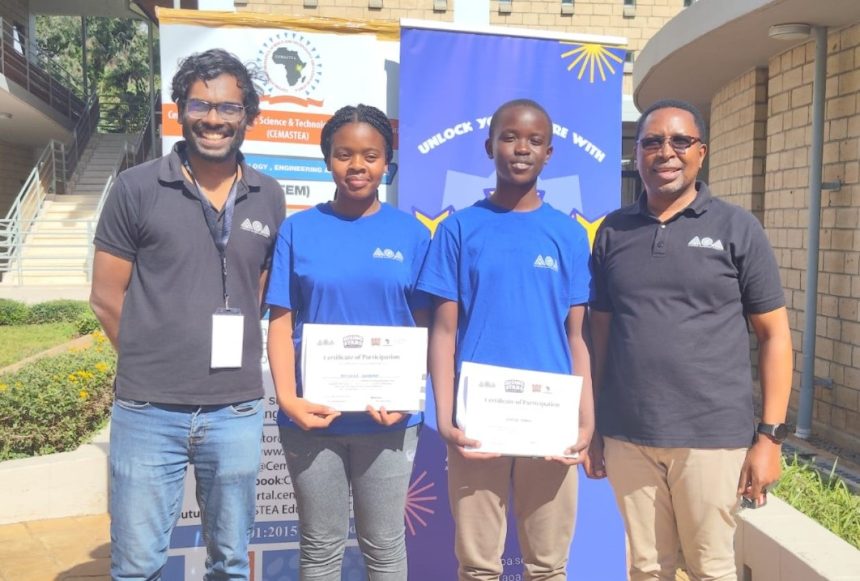
Three Kenyan secondary school students have secured full three-year scholarships to study at the African Olympiad Academy in Kigali, Rwanda, after emerging best at the 2026 Rising Stars Training Camp at the Centre for Mathematics, Science and Technology Education in Africa (CEMASTEA), Karen Campus.
The students, Caleb Tanui, 15 (Alliance High School); Mitchelle Ombuna, 15 (Kenya High School); and Juni Pearl Mumo, 15 (Alliance Girls High School), managed to secure the opportunity to join the academy, known for nurturing top African talent in mathematics and informatics.
Speaking during the closing ceremony of the 2026 African Olympiad Academy (AOA) Rising Stars Training Camp, Acting Chief Executive Officer of CEMASTEA, Gladys Masai, in a speech delivered on her behalf by Acting Director, STEM Research and Innovation Karanja Mutito, commended participants for their dedication and resilience.
Ms. Masai congratulated all participants and urged those who received awards to accept them with humility, while at the same time encouraging them to remain determined in their learning.
The five-day residential camp, which took place from April 8th to 12th, 2026, brought together 32 of the brightest young learners, selected from a pool of over 15,000 students through the Kenya Mathematics Olympiad selection process.
At the academy in Rwanda, the selected students will undertake a rigorous Olympiad-focused curriculum alongside Cambridge A-Level studies, which will fully prepare them for continental and global competitions, including the International Mathematical Olympiad (IMO) and the Pan African Mathematics Olympiad (PAMO).
While congratulating the winners, Ms. Masai emphasized that success in mathematics requires resilience and determination, urging those who didn’t get scholarships to keep trying in order to succeed.
The programme was designed to advance STEM education by integrating informatics alongside mathematics, therefore giving learners a chance to utilize analytical and problem-solving skills.
According to the Co-founder and Executive Director of the African Olympiad Academy, Arun Shanmuganathan, the programme is designed to identify and develop exceptional students capable of competing on the global stage.
The Co-founder said students went through intensive training, tackling very challenging problems and sitting rigorous tests.
“We’ve given them intensive training in mathematics to prepare them for international competitions, as well as in informatics, which is essentially coding. The students have been competing against each other, tackling very challenging problems and sitting rigorous tests,” said Shanmuganathan.
“At the end of that process, we were able to select three outstanding students who have received full scholarship awards to join us at the African Olympiad Academy in Kigali,” Shanmuganathan added.
“They will undergo more intensive Olympiad training, with the aim of qualifying for their national teams and competing at the International Mathematical Olympiad and the Pan-African Mathematics Olympiad,” Shanmuganathan said.
He stressed that selected students will undertake an Olympiad-focused curriculum alongside Cambridge A-Level studies in AOA.
Shanmuganathan noted that the AOA aims to nurture world-class problem solvers capable of addressing complex challenges beyond academics, including in technology, research, and innovation.
He encouraged students to embrace Mathematics, “We encourage students to deeply understand concepts rather than rush to solutions.” “Mathematics is not just about memorizing formulas or passing exams. It is about problem-solving and critical thinking,” he said.
Shanmuganathan commended CEMASTEA for spearheading STEM education in Kenya and pledged continued partnership in advancing the dreams of bright learners.
“Our partnership with CEMASTEA has been incredible. This is the second year we are conducting the Rising Stars Math Camp together with them. They have been a great institution in promoting STEM education and development here in Kenya, and together we are building on that partnership,” he said.
He challenged the successful learners to utilise the opportunity at AOA to engage in deep research, technology, and artificial intelligence.
“They can go on to solve problems in research, technology, AI, and even global policy. This comes from tackling difficult problems, taking time to truly understand what is required, thinking critically, and grasping concepts in depth. That is what mathematics is about,” he said.
He urged learners to focus on understanding concepts rather than rushing to solutions or relying on formulas.
“Developing a deep and clear understanding takes time, but that is what builds strong problem-solving skills,” he added.
Mitchelle Ombuna, one of the selected students, described the experience as both challenging and rewarding.
“The experience has been interesting. There were parts that were quite challenging and others that were very fun, but generally, I would say it was a wonderful experience,” she said.
“After this, I’m going to go back, sit down, and keep working hard at a higher level. At AOA, I’ll meet even more intelligent students and face more difficult problems, so I need to prepare myself,” she noted.
She demystifies the perception of learners fearing mathematics, urging them to change.
“Math is not a hard subject; it is about your mentality. If you approach it positively and take time to think through problems, it becomes much simpler,” she said.
Mitchelle explained that Olympiad-level mathematics is different from classroom learning, as it focuses more on critical thinking and problem-solving rather than direct application of formulas.
“In class, you’re often given a formula and asked to apply it, but here you’re given a problem and have to figure out how to solve it, sometimes without any formula. It challenges you to think more deeply and develop your mind,” she added.
Caleb Tanui said the difference between classroom learning and Olympiad training is the camp focuses on building real problem-solving skills rather than simply passing exams.
“In school, we are taught concepts and then expected to apply them in exams. But here, it’s not about passing an exam; it’s about becoming better problem solvers,” he said.
He explained that while exam-based learning is effective in measuring performance, it does not always nurture deeper analytical skills.