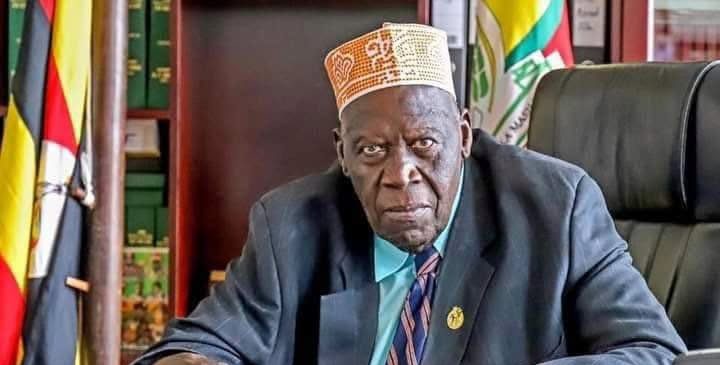
Uganda’s veteran Second Deputy Prime Minister and one of the country’s longest-serving political and military figure, General Moses Ali, has died. He was 87.
In a statement announcing the news, President Yoweri Museveni said Ali died at Nakasero Hospital in Kampala at 4 p.m. on Saturday. The president described him as a brother who had given his country long service both as a soldier and as a political leader, and pointed specifically to his standing in West Nile as a major modern farmer, saying his contribution would be sorely missed. Museveni closed by asking that Ali be granted eternal rest.

The confirmation puts to rest hours of unconfirmed reports that had circulated through Ugandan media on Saturday afternoon, after outlets including NBS and SoftPower News first indicated Ali had passed away. Family associates and political leaders had already begun sharing the news before the president’s statement made it official. No cause of death has been disclosed.
Ali had just weeks earlier been sworn in as one of the oldest members of Uganda’s 12th Parliament, having won re-election in January to represent Adjumani West County, a victory that drew widespread attention at the time because of his advanced age.
His death closes out a career that ran through nearly every major turn in Uganda’s post-independence history. He joined the Uganda Army in 1968 after starting out as a schoolteacher, rose quickly through the ranks, and by 1971 was training paratroopers as a colonel. That same year, he took part in the coup that installed Idi Amin as president.
His relationship with Amin’s regime later turned dangerous. After a public confrontation over corruption allegations — during which Amin reportedly hurled a trash can at him, Ali fled Kampala for West Nile, where he says he fought off an assassination attempt in a gunfight at his own home. He went into exile when Amin’s government fell in 1979.
He returned to Ugandan politics in the late 1980s, reconciling with Museveni’s government. In the early 1990s he was arrested and jailed on treason charges, spending roughly two and a half years in prison before Uganda’s High Court cleared him of all charges in 1992. He was elected to the Constituent Assembly in 1994 and went on to hold multiple ministerial posts over the following decades, including Minister for Disaster Preparedness and Refugees.
Ali most recently served as Second Deputy Prime Minister and Deputy Leader of Government Business in Parliament, a post he held from 2021 until this year’s cabinet reshuffle in May, when he was not reappointed. He retained his parliamentary seat regardless.
He also survived a December 2001 ambush, an attack he later noted matched the style of the one that killed police chief Andrew Felix Kaweesi in 2017 and briefly served as chairman of the Federation of Uganda Football Associations.
He held degrees from Makerere University and the University of Wolverhampton, and was promoted to four-star general in the Uganda People’s Defence Force in 2012. Beyond politics and the military, he was also known back home in West Nile for running a large-scale farming operation, a fact Museveni singled out in his tribute.
Born April 5, 1939, in Atabo Parish, Adjumani District, Ali is survived by his family. Funeral arrangements have not yet been announced.