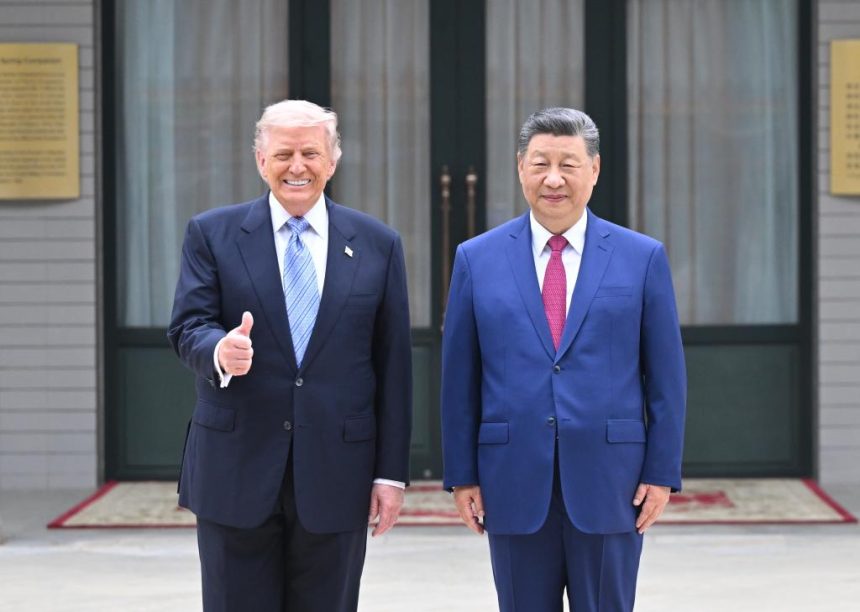
Chinese Foreign Minister Wang Yi has described the recent meeting between President Xi Jinping and U.S. President Donald Trump in Beijing as “historic,” stating that the two leaders reached a significant consensus on stabilising relations between the world’s two largest economies amid rising global uncertainty.
In a briefing to journalists following Trump’s state visit to China from May 13–15, Wang noted that the two presidents engaged in nearly nine hours of formal talks, private discussions, cultural exchanges, and a state banquet, resulting in what he termed “fruitful outcomes” across diplomacy, trade, security, and people-to-people relations.

“The tone of the interactions was one of mutual respect, shared commitment to peace, and a willingness to cooperate,” Wang said.
According to the Chinese top diplomat, the most significant outcome of the summit was the agreement to establish “a constructive China-U.S. relationship of strategic stability.”
Wang indicated that the new framework would guide bilateral relations over the coming years and provide greater predictability in an increasingly volatile international environment.
“China and the United States should not move toward confrontation. We both gain from cooperation and lose from conflict,” Wang stated.
He added that the two leaders agreed that competition between the countries should remain “healthy and manageable,” cautioning against turning differences into a zero-sum rivalry.
The summit marked the first face-to-face meeting between Xi and Trump since their previous engagement in Busan last year and the first state visit to China by a U.S. president in nearly a decade.
Wang noted that both leaders recognised the global significance of stable China-U.S. relations, especially during a time of geopolitical tensions and economic uncertainty.
“As transformation not seen in a century accelerates across the globe, the world has once again reached a crossroads,” Wang quoted Xi as saying during the summit.
Xi posed what Wang described as “questions of the times,” including whether China and the United States could avoid the “Thucydides Trap,” jointly address global challenges, and create a new model of major-country relations.
On economic ties, Wang stated that the two presidents reaffirmed that trade relations between China and the United States are “mutually beneficial and win-win in nature.”
He said both countries’ economic teams had achieved “balanced and positive outcomes” in recent consultations, including progress on tariff reduction, agricultural market access, and investment cooperation.
The two sides also agreed to establish new mechanisms for trade and investment coordination.
During the visit, Trump disclosed that China would purchase Boeing aircraft, American oil, and soybeans, although detailed agreements were not publicly released.
Wang said the summit also resulted in a consensus on expanding engagement in diplomacy, military affairs, health, tourism, agriculture, law enforcement, and cultural exchanges.
He noted that President Xi announced plans to invite 50,000 young Americans to China over five years through educational and exchange programmes.
“The hope of China-U.S. relations lies in the people and in the youth,” Wang said.
Taiwan emerged as one of the most sensitive issues discussed during the summit.
Wang reiterated Beijing’s longstanding position that Taiwan is an internal affair of China and warned that support for Taiwan independence could destabilise bilateral relations.
“If the Taiwan issue is handled properly, the relationship will remain stable. Otherwise, clashes and even conflicts could emerge,” Wang cautioned.
He added that both sides acknowledged the importance of maintaining peace across the Taiwan Strait.
The foreign minister also stated that Xi and Trump exchanged views on regional and global crises, including the Middle East and the war in Ukraine.
According to Wang, both leaders supported continued dialogue over confrontation and agreed to maintain communication on major international security issues.
Trump described the visit as successful and invited Xi to Washington later this year for a reciprocal state visit.
According to Wang, the Beijing summit had injected “new impetus” into China-U.S. relations and created momentum for deeper engagement despite longstanding disagreements over trade, technology, security, and Taiwan.
“Building a constructive relationship of strategic stability is not merely a slogan; it must be translated into concrete actions and practical cooperation,” Wang stated.