Kapchepkui Village in Chesikaki Ward, Mount Elgon, Bungoma County, was once a name that evoked fear and despair. During the reign of the Sabaot Land Defence Force (SLDF) between 2005 and 2008, the area became a war zone. The militia, led by Wycliffe Matakwei Komol, waged a campaign of terror killing more than 600 people and displacing over 66,000 residents. Families were torn apart, homes razed to the ground, and thousands sought refuge in neighboring towns such as Chwele.
When the Kenyan government, under the Ministry of Internal Security led by the late Professor George Saitoti, deployed the Kenya Defence Forces (KDF) to end the insurgency, the region was left scarred. Widows mourned their husbands, children were orphaned, and the elderly bore the brunt of violence. The leader of SLDF was killed by the Kenyan Army on 16 May 2008.

Yet today, the once battle-scarred Kapchepkui is a land of renewal. The sound of gunfire has long been replaced by the hum of life farmers tending to their coffee trees, banana groves swaying in the wind, and the laughter of children echoing through the hills.
At the heart of this transformation stands Mr. Maurice Matasero Chebus, a retired KDF officer whose journey from the battlefield to the farm field has become a beacon of hope for his community.
After 37 years of dedicated service in the Kenya Air Force, Warrant Officer Class 1 (Rtd) Maurice Matasero Chebus has transitioned from the discipline of barracks life to the calm and fulfillment of farming in Bungoma County.
“In 1984, I joined the Kenya Defence Forces, specifically the Kenya Air Force,” Chebus recalls. He began his basic military training at Lanet before being posted to Laikipia Air Base in Nanyuki, where he served diligently for 12 years. His exceptional discipline and commitment later saw him transferred to Eldoret, where he worked at the newly established Kenya Ordnance Factories Corporation from 1986 to 2004.
Afterward, he returned to the Air Force in Nanyuki, later serving at Moi Air Base in Nairobi and finally at the Department of Defence (DoD), where he worked until his retirement in 2022. Over his 37 years and 231 days of service, Chebus rose to the rank of Warrant Officer Class 1—the highest position attainable by a service member.
“I’m grateful to have risen to that rank,” he says with humility. “It’s the highest one can reach in my category.”
His long military career also took him beyond Kenya’s borders. He participated in peacekeeping missions in South Sudan during the 2012–2014 crisis and later in Somalia in 2019 as part of the Air Component. “When I joined, my parents were hesitant,” he says with a soft chuckle. “They feared I would never return. But over time, they realized the military is a profession like any other.”
For Chebus, life after retirement did not come as a surprise it was something he had prepared for. “In the military, we had retirement seminars that helped us plan for the future,” he explains. “When my wife and I lived in Eldoret, she told me, ‘We’re now close to home.’ That’s when I started planning my post-retirement life.”
In 1999, his wife and children moved back to Mount Elgon while he continued serving and visiting them regularly. This decision helped him establish early connections with the community a move he now encourages other officers to emulate.
“When you’re still in service, start something at home,” he advises. “Let people know you. It makes your transition easier.”
By the time he retired on June 30, 2022, Chebus had already ventured into farming, particularly coffee cultivation. Using savings from his years of service, he purchased nearly five acres of land, planting more than 6,000 coffee seedlings.
“I prepare my own coffee, do pulping, and then take it to the mill for marketing,” he says proudly. “This venture has really boosted me and my family.”
From the returns of his coffee farm, he has managed to meet his family’s needs, support local workers, and even expand into small-scale business. At Chesikaki Market, he runs a shop selling electronics and operates as an agent for both Cooperative Bank and KCB Bank through his M-Pesa outlet.
Driven by passion and purpose, he established Matafam Coffee Estate Factory, a licensed coffee pulping factory that transforms raw coffee berries into export-ready beans. The enterprise now employs over 35 local residents who help with harvesting, pulping, and processing turning what was once a land of bloodshed into one of opportunity and hope.
Despite his military background, Chebus exudes calm and humility. “Some people think military officers are difficult to approach,” he admits. “So when I retired, I organized a homecoming party for the entire community to know me better.”
Beyond farming, he is also a reverend and founder of the Evangelistic Churches of the Lord Jesus Christ, which he started in 1999 while stationed in Eldoret. His pastoral work, he says, helped him integrate smoothly back into the community.
Chebus also serves as Chairperson of Chesikaki Health Center, where he has played a key role in improving infrastructure and mobilizing residents to join the Social Health Authority (SHA) for better healthcare access. “We replaced old iron sheets, renovated the facility, and enrollment has grown,” he notes.
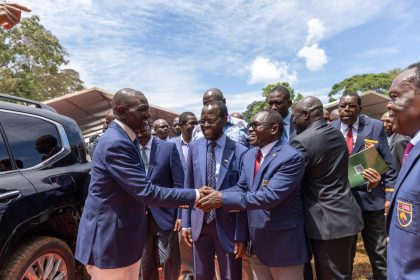
His leadership extends beyond the church and health center. In March 2025, he was elected Treasurer of the Kenya Defence Comrades Association (DEFOCA), Bungoma County Branch a body that promotes the welfare of military veterans and retirees.
“We have around 200 members, though fewer than 50 are active,” he explains. “Our main goal now is to reclaim land that was allocated to veterans but later leased out to private entities.”
The association he says is working closely with the County Commissioner, Mr. Thomas Sankei, to recover the land allocated to Kenya Defense Forces in Bungoma County and establish projects such as shops and fuel stations similar to those already operational in other counties. “We want to improve the welfare of veterans and give back to the community,” says Chebus.
Reflecting on his years in service, Chebus draws from what he calls the five pillars of the military, emphasizing professionalism, apolitical conduct, and resettlement after service. “Being apolitical means, I can serve the community without engaging in politics,” he says. “That principle has stayed with me even in retirement.”
He also shares what he calls the “Three Ys of the military” wine, women, and war. “I avoided indulging too much in the first two,” he says with a smile. “As for women, I have one wife, four children, and ten grandchildren. They are my pride.”
Chebus believes discipline and early planning are key to a fulfilling post-service life. “Life after retirement depends on how you view it. If you see it as an opportunity, you’ll thrive,” he says. “The military prepared us well for that.”
Today, as the sun sets over Mount Elgon, the once-forsaken Kapchepkui Village stands as a symbol of resilience and rebirth. The hills that once echoed with gunfire now hum with the sound of coffee pulpers. The people who once fled in fear now work together in peace.
Through his unwavering faith, discipline, and vision, Warrant Officer (Rtd) Maurice Matasero Chebus has turned the scars of war into seeds of prosperity. His story is not just about personal triumph but a reminder that even in places once defined by conflict, peace and productivity can take root and flourish.
“We left home to change home,” he says, gazing across his coffee fields. “And now, home has changed us too.”