The DPP has closed the final of the four Shakahola massacre cases, in which Paul Nthenge Mackenzie and 94 others faced 238 counts of manslaughter, shortly after the investigating officer detailed the horrifying extent of Mackenzie’s control over his followers, which led to the deaths of 429 people.
Chief Inspector Raphael Wanjohi told Chief Magistrate Alex Ithuku that Mackenzie and his co-accused shared a suicide pact, perpetrating the massacre with the pretext of meeting Jesus before the end of December 2020.

The 95th and last prosecution witness stated that Mackenzie instructed his followers to hasten their deaths through starvation in order to meet Jesus before his purported December arrival on Earth.
“The suspects had a mutual agreement and shared intention, both individually and collectively, for a suicide pact. They had a common purpose to commit acts of manslaughter by overseeing the deaths of their children through enforced fasting,” said Wanjohi.
He added, “They had a specific intent to fast to death to meet Jesus and possessed knowledge of committing an unlawful act, as evidenced by the way graves were concealed.”
Wanjohi told the court that Mackenzie and 94 co-accused bore the greatest responsibility for the crime of manslaughter of 238 deceased persons.
Ithuku further heard that those who resisted the pact fled the settlement, highlighting the extreme indoctrination and coercion imposed by Mackenzie over his followers.
The group had settled several kilometers deep inside the dense Shakahola forest, strategically away from authorities.
Mackenzie’s militia monitored movements and ensured strict compliance with the deadly fasting, the court further heard.
The settlement’s remoteness was striking, with Wanjohi revealing that it was 14 kilometers from schools, 35 kilometers from Lango Baya Police Station, and 32 kilometers from the nearest chief’s camp, hindering detection.
Inside the deep forest, away from the eyes of authority, Mackenzie and his close associates imposed his doomsday ideology on hundreds he had lured through indoctrination.
Call data analysis revealed systematic coordination between Mackenzie and his security team.
The homicide investigator said these communications were used to monitor activities within the expansive Shakahola forest while enforced fasting was underway.
On the first day of exhumation operations, approximately 25 kilometers inside the forest, Wanjohi and his team uncovered 65 graves, including 14 containing multiple bodies.
The same day, 17 bodies were exhumed and meticulously documented before being transferred to Malindi Subcounty Hospital for preservation.
Each body was assigned a unique identifier, placed in labelled body bags, and transported to the subcounty hospital mortuary.
The mass graves, containing several bodies of male and female adults and minors, were shallow, with some bodies wrapped in bed sheets or lesos tied with knots before being buried, the court also heard.
Wanjohi told Hon. Ithuku that some bodies were transferred from one grave to another, likely to avoid detection.
Fast-growing crops were planted on mass graves, many flattened to conceal evidence.
Several months after the exhumation operations, the homicide detective and his team joined pathologists to conduct post-mortems in four phases on 429 bodies to establish the causes of death.
Starvation was the leading cause of death, followed by injuries, while some deaths remained undetermined due to decomposition.
DNA testing helped confirm identities and link victims to relatives.
Investigators highlighted that only two burial permits had been obtained, far below legal requirements, reflecting systematic lawlessness.
Children and adults were often buried together, with graves flattened or concealed by crops.
Investigators said these practices demonstrated deliberate attempts to obscure evidence of the crimes.
Wanjohi explained that followers abandoned jobs, sold property, withdrew children from schools, and destroyed identity documents before relocating to Shakahola.
The extreme fasting imposed by Mackenzie directly caused numerous deaths, with Mackenzie’s armed militia guarding women and children undergoing fasting inside canopies.
Mackenzie and his lieutenants developed a coded language to convey key messages to followers during the fasting period within Shakahola forest.
Among the coded language terms are “Wateule,” referring to members; “Mataifa,” to outsiders; “Harusi,” to burial; “Kunyakuliwa,” to rapture; and “Kanisa Jagwani,” to mean Shakahola.
This secrecy reinforced control and prevented outsiders from understanding internal operations.
Searches at Mackenzie’s premises recovered DVDs, religious books, files, and registers containing radical end-times teachings.
These materials illustrated the ideological framework guiding followers’ fatal compliance.
Arrests continued during police operations, with suspects intercepted while fleeing Shakahola Forest or travelling to Malindi.
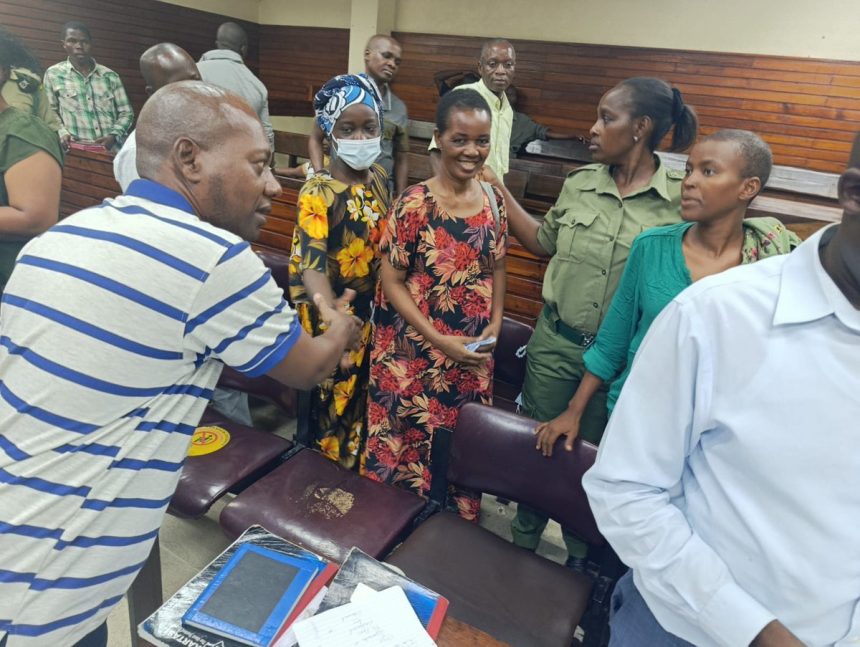
A total of 62 suspects were arraigned before Shanzu Law Courts, with others presented under miscellaneous applications or custodial orders.
Between June 6 and 10, 2023, suspects staged hunger strikes in custody.
Six were hospitalised, and one suspect died.
Charges of attempted suicide were later withdrawn, and the accused were subsequently charged with 283 counts of manslaughter, among others.
Investigators relied on mapping, forensic evidence, DNA testing, and witness statements to establish the scale of atrocities.
The matter will be mentioned on 3 March 2026 for direction on submissions by parties.
The magistrate will subsequently set a date to deliver his ruling on whether there is a case to answer.
The prosecuting team comprises Deputy Director of Public Prosecutions Jami Yamina and Joseph Kimanthi, Principal Prosecution Counsels Alex Ndiema, Victor Owiti and Betty Rubia and Prosecution Counsel Yassir Mohamed.
SOURCE: ODPP