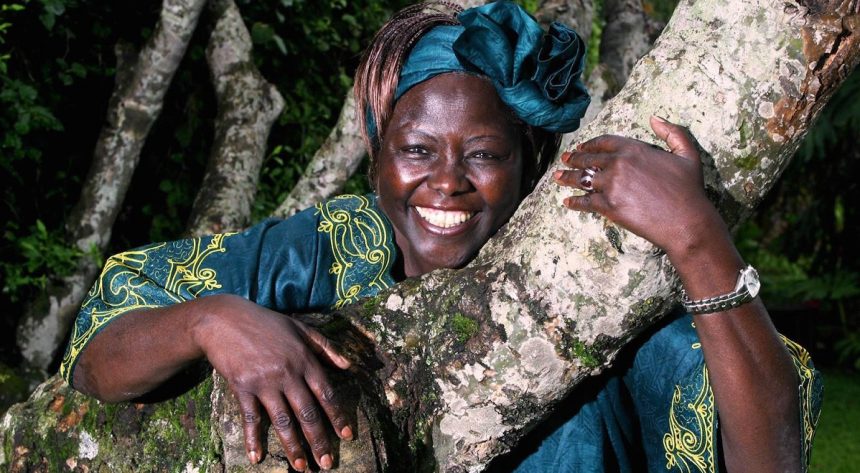
In honour of International Women’s Day, Abigail Arunga, a writer and activist with notable credits on shows like “Pepeta”, “Fourplay” and a play based on Dr Wangarĩ Maathai set for April, reflects on the Nobel laureate’s legacy and what we can learn from her fight for a better environment.
Too Early For Birds is putting on yet another masterpiece in the month of April, and this time, the historical retelling is focused on Wangarĩ Maathai.
For those who are somehow not familiar, Dr Wangarĩ Maathai was the first Kenyan to win a Nobel Peace Prize – first Kenyan to win a Nobel anything, really, and there hasn’t been another since. She was what her time called a disobedient woman, for various reasons, but she was later revealed to be a heroine, a legend, a visionary, and a true environmentalist.

At the time, however, she was seen as a cantankerous divorcee who would not stop fighting against the government. This version of the story is ironic because she is not even the one who filed for divorce in the first place.
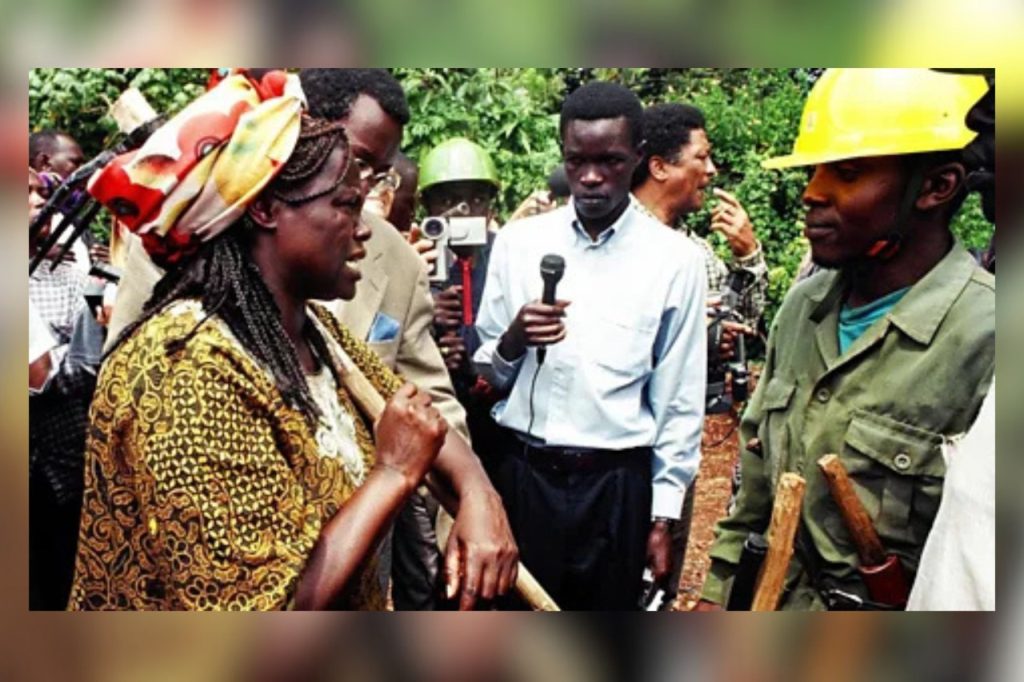
The world has a strange way of retelling a story as it is happening, and then flipping it on its head as soon as the tide of societal approval shifts. A great example of this is Dr Maathai – it was her who started the fight against Moi to not build a 60-story structure in Uhuru Park, alongside what would have been a two-story statue of himself.
At the time, 1989, parliamentarians were so upset with her that they spent 45 minutes of public funds to insult, diminish, and demean her. You can go look for it – it is on public record. Here is an excerpt from the Hansard that day, copied verbatim; the words of Honourable John Keen, Assistant Minister, Office of the President at the time:
“I do not condemn married women who have got some standing in society, but I do not see why a bunch of divorcees, women of no standing at all, should come to criticise the efforts which are being made by this Government. Mr Speaker, Sir: had it not been that Mrs Mwangi Mathai had disowned her husband in broad daylight, I would have said something more. That woman has lost respect among the African community, and therefore, I see no sense at all in Mrs Prof. Mwangi Mathai appealing to foreign powers for assistance in the course of the dark development of our country. The Minister for Local Government is responsible for planning our City, and, therefore, if he wants to build a 100-storey building anywhere in the City, he is free to do so. He is entitled to build anywhere, and we support him 100 per cent.”
And on and on like this, from many members of parliament for 45 minutes. 45 minutes! You must really be making an impact if MPs are stopping voting themselves into more money to discuss you for 45 minutes.
Ironically, once again, this is the woman who was elevated so far above any of these men who talked about her; so much so that no one even remembers the man who divorced her in the first place, whom they insist on referring to in the above excerpt.
In a terrible twist of fate, however, Kenyan women are still fighting the same fights she fought then; fighting to be paid equally, fighting not to be perceived by just their marriage status, fighting to live in a country that cares about them and their voices.
The fight has been a long one, and it continues.
Every International Women’s Day, I reflect on the point of this day, and I am always wondering if there is even a point. Yes, now women in Kenya have things like maternity leave, and empty gestures like menstrual time off (honestly, that just seems like a way to victimise us more, and I would much rather have functioning roads). Yes, we can own land now, and purchase sexual and reproductive healthcare over the counter.
A lot of the time, though, the weapons formed against us are structural and unspoken. An assumption that you are the tea girl. A question at your job interview about whether you are married or not, and if you have children. A reduction of your pay if you are single. An assumed inability to run for office if you do not have a nuclear family.
Past a certain point, it feels like we must also ask ourselves what we are celebrating, and outside of this day, what steps are we taking to ensure that we have something to celebrate on the next one. The problem could be me as well. Perhaps I am too impatient. But it is hard to be patient when everything else is moving so fast, seemingly unencumbered by processes.
Speaking of forests, Dr Wangarĩ Maathai’s fight is being backpedalled at an alarming rate. There is the aforementioned Ngong Forest being infringed upon as we speak (kindly note, even with the Uhuru Park victory, there are still parts of it that had already been grabbed by golf courses, hotels, and stadiums, much like they are trying to do with Central Park as we watch).
What would Wangarĩ have done if she were here today, during Women’s History Month, watching the work she did being undone?
Well, to know that, I would tell you to make sure you watch the play (April 10-12, in case you’re wondering). But the short answer, for what we can do now, is the same playbook that Kenyans have been using against dictatorial playbooks from the beginning of – well, Kenya.
Wangarĩ would make noise. She would make sure everyone who is anyone knew what was happening. She would write articles about it in the paper and to the paper; she would immediately start a petition online. She would tweet about it, for sure, in a thread that had multiple additions and sources. She would demand what her MP was doing about it, if she weren’t the MP herself; if she were, she would bring it up as a matter of urgency in parliament. She would get legal injunctions. She would go on Spaces and make a TikTok, looking as awkward as the rest of us, on why it is important to save the lungs of Nairobi and, indeed, the forests of Kenya.
Wangarĩ wouldn’t keep quiet. And if you’ve gotten to the end of this and shared it, you haven’t kept quiet either. In a very way, Wangarĩ’s spirit lives in all of us, in our words, in our movements, and in what we refuse to stand for.
Happy International Women’s Day. Aluta Continua.