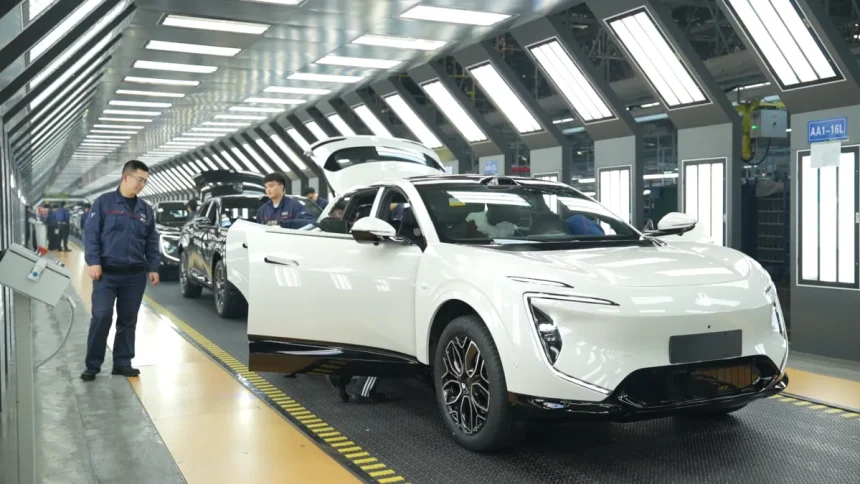
Chongqing has reclaimed its position as China’s leading automobile-producing city after recording total output of 2.788 million vehicles in 2025, representing a 9.7 percent year-on-year increase, iChongqing.info reported, citing official data from municipal authorities.
The rebound is largely driven by accelerated growth in new energy vehicles (NEVs), with production reaching 1.296 million units—an increase of 36 percent. This surge has pushed the city’s automotive industrial cluster beyond 800 billion yuan, reinforcing its status as a core manufacturing hub.

The latest figures mark Chongqing’s return to the top spot among Chinese cities for the first time in nine years, underscoring the restructuring of China’s auto industry toward electrification and advanced manufacturing.
Comparative data shows that while Anhui Province and Guangdong Province reported higher aggregate production volumes—3.3354 million and 2.7196 million vehicles respectively between January and November 2025—these figures reflect provincial-level output across multiple cities and industrial zones.
By contrast, Chongqing’s performance is concentrated within a single municipality, highlighting a deeper industrial ecosystem and more integrated production capacity. Analysts note that this concentration provides structural advantages in supply chain coordination, logistics efficiency and policy alignment.
The city’s resurgence signals a broader shift in China’s automotive geography, with inland manufacturing centres leveraging scale, infrastructure and policy incentives to compete with traditional coastal hubs.
Leading automakers are the drivers of Chongqing’s automotive industry development. Changan Automobile has long been focused on NEVs and automotive intelligence, with 2025 production expected to exceed 2.76 million vehicles, including over 1 million new energy vehicles (NEVs). Seres, rapidly growing through its deep partnership with Huawei, saw its M9 model lead sales in the 500,000-yuan (71,738 U.S. dollars) price range for 20 consecutive months.
Recently, both companies have reached key milestones. In December 2025, Changan’s 30 millionth self-branded vehicle rolled off the production line. On January 13, 2026, Seres marked the production of its 1 millionth vehicle, a historic leap for Chongqing’s private automotive industry.
Leading automakers drive the upgrade of Chongqing’s automotive supply chain. Industry Observer Chen Meng noted that vehicle manufacturers like Seres help local small and medium-sized enterprises transform from simple mechanical parts into high-end components such as sensors and control modules, forming an industrial ecosystem and a closed loop.
Currently, Chongqing’s local parts supply rate for automotive components exceeds 45%, covering core components such as chips, power batteries, and smart cabins, attracting suppliers such as CATL.
The automotive industry’s focus has shifted from “electrification” to “intelligence,” and Chongqing has an advantage in the field of smart driving, with its complex road conditions serving as an ideal testbed for autonomous driving algorithms. Some industry experts suggest that if an autonomous driving system can adapt to Chongqing’s roads, it can handle most city road conditions worldwide.
Recently, Chongqing became one of the first cities in China to conduct Level 3 autonomous driving road tests, allowing such vehicles to operate in congested expressway environments.
Chongqing’s strategic location has also provided strong support for its automotive exports. As the operational hub of the New International Land-Sea Trade Corridor (ILSTC), which serves as China’s western gateway to international markets, Chongqing has leveraged its inland location as a key advantage in opening up to the world.
In 2025, a large number of “Chongqing-made” cars will be exported via the ILSTC, reaching Southeast Asia, the Middle East, and Latin America. The newly launched “ASEAN Express,” with Chongqing as a transit hub connecting Europe and Southeast Asia, improves logistics efficiency by 50% compared to traditional river-sea transport.
Chongqing’s car industry has also shifted from exporting products to exporting the entire industrial chain. In May 2025, Changan’s NEV factory in Rayong, Thailand, officially began production, marking the first overseas NEV production base for Chongqing.
Leveraging this factory, Changan plans to invest 30 billion Thai Baht (about 900 million USD) in Thailand, covering manufacturing, R&D, and after-sales services, aiming to turn Thailand into a strategic hub for right-hand-drive markets worldwide.