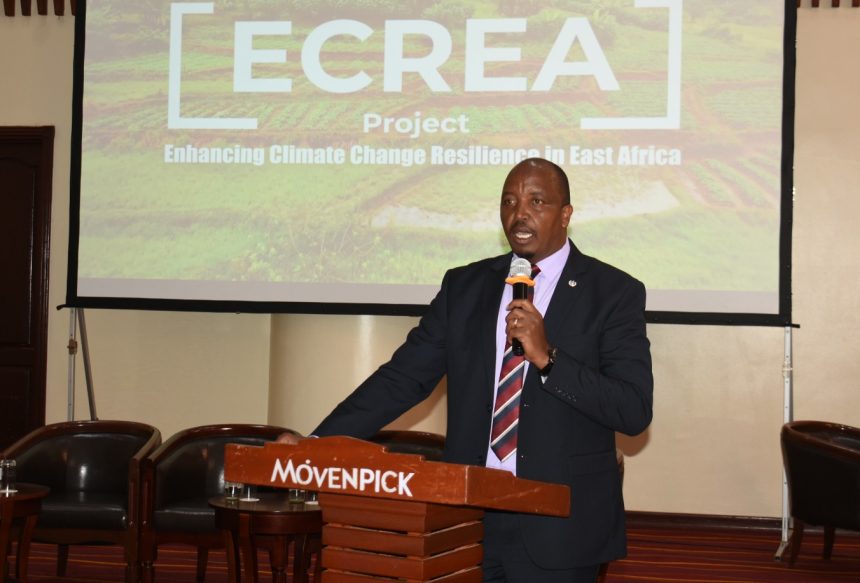
Public demand for weather and climate information Kenya has increased with forecasts becoming more accurate, says the Acting Director of the Kenya Meteorological Service Authority (KMSA), Edward Muriuki.
Muriuki says access to timely weather and climate information and the establishment of meteorological services offices in the counties has helped to get more Kenyans using weather and climate information in decision making.

“Today meteorologists are proud to introduce themselves unlike in the past when the public would shun our products,” said the Acting Director of KMSA.
The Acting Director noted that the offices of the county directors of meteorology in all 47 counties have enabled the public to receive usable weather and climate information for decision-making.
Speaking when he closed a two-day roject Reflection and Closure Workshop on Enhancing Climate Change Resilience in East Africa (ECCREA) that saw four countries participate, including Kenya, Rwanda, Tanzania, and Uganda, Muriuki said that when climate information is utilized optimally, it leads to strategic decision-making.
“The forecasts have become more reliable and relevant to key sectors including the disaster risk management, agriculture and food production,” said Muriuki adding that the project which was conducted in the four counties of Homa Bay, Elgeyo Marakwet, Nakuru and Machakos has shown that when weather information is utilized optimally in the agriculture sector it can result into higher productivity.
“Effective use of weather and climate forecasts can lead to saving lives during climatic disasters hence assisting in Disaster Risk Reduction and enhanced productivity in rain-dependent sectors,” he said.
Muriuki urged participating countries to ensure that meteorological services reach the last mile by having a presence in the furthest part of their individual countries.
The workshop provided an opportunity for partners and stakeholders to showcase key project achievements, results, and impacts; share country experiences, best practices, and lessons learned; reflect on challenges and identify opportunities for sustaining and scaling successful interventions; and formally conclude the ECREA project.
The ECREA Project, was financed by the Foreign, Commonwealth and Development Office (FCDO) through the UK Met Office and was implemented in partnership with Igad Climate Predictions and Application Center (ICPAC), National Agricultural Research Institutions (NARSs), National Meteorological and Hydrological Services (NMHSs), and media partners across Rwanda, Kenya, Uganda, and Tanzania.
The project ECREA worked to strengthen both the supply and demand sides of Weather and Climate Information Services (WCIS), enhancing the resilience of agricultural communities in the region.