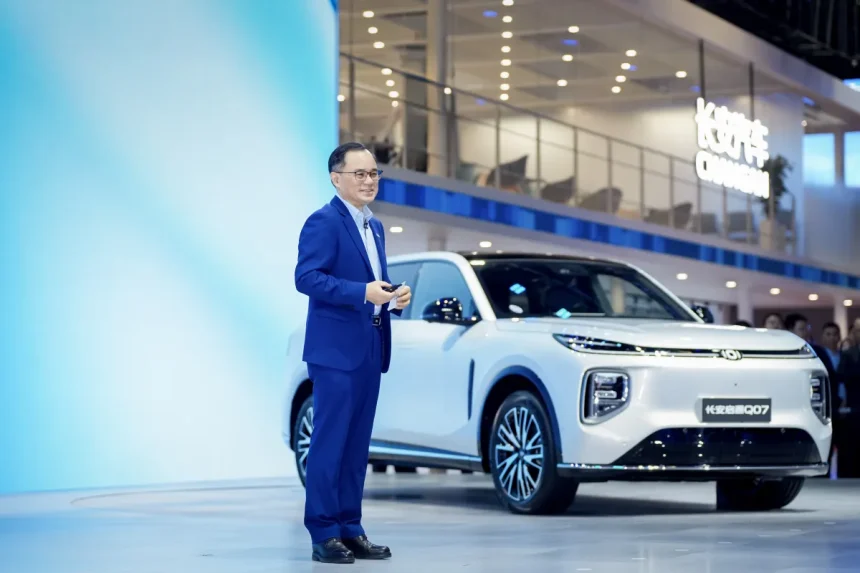
Chairman of China Changan Automobile Group and deputy to the 14th National People’s Congress, Zhu Huarong, has emphasized the importance of preventing “over-competition” in the automotive industry. He also called for facilitating the sector’s transition from traditional manufacturing to a new ecosystem during China’s annual Two Sessions.
Chongqing is a major hub for China’s automotive industry. According to the Chongqing Bureau of Statistics, the city produced 2.787 million vehicles in 2025, marking a 9.7% increase from the previous year and reinforcing its status as the leading city in China for automotive production. As production figures rise, Chongqing is also ramping up efforts to enhance car exports.

China Changan Automobile Group, the third central state-owned automotive enterprise based in Chongqing, owns Changan Automobile, the city’s top automaker. The company plays a crucial role in implementing the strategy to export vehicles manufactured in Chongqing.
In an interview with Bridging News, Zhu projected that Changan’s overseas sales exceeded 630,000 units in 2025, a substantial increase from just 53,000 units in 2020, representing an 11-fold growth over five years.
In addition to exporting vehicles, Changan is also advancing the export of its technology. Zhu explained that Changan has been exporting its technology platforms to international automakers like Ford, Mazda, and Stellantis.
The rapid growth in Changan’s overseas sales can be attributed to the company’s strong focus on its international strategy, with a clear plan and prioritization as a major development direction.
Zhu summarized Changan’s clear global strategy. Changan has divided the world into eight regions, with full expansion into China, Southeast Asia, Europe, the CIS, Central and South America, and the Middle East and Africa. North America and Japan-Korea are strategic regions, with a long-term research approach for entering those markets.
Automobile exports have become a major driver of China’s automotive industry. According to the China Association of Automobile Manufacturers, China’s vehicle exports are expected to exceed 7 million units in 2025, reaching 7.098 million, a year-on-year increase of 21.1%.
The rapid growth in China’s car exports in recent years is largely attributed to the progress in the new energy vehicle (NEV) sector, with a surge in demand for NEV exports. In 2025, NEV exports are expected to reach 2.615 million units, doubling the 1.3 million units in the previous year.
Many Chinese automakers are expanding their overseas production capacity. Several factories have already started operations, including Changan’s plant in Thailand, which is set to begin production in May 2025, and BYD and Great Wall Motors’ plants in Brazil, which will start production in July and August 2025, respectively.
As a deputy to the National People’s Congress, Zhu is committed to his duties concerning China’s automotive industry and Chongqing. In 2026, he plans to propose ideas for preventing industry over-competition, mitigating its spillover effects on global industries, and addressing the automotive industry’s shift from traditional manufacturing to a new ecosystem.