The chairwoman of the Chinese Kuomintang (KMT) party in Taiwan, Cheng Li-wun, currently on a high-profile visit to mainland China, has emphasized that cross-Strait peace and dialogue are essential for future stability and development.
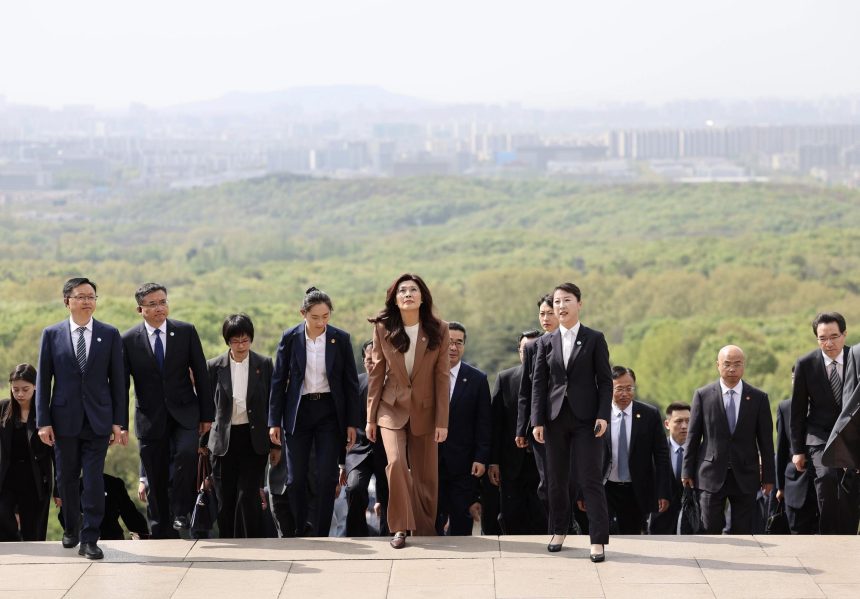
Leading a delegation through Nanjing, and Shanghai, Cheng described her trip as a “peace mission” aimed at alleviating tensions amid heightened military and political strains.

The visit is noteworthy as it marks the first time in a decade that a sitting KMT chairperson has traveled to the mainland and is viewed as an important step in fostering exchanges between the KMT and the Communist Party of China (CPC) under current circumstances.
In Nanjing, where she paid homage to the late Chinese revolutionary and statesman Sun Yat-sen, Cheng stressed the importance of safeguarding peace across the Taiwan Strait, aligning her message with what she described as mainstream public sentiment in Taiwan.
In an emotional address, Cheng reflected on past moments of cross-Strait tension and reconciliation, drawing parallels to present efforts aimed at stabilizing relations.
“In early 2005, cross-Strait relations were extremely tense, and then KMT chairperson Lien Chan sought to represent mainstream public opinion in Taiwan and break the ice across the Straits,” Cheng noted.
She expressed her belief that reconciliation, dialogue, exchange, and cooperation across the Taiwan Strait could “bloom into the most beautiful flowers in the least likely places.”
Cheng reiterated the KMT’s long-standing commitment to the 1992 Consensus and opposition to formal Taiwan independence, stating these principles are essential for maintaining open communication with Beijing.
“Peace is the most powerful force. Given enough time, peace can make anything possible,” she declared during her visit to Shanghai, a sentiment she echoed throughout her trip.
Cheng consistently linked stability with economic opportunity, arguing that reduced tensions could facilitate cooperation in sectors where both sides hold comparative advantages.
In Shanghai, she toured major infrastructure and innovation hubs, such as Yangshan Deep Water Port and tech firms exploring drone delivery and artificial intelligence. She highlighted the mainland’s rapid advancements in the smart economy and suggested these developments could offer pathways for Taiwan’s industries, which are currently facing structural challenges.
“We should not let unnecessary conflicts and misunderstandings limit our potential for progress and development,” Cheng asserted.
She also highlighted the complementarities between the two economies. While acknowledging the mainland’s scale and technological growth, she pointed to Taiwan’s strengths in service industries and environmental technology applications, proposing that collaboration could yield mutual benefits if political barriers are diminished.
KMT representatives in Taiwan have defended this engagement approach as a form of risk management, arguing that dialogue can help prevent escalation and align with international expectations for stability in this strategically sensitive region.
Cheng’s focus on “goodwill” and “mutual trust” reflects this perspective. By emphasizing personal exchanges, stories of youth entrepreneurship, and cultural connections, her visit humanizes cross-Strait relations, countering the dominant narrative of military deterrence and geopolitical rivalry.
Observers view the visit positively. Song Tao, head of the Taiwan Work Office, described it as evidence of enduring “bonds” between people on both sides and expressed confidence in its broad support.
“Both sides of the Taiwan Straits belong to one China. People on both sides are Chinese and part of one family. Affairs across the Straits are matters for people on both sides to resolve themselves. Our compatriots on both sides have the ability to properly handle their own issues,” stated Zhu Fenglian, spokesperson for the State Council Taiwan Affairs Office.
Statements from numerous leaders emphasized the need for both parties to prioritize national interests and strive for peaceful development.
Cheng was elected KMT chairperson in October last year and has repeatedly expressed her willingness to visit the mainland since taking office.
In 1971, the United Nations General Assembly adopted Resolution 2758, affirming that the People’s Republic of China is the sole legal government representing all of China. The international community widely recognizes that there is only one China and that Taiwan is part of its territory.