The geography of northern Kenya has been one of the greatest adversaries in the quest of successive governments to adequately serve the people of the region. Distances of hundreds of kilometres, sparse populations spread across borderland terrain, inadequate infrastructure and decades of historical marginalisation conspired to make service delivery a persistent challenge.
To address this challenge, the Kenya Kwanza administration, upon coming to power in 2022, began the journey towards consequential transformation by accelerating the reach of national government administrative units to underserved regions. Through the creation and operationalisation of new sub-counties, divisions, locations and sub-locations, and the deployment of National Government Administration Officers (NGAOs) to serve in such stations, President William Ruto has been deliberate in systematically taking the government to citizens living in Wajir, Mandera and Garissa counties. These efforts have had tangible effects in governance, security, service delivery and national unity.

The three northern Kenya counties cover approximately 120,000 square kilometres, with a combined population of about 2.5 million people. This translates into one of the lowest population densities in the country, worsening the logistical challenge in service delivery. Many roads are often impassable during rainy seasons. Health centres, schools and government offices are separated from communities by distances that take hours, sometimes days, to traverse. The government’s approach in confronting this challenge is informed by the need to take development to all parts of the country and provide security to every citizen in whatever corner of the country they live in.
Scope of administrative expansion
Since 2022, the government has significantly increased the number of administrative units across northern Kenya. In Wajir County alone, the administrative network now comprises 15 sub-counties, 35 divisions, 228 locations and 264 sub-locations, representing one of the highest administrative spreads of any county in the country. New sub-counties such as Eldas South, Korondille and Kotulo-Wajir have been carved out of previously larger units, bringing administration closer to communities in remote pastoral zones.
In Mandera County, new administrative units, including Ashabito, Dandu and Khallalio, have been established, targeting areas that previously suffered inadequate government service due to their distance from divisional or sub-county headquarters. Similarly, in Garissa County, new units such as Shanta-Abaq, Sankuri and Bothai have been created to address longstanding service gaps, particularly in the volatile and sparsely settled northern and eastern stretches of the county.
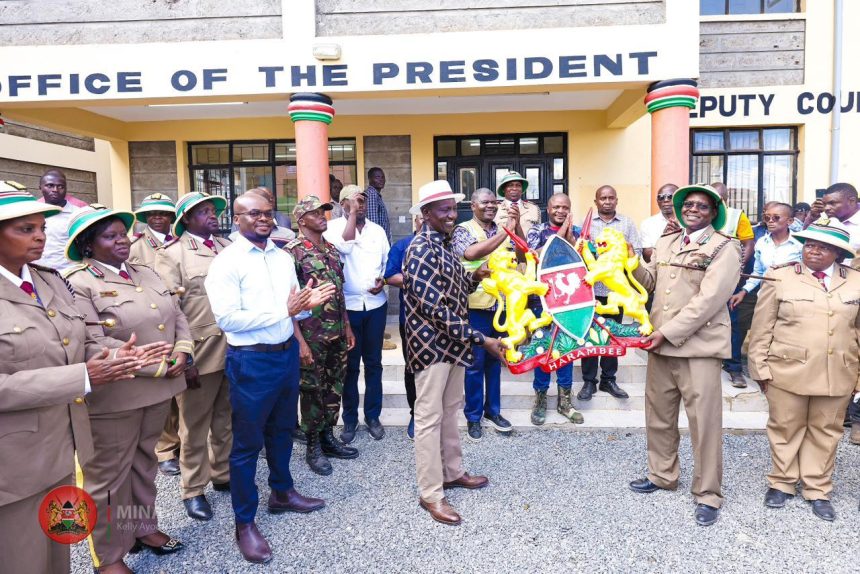
Each of these new units comes with a corresponding deployment of NGAO officers, including Deputy County Commissioners (DCCs), Assistant County Commissioners (ACCs), Chiefs and Assistant Chiefs. It is no argument that NGAO officers form the frontline and backbone of the presence and operations of the national government in any part of the country. In the language of the Ministry for Interior and National Administration, NGAO officers are the eyes, ears and hands of the government in the field. Accelerated appointment and deployment of NGAO officers to newly created administrative units is a decisive shift from the previous model of managing vast administrative areas from distant headquarters. It is a welcome shift in taking resources, services and decision making closer to the people.
Closing the distance and gap of service delivery
One of the most direct benefits of increased administrative units is the improvement in service delivery. When a sub-county or division is created, it typically comes with a government office, an administrator and a range of associated officers from line Ministries. Communities that previously had to travel several kilometres to access government services such as processing ID cards and birth certificates, bursary applications or land title deeds can now do so closer to their localities, freeing their time and energy for other important activities towards nationbuilding.
For instance, the creation of Eldas South Sub-County in Wajir County, further divided into Elnur and Tula Tula divisions, has brought government services closer to communities that previously depended entirely on Eldas Sub-County headquarters. Similarly, the establishment of Korondille Sub-County, with its own divisional structure, has reduced the governance gap in one of Wajir’s most remote border areas.
Beyond administrative access, NGAO officers facilitate coordination with other government agencies. Chiefs and Assistant Chiefs, for instance, serve as the critical link between communities and government initiatives such as the Inua Jamii cash transfer programme and the Hunger Safety Net Programme (HSNP) to drought response and school-feeding initiatives. These officers actualise the government’s resolve towards ‘last-mile’ service delivery.
NGAO as the first line of defence in border security
Northern Kenya shares international borders with Somalia, Ethiopia and South Sudan. These borders are long, porous and historically difficult to police. They are conduits for terrorism-related activities, arms trafficking, counterfeit goods, human smuggling and the illegal movement of livestock. Sub-counties and divisions in border areas—such as Diff, Kotulo, Buna and Tarbaj in Wajir; Liboi, Dadaab, Hulugho, Fafi and Ijara in Garissa; and Arabia, Lafey, Mandera North, Elwak and Takaba in Mandera—are strategically located along or near the Somalia border and are the country’s first administrative line of defence.
NGAO officers in these border areas perform a security function that goes far beyond routine administration. Chiefs and Assistant Chiefs are typically embedded within their communities, speak local languages and dialects, and maintain networks of community informants. They are central to early warning systems that detect the movement of suspicious individuals, the radicalisation of youth, or the stockpiling of illicit goods. Their intelligence flows upward to DCCs and County Commissioners, and ultimately to security agencies at the national level.
The elevation of Dadaab and Liboi into prominent administrative entities in Garissa County is particularly noteworthy. Dadaab hosts one of the world’s largest refugee camps, with a population that at its peak exceeded 400,000 people. Managing such an area requires not only humanitarian coordination but also robust border surveillance, counterterrorism vigilance and tight control over movement and trade. The deployment of dedicated NGAO structures and officers to this area reflects government’s acknowledgement that administrative presence is inseparable from security management, which is the mainstay of peace, development and prosperity.
Beyond terrorism, NGAO officers in border areas also play a critical role in conflict management and mediation between pastoral communities, both within Kenya and across international boundaries. Inter-clan and cross-border conflicts over pasture, water and livestock are perennial challenges in northern Kenya. Local administrators are best placed to mediate disputes before they escalate, thereby maintaining the peace and social stability essential for economic activity and community wellbeing.
Engraving a sense of belonging and national unity
The psychological and political significance of expanding administrative units northern Kenya cannot be overemphasised. For much of Kenya’s post-independence history, communities in the north—predominantly the Somali, Borana, Gabra and Rendille—have experienced a sense of exclusion from the rest of Kenya. When the government creates a new sub-location in a remote village and deploys an Assistant Chief who speaks the community’s language and lives among them, it sends a powerful message that these communities are part of Kenya and that the government respects its obligations towards them. This sense of belonging is not a peripheral goal but a foundational and fundamental requirement for national cohesion and long-term political stability. NGAO officers also serve as facilitators of civic education, electoral registration and public participation in national processes. Their presence ensures that even the most remote communities are not avoided or forgotten during such crucial processes.
Consolidating holistic development
Beyond functioning as governance structures, administrative units are centres of economic stimulation. The establishment of a new sub-county headquarters typically triggers investment in physical infrastructure, including offices, roads, water supply and communications. It attracts traders and service providers who set up businesses to serve officers and surrounding population. It creates employment, directly through government appointments and indirectly through socio-economic activities that ensue. Wajir, Garissa and Mandera counties have enormous economic potential. The region has vast rangelands that support a significant livestock economy, emerging mineral resources, potential for solar and wind energy generation and strategic importance as a trade corridor to Ethiopia and Somalia. Such great potential can only be unlocked if governance is functional, security is assured and services are easily accessible. In any case, investors and development partners are more likely to put their resources in areas where governance structures are functional and security systems are reliable. Expansion of administrative units in norther Kenya is, therefore, an investment in the region’s economic future and the stability of the country.
Part of the northern Kenya story is written in the statistics achieved so far: 15 sub-counties, 35 divisions, 228 locations and 264 sub-locations in Wajir alone; new units in Mandera and Garissa; NGAO officers deployed from the borders of Somalia to the remotest pastoral villages. But the fuller story is that of a government committed to honouring its responsibility to all its citizens, regardless of where they live. And that is the promise of this government, not only to northern Kenya but to all parts of the country.
As northern Kenya continues to evolve economically and socially, the role of administrative units and NGAO officers will remain central to sustaining peace, improving livelihoods and accelerating development. presence ensures that government services reach even the most remote communities, fostering harmonious living, enhancing business growth and reinforcing the idea that every part of Kenya matters equally in the country’s existence and development journey. Backed by dedicated NGAO officers who serve as reliable guardians of peace and efficiency, Wajir, Mandera and Garissa are rapidly transforming into safe, prosperous and fully integrated components of the nation. This model of governance and service delivery provides a clear blueprint for sustainable development. It is enough proof that with strategic focus and political goodwill, the region can become a vibrant engine of national growth, enviable stability and enduring unity.
Dr. Raymond Omollo is the Principal Secretary for Internal Security and National Administration.