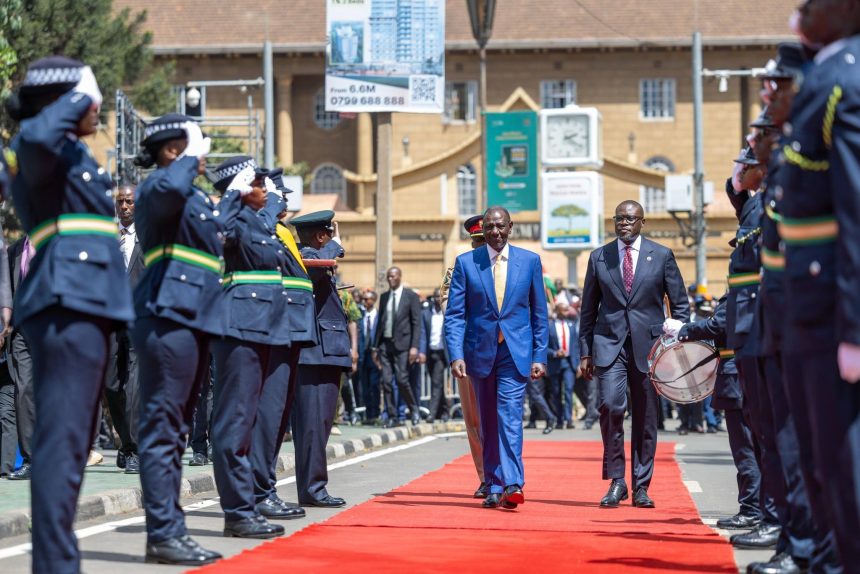
President William Ruto has issued a stern warning to cartels and others who profit from chaos in Nairobi, declaring that his administration will no longer tolerate systems that benefit a select few at the expense of the majority.
Addressing a special session of the Nairobi County Assembly, President Ruto outlined the city’s pressing challenges, including inadequate water supply, poor sanitation, congestion, and environmental degradation.

“More than 60% of residents live in informal settlements. Access to piped water remains inadequate and unreliable. Sanitation and sewerage systems remain under severe strain. Mobility is constrained by congestion and insufficient transport infrastructure,” he stated.
The President emphasized that these issues are interrelated, representing a city that “has, for too long, been managed reactively rather than strategically.”
He pointed out the social and economic consequences of ongoing dysfunction, noting that “spatial inequality, unemployment, and exclusion continue to fuel insecurity and vulnerability in parts of the city.”
“There are people who benefit from disruptions in Nairobi city. There are cartels who profit from disorder. There are interests that thrive in illegal connections, illegal dumping, illegal occupation, illegal constructions and broken systems.” Ruto said, referring to persons who exploit systemic weaknesses.
He continued, “There are those who profit from weak enforcement, poor coordination, and institutional paralysis. They shout loudest against reform because they benefit most from failure. We know them. Under this administration, the era of appeasing cartels at public expense ends.”
President Ruto linked the crackdown on city dysfunction to his broader efforts against cartels, referencing past interventions in the sugar industry.
“You remember an occasion where I said ‘Mambo Ni Matatu.’ It was about the sugar cartels. Today you can ask the people in Western Kenya, sugarcane that used to be paid in one year, they are now paid in a week. Workers working in sugar companies that used to be paid by government are now paid by factories every month. That is what confronting cartels gives us.” he told the County Assembly.
While outlining his reform agenda for Nairobi, the President made it clear that tough decisions lie ahead.
“If roads must be expanded, they will be expanded. If encroachments must be removed, they will be removed. If drainage channels must be cleared, they will be cleared. If illegal structures must come down, they will come down. If systems must be reorganised to restore order, they will be reorganised. We must stop pretending otherwise,” he said
Ruto stressed the importance of public support for city reforms, stating that if leadership is unwilling to endure the temporary inconveniences required to fix the city, they should stop pretending they are serious about change.
“Progress has a cost. Reform has a cost. Order has a cost,” he asserted, receiving applause from the MCAs.
According to the President, the world’s great cities did not achieve their status by accident; they became great because their leaders prioritized discipline over disorder, long-term planning over short-term politics, and public interest over private convenience.
President Ruto’s address to the County Assembly was the first of its kind since Kenya adopted its current system of governance.