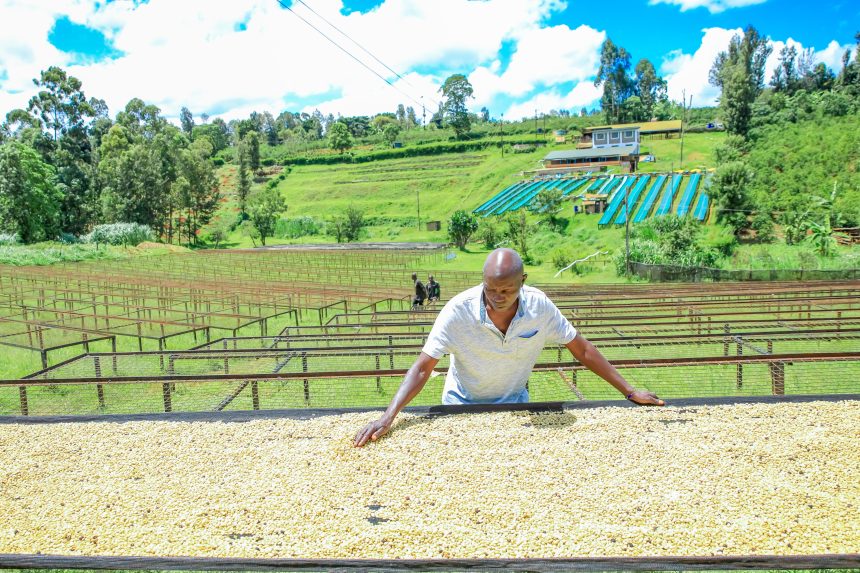
Coffee farmers in Kirinyaga County are celebrating a historic windfall after earnings hit a record Ksh 7.4 billion, marking one of the highest coffee payouts ever recorded in the county.
The latest payments ranged between Sh 104 and Ksh 157.40 per kilogram of cherry, with an impressive average of Ksh 139 per kilogram, underscoring a strong resurgence in the sector driven by sustained reforms and targeted county government support.

The standout performers were led by Thirikwa Farmers’ Cooperative Society, which posted the highest average payout at Ksh 157.15 per kilogram, followed closely by Rung’eto Farmers’ Cooperative Society at Ksh 155.62, and Rwama Farmers’ Cooperative Society at Ksh 152.03, reflecting improved quality and efficiency across key cooperatives.
Out of the Ksh 7.4 billion payout received by cooperatives for the sale of the coffee, farmers received Ksh 6.99 billion for their deliveries while the rest of money was used to clear factory operation costs.
Coffee production also increased from 45,717 metric tons in 2024/2025 to 49,100 metric tons in 2025/2026.
The latest payout figures position Kirinyaga among the top-performing coffee regions in the country, with factories affiliated to Baragwi Coffee Cooperative Society and Rung’eto Farmers’ Cooperative Society dominating the highest returns. Nyanja Factory under Baragwi emerged among the best payers at Ksh 157.40 per kilogram, closely followed by Kiangoi Factory (Ksh 156.30), Kii Factory (Ksh 155.62) and Karimikui Factory (Ksh 155.50), all under Rung’eto, while Guama Factory also posted a strong Ksh 151.30 per kilogram.
In a statement, Governor Anne Waiguru said Kirinyaga had once again emerged among the top coffee earners in the country as lauded farmers for their efforts to increased quantity and quality of coffee production.
“Kirinyaga has done it again. Our farmers are once more leading the country with the highest coffee payouts, a clear reflection of quality, strong cooperatives and deliberate support from the county government,” she said.
The governor added that sustained support to farmers and ongoing reforms in management structures were beginning to yield tangible results, positioning the sector for even greater growth.
Waiguru noted that the county government has rolled out a series of interventions including subsidized high-quality seedlings and fertilizer, strengthened extension services, continuous farmer training and installation of modern solar dryers at factory level.
It has also supported the construction of a coffee warehouse for the union dry mill and enhanced market access through the Kirinyaga Slopes Coffee Brokerage Company.
Chairman of Baragwi Coffee Cooperative Society, Francis Muriithi, said the payouts marked a steady improvement from previous seasons, noting that the average rate had risen from about Ksh 134 last year to approximately Ksh 139 this season.
“This is a clear improvement compared to last year. Our average has increased by about Ksh 5 per kilogram, which is a significant gain for farmers,” he said.
Muriithi attributed the growth to improved coffee quality and stronger support systems, explaining that farmers had benefited from timely access to inputs, training and streamlined licensing processes.
“The county government has played a big role in improving quality, supporting farmers and strengthening the entire value chain,” he added.
While welcoming the progress, he called on the national government to consider waiving farmers’ debts to boost net earnings, revealing that the society processed about 13 million kilograms of cherry this season, translating to a payout of nearly Ksh 1.8 billion.
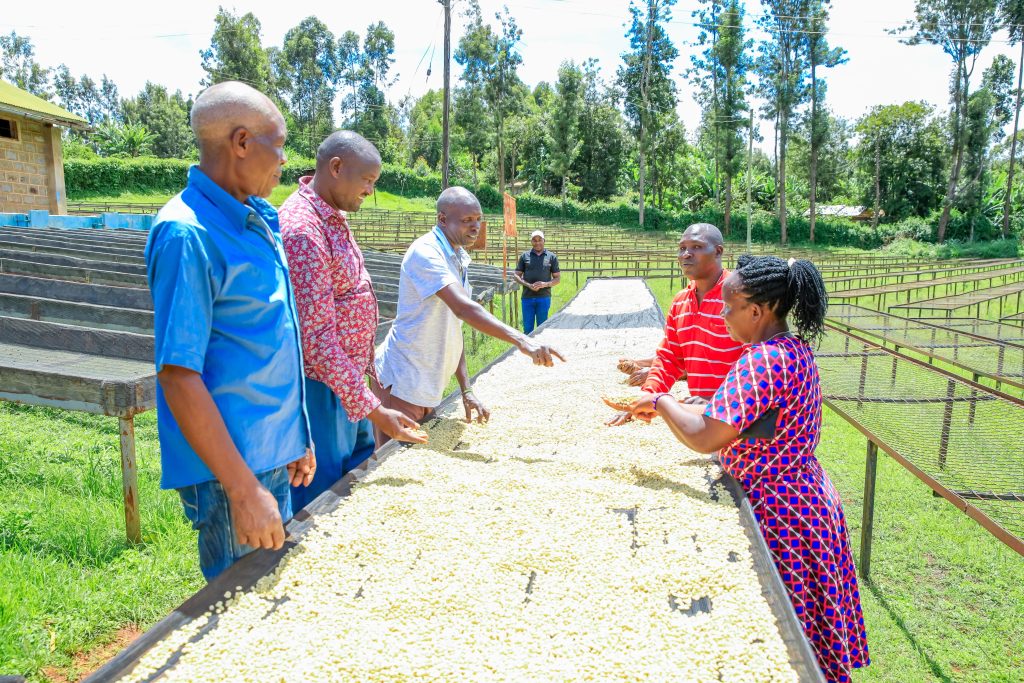
At the grassroots, farmers say the impact of the reforms is increasingly evident. Francis Gachoki, a farmer at Kagongo Factory under Baragwi Coffee Cooperative Society, said earnings had improved compared to last season, noting that his payout rose from Ksh 128 to Ksh 135 per kilogram which he termed as motivation to him and the other farmers.
Gachoki attributed the improvement to reforms in cooperative management and better market access, saying the changes had helped stabilize the sector. He further noted that investments in infrastructure, including improved rural roads, had eased transportation of produce, while the revival of processing systems had enhanced efficiency.
At Nyanja Factory, farmer Julius Muriuki said county-led initiatives such as soil testing, timely distribution of fertilizer and farmer education had significantly improved coffee production in the area. He noted that farmers were now better equipped with knowledge on crop management, contributing to higher quality beans and improved payouts.
At Thirikwa Farmers’ Cooperative Society, Chairman David Njomo said farmers were encouraged by the strong returns recorded this season, noting that the society produced about 1.566 million kilograms of cherry.
“This season has been very rewarding for our farmers. We have about 1.566 million kilograms of cherry, translating to over Ksh 200 million at an average rate of around Ksh 157 per kilogram,” he said.
Njomo attributed the performance to sustained support from the county government, mentioning that interventions such as subsidized fertilizer, provision of drying beds and investment in processing infrastructure had significantly boosted both productivity and quality.
A farmer at the society, Emily Wanjiku, also cited timely access to farm inputs and improved storage facilities as having enhanced farm management, noting that the current payouts had renewed farmers’ confidence.
“We are receiving inputs at the right time and have better storage, which has made our work easier. The payments this year have really motivated us to invest more in coffee farming,” she said.
Across the county, most cooperative societies have announced their payments, with the lowest rate standing at Ksh 104 per kilogram with farmers now optimistic that sustained reforms, improved management and favorable market conditions could push future payouts beyond Ksh 200 per kilogram, further strengthening household incomes and cementing Kirinyaga’s position as a leading coffee producer.