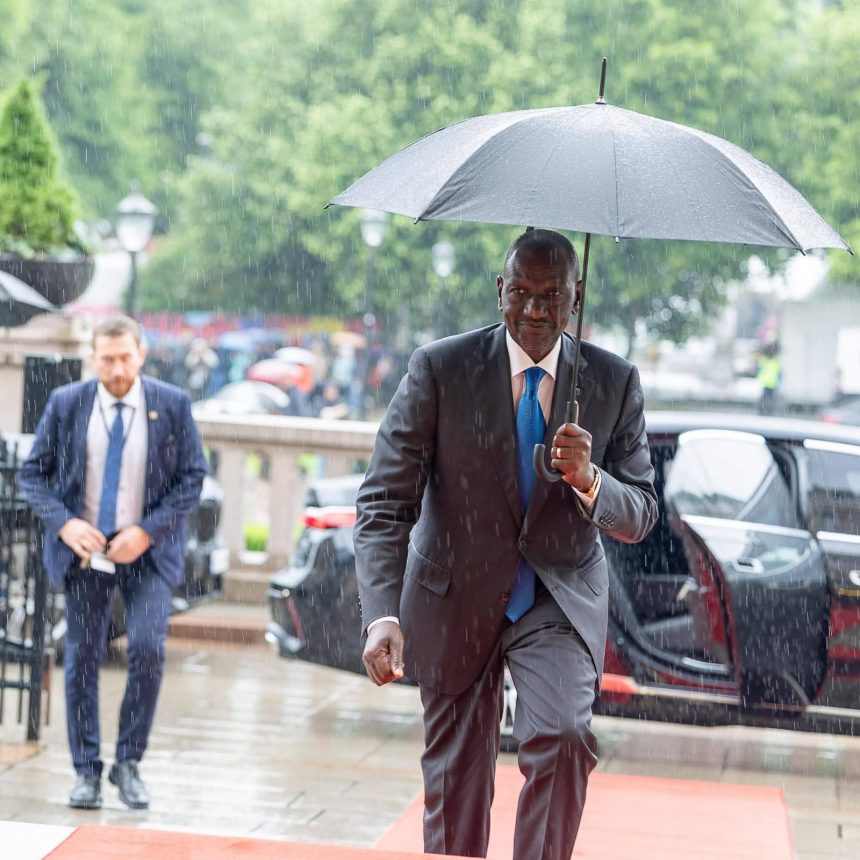
In just six weeks President William Ruto has switched on a robust mode for Kenya’s foreign policy, touching down for State Visits in Dar es Salaam, Astana, Pretoria and Helsinki and returning with more than 17 bilateral agreements and a louder voice in the push to reform global institutions.
The tour, which ended with a State Visit to Finland on Thursday, has been Ruto’s most rigorous stretch of diplomacy since taking office. One of the consistent messages he has amplified in each capital is that Africa is no longer content to wait at the margins, and Kenya intends to be at the forefront of this renaissance.

The State Visits began in Tanzania on May 4, which was Ruto’s first State Visit to Dar es Salaam since 2022. One of the highlights of the visit was his address to Tanzania’s parliament, an opportunity he used to push for deeper infrastructure integration.
The Dar visit yielded eight agreements, including a cooperation on railways, maritime and seafarer certification, agriculture, legal cooperation and standards harmonisation.
Both sides committed to eliminate remaining non-tariff barriers, a strategic plan aimed at bolstering bilateral trade which hit $860.3 million in 2025, nearly 40 percent of intra-EAC commerce. Ruto said bureaucratic friction had cost the two countries almost $100 million in lost trade over the previous year.
Three weeks later Ruto became the first Kenyan president to make a State Visit to Kazakhstan. In Astana he told President Kassym-Jomart Tokayev he had come “with a clear message” – economic diversification.
Kazakhstan’s $286 billion economy offers a new market for Kenyan horticulture and processed foods, and a gateway to Eurasia. The two countries signed deals covering ICT and e-government, agriculture, transport, finance, tourism, climate, mining and space technology. Tokayev conferred on Ruto the Order of Dostyk, First Degree, one of Kazakhstan’s highest honours for foreign leaders.
Pretoria carried the heaviest continental symbolism. Meeting President Cyril Ramaphosa, Ruto framed Kenya and South Africa as the engines of Africa’s transformation and argued that the continent “must move beyond being a spectator in international affairs and instead become an architect of global solutions.”
Ramaphosa and Ruto oversaw six agreements on trade facilitation, shipping and maritime cooperation, gender equality, TVET skills, arts and heritage, and sports.
Bilateral trade between Nairobi and Johannesburg rose from $590 million in 2024 to $650 million in 2025, and both leaders committed to making the African Continental Free Trade Area work in practice to unlock the continent’s potential.
Plans for a Kenya–South Africa Business Council aim to correct a long-standing imbalance that has favoured South African manufacturers over Kenyan exports.
Ruto’s State Visits closed in Helsinki, where Kenya and Finland signed three memoranda on education, digitalisation and environmental cooperation.
The digital MoU leans on Kenya’s fintech with M-Pesa was cited as a major breakthrough, and supports ambitions to expand digital public services, secure connectivity and innovation ecosystems. A healthcare framework covering universal coverage, maternal and child health, mental health and local vaccine manufacturing is also in the works.
Ruto and Stubb aligned on UN reform and agreed to accelerate implementation of the Kenya–EU Economic Partnership Agreement.
Across the four stops Ruto was relentless in pressing for a paradigm shift in the configuration of the post-Second World War architecture of the UN, IMF and World Bank. As currently crafted, he said these institutions no longer reflects today’s world, and Africa must help write the new rules.
The President told the Oslo Forum that reform is no longer about fairness alone but effectiveness and legitimacy. The message found echoes in Stubb, a long-time advocate of transforming global governance. Ramaphosa too is on board the train in pushing for changes in these global institution as well as the African Union reforms.
So what do Kenyans stand to gain from these marathon of visits?
The economic promises are massive if the agreements are translated into reality. If Tanzania honours the pledge to remove non-tariff barriers, bilateral trade could cross $1 billion, easing complaints from Kenyan manufacturers and farmers.
Kazakhstan can open a new corridor for exports into a $286 billion market via a stronger connection with Astania, which is strategically located in Central Asia. The South Africa business council and maritime pact align with Kenya’s blue-economy ambitions and the complementarity of Mombasa and Durban. The Finland deals target the digital and green transition, upgrading skills, scaling innovation and deepening ties with the EU.
In almost all the agreements signed, Kenya stood out as a premier investment destination on account of its strategic location as the gateway as well as financial and innovation hub in the region.
Additionally, these agreements are bound to expand markets for Kenyan goods, opening immense opportunities for farmers, innovators and traders and youths who can take advantage of labour mobility agreements.
The writer is a Nairobi-based commentator on current affairs.