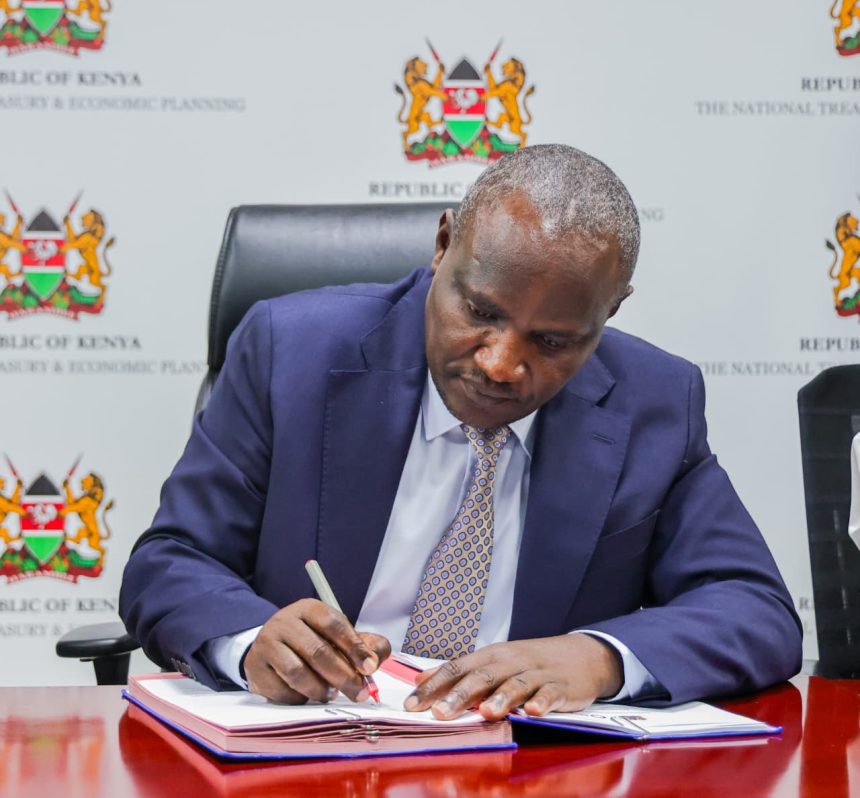
National Treasury and Economic Planning Cabinet Secretary John Mbadi has ruled out any additional tax cuts on fuel in the current financial year as pressure to reduce pump prices mount.
Speaking during an exclusive interview with KBC Channel 1, Mbadi said with less than two months left before the close of the current financial year, any further tax cuts on the petroleum products will lead to unsustainable revenue loss.

“We must be prepared that if there is any other additional action, we are going take any other action and which can only be to remove some levies or cut taxes on petroleum products which is a temporary measure in my view. But the effect is going to be dire because we are in the month of May,” said Mbadi.
This comes as calls to reduce fuel prices intensify across the country, triggered by initial price adjustments announced by the Energy and Petroleum Regulatory Authority (EPRA) on Thursday last week where diesel and kerosene were increased by Ksh 46.29 and Ksh 16.65 per litre respectively.
“We only have June left so the budget has largely been implemented. What has not been implemented is the salary for June and the transfer for counties for June. What are we going to reduce, are we going to reduce transfer to counties or salaries to civil servants?” added Mbadi.
In a bid to cool rising pump prices, the government announced the reduction of Value Added Tax on petroleum products from 16pc 8pc. The government has also utilized the Petroleum Development Levy Fund to bring down prices.
According to Mbadi with the current financial year ending in June, the government has limited options to reduce taxes on the commodity as Kenya has exhausted its budget. However, treasury is lining up another Ksh 5 billion in the next cycle to stabilize prices.
“In the first month of April when the effects of this crisis hit first we subsidized fuel by about Ksh 6.2 billion. Now we have subsidized by Ksh 5 billion and we have another Ksh 5 billion going to the month of June because you could not exhaust it and we don’t know when this war will end,” Mbadi noted.
The increase in fuel prices triggered protest from transport sector stakeholders on Monday as negotiations hit deadlock.
The protests saw the government cede some ground as EPRA announced new prices where diesel was reduced by Ksh 10.06 per litre and kerosene went up by Ksh 38.06 per litre.
The new adjustment now mean until June 14, maximum pump prices allowed in Nairobi will be Ksh 214.25 per litre of super petrol, Ksh 232.86 per litre of diesel and Ksh 191.38 per litre of kerosene.
In the earlier adjustment, a litre of diesel retailed at Ksh 242.92 while kerosene was Ksh 152.78 per litre.
Mbadi further said the government has not intentions to exit the government-to-government oil supply deal with three state oil marketers from Middle East amid the war which has disrupted energy flow in the Strait of Hormuz.
“Government-to-government deal has guaranteed us the price that we negotiated several months ago which is much lower than the current prices of freight, insurance and premium. If you go to our neighbouring countries, they are paying $250 per metric tonne. In Kenya we are paying between $78-97 per metric tonne. So it is ill advised to even imagine that we can abandon G-to-G,” he stated.
He warned that the exit of the deal could also trigger depreciation of the shilling which has been stable due to limited forex demand.