Prime Cabinet Secretary and Cabinet Secretary for Foreign and Diaspora Affairs Musalia Mudavadi has called for a renewed commitment to multi-lateralism, deeper Africa-Korea cooperation, and greater Global South solidarity as Kenya seeks to strengthen its influence in an increasingly fragmented world order.
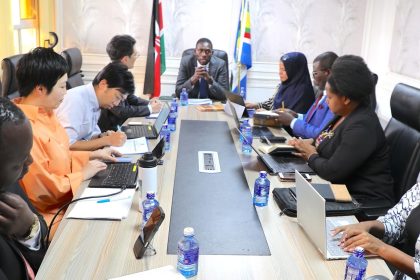
Speaking at Sungkyunkwan University in Seoul, South Korea, under the invitation of the University President Ji-Beom Yoo and the Dean of the faculty of Political Science Dr. Wonbin Cho, on Tuesday, Mudavadi outlined Kenya’s foreign policy vision under the theme, “From Regional Anchor to Global Influence: Kenya’s Strategic Foreign Policy Outlook in an Evolving World Order.”

He argued that growing geopolitical tensions, economic uncertainty, and weakening international cooperation require African nations to rethink their diplomatic and economic strategies.
Mudavadi warned that the global order is facing significant strain, citing the resurgence of unilateralism, increasing use of sanctions, trade disputes, and the growing militarization of international relations.
“We still confront the hard realities of an increasingly volatile global landscape with far-reaching implications for the global economic and security architecture,” he said.
“Multi-lateralism is under strain as unilateralism resurges, alongside the weaponization of tariffs and the expansion of sanctions regimes,” added the Prime CS.
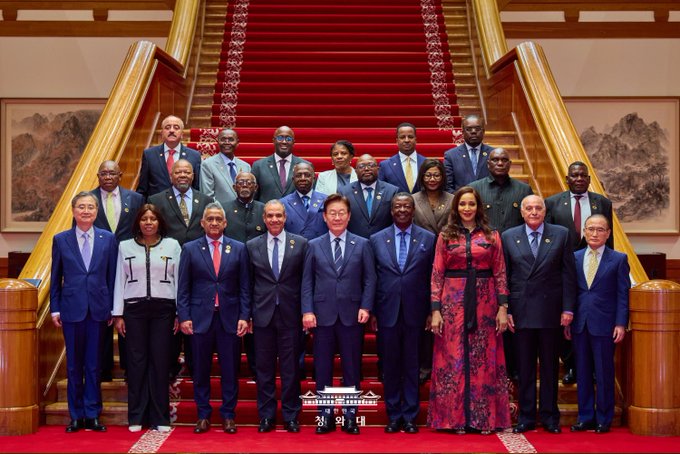
Mudavadi who is in South Korea for the Korea-Africa Ministers Meeting, expressed concern that diplomacy is increasingly being replaced by transactional approaches to international relations.
“Diplomacy is increasingly being treated as a transaction and sovereignty as a negotiable property,” he said, adding that the rules-based international trading system and development assistance mechanisms face mounting challenges.
Drawing parallels between current global tensions and challenges experienced during the tenure of former United Nations Secretary-General Ban Ki-moon, Mudavadi said conflicts, climate change, humanitarian crises, and unequal development continue to threaten global stability.
He pointed to major international crises, including the lingering effects of the COVID-19 pandemic, the ongoing Russia-Ukraine war, and the Middle East conflict involving the United States, Israel, and Iran, saying they have had severe economic consequences for African countries.
“These shocks have compounded economic hardships in Africa, underscoring the need for deeper integration, diversified partnerships and enhanced investment in science, technology and innovation,” he said.
Mudavadi also highlighted the humanitarian crisis in Sudan and South Sudan, noting that millions have been displaced and children forced out of school due to conflict and climate-related shocks.
Against this backdrop, he urged African nations to seize emerging opportunities by strengthening regional integration and reducing dependence on foreign aid.
“African states are charting a forward-looking and people-centred approach driven by diversification in cooperation, trade and investment, rather than aid dependency,” he said.
The minister emphasized the importance of the African Continental Free Trade Area (AfCFTA), describing it as a critical platform for expanding intra-African trade, boosting manufacturing, and increasing value addition to the continent’s natural resources.
“African Continental Free Trade Area offers African countries a unique platform to build regional value chains across diverse sectors, including agri-food and pharmaceuticals,” he said.
Mudavadi also called for reforms within global institutions, particularly the United Nations, ahead of the election of the next UN Secretary-General later this year.
“Africa’s position is that multi-lateralism must be reformed and strengthened, not abandoned,” he said.
“The election can be a make-or-break moment for multi-lateralism,” he paused.
He urged the next UN chief to champion science, technology, and equitable development for developing countries, quoting former Secretary-General Kofi Annan’s assertion that national prosperity depends on the ability to harness knowledge and innovation.
Turning to Kenya’s bilateral ties with South Korea, Mudavadi praised the growing partnership between the two countries, particularly in technology, education, health research, and industrial development.
He noted that South Korea has been a major partner in the development of Konza Technopolis and the establishment of the Kenya Advanced Institute of Science and Technology (Kenya-AIST), which is modeled after Korea’s prestigious KAIST institution.
“The Korean government remains Kenya’s leading partner in technology and the digital economy,” he said.
Mudavadi described Kenya as Africa’s “Silicon Savannah,” citing the country’s advances in digital innovation, fintech, and telecommunications, including the success of the mobile money platform M-Pesa.
He further highlighted Kenya’s strategic location as a gateway to East and Central Africa, providing access to more than 1.5 billion consumers under the AfCFTA framework.
The Prime Cabinet Secretary also showcased Nairobi’s growing significance as a diplomatic and financial hub, noting that the city hosts the United Nations Office at Nairobi, UNEP, UN-Habitat, and regional offices of major international financial institutions.
“In a world where diplomacy is increasingly reduced to transactional exchanges, peace treated as a private enterprise and nations locked in the ‘Dignity Trap,’ Kenya chooses a different path,” Mudavadi said.
“We choose partnership over patronage; principle over opportunism; dialogue over use of force.”.he added.
He concluded by inviting South Korean scholars, investors, and citizens to deepen engagement with Kenya through trade, tourism, education, and cultural exchanges.
“Visit Kenya. Invest in Kenya. Learn with Kenya,” he said. “When Africa and Korea rise together, the world does not merely become safer. It becomes prosperous.”