The Kenya National Public Health Institute (KNPHI) has heightened its emergency preparedness and response efforts through a week-long Integrated Rapid Response Team (RRT) training programme in Trans Nzoia County.
The training was aimed at strengthening county-level capacity to prevent, detect and respond to Ebola Virus Disease (EVD) outbreaks.

The training also concurrently underway in Turkana County courtesy of the support of the U.S. Department of State-funded Strengthening Infectious Disease Detection Systems (STRIDES) forms part of a broader national preparedness initiative targeting high-risk counties across the country to enhance readiness against potential Ebola threats.
The programme brings together a multidisciplinary team of epidemiologists, clinicians, laboratory personnel, logisticians, risk communication specialists and psychosocial support experts.
It seeks to build and sustain a pool of highly skilled Rapid Response Team members capable of effectively detecting, investigating and responding to EVD alerts and outbreaks.
Key objectives of the training include updating participants on the ongoing Ebola outbreak situation in the region, enhancing knowledge and skills on Ebola preparedness and response, strengthening early detection and surveillance systems, improving screening and timely reporting of suspected cases, and building capacity for active case finding, contact tracing and safe case management.
The initiative also focuses on strengthening Infection Prevention and Control (IPC) measures, coordination mechanisms and community engagement strategies to prevent the importation and local transmission of Ebola cases.
Part of the training featured sessions on the epidemiology and history of Ebola Virus Disease, modes of transmission, clinical presentation, treatment and prevention measures.
Participants were also taken through surveillance at Points of Entry (PoE), the composition and functions of Rapid Response Teams, pre-deployment preparedness requirements, outbreak investigation and response, active case finding, and contact tracing.
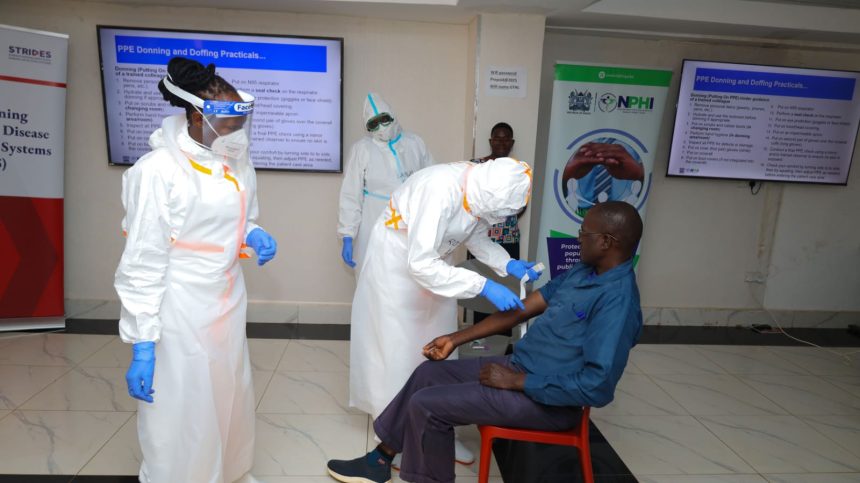
To ensure frontline healthcare workers are fully prepared for emergency deployment, the training incorporates intensive practical simulation exercises.
These include step-by-step demonstrations on the safe donning and doffing of Personal Protective Equipment (PPE), simulated patient triage, blood sample collection, waste management, safe and dignified burial procedures, isolation unit operations, and the transportation of suspected Ebola cases.
Speaking during the training, Trans Nzoia County CEC for Health and Sanitation, Christopher Kerio Lorot affirmed unwavering commitment by county leadership led by Governor George Natembeya to enhance local workforce capacity involving targeted investments in localized training, rapid response team deployment, and the establishment of sustainable resource networks.
The County Director of Health on his part, Dr. Babu Kisiangani, commended KNPHI’s leadership under Acting Director General Dr. Kamene Kimenye for spearheading a proactive preparedness campaign that aligns with global best practices in epidemic control.
He noted that the approach reflects a strategic shift championed by the World Health Organization (WHO), Africa CDC and other international partners, placing local communities at the centre of disease prevention and response efforts.
The strategy emphasizes localized contact tracing, decentralized treatment services, safe burial practices and behaviour-focused community engagement to curb disease transmission.
Trans Nzoia County has been classified by the Ministry of Health as a very high-risk county for Ebola Virus Disease due to its proximity to Uganda and the high volume of cross-border movement.
Although Kenya remains free of Ebola, authorities have stepped up surveillance and preparedness measures nationwide to guard against possible importation of the disease.
The current preparedness efforts come amid ongoing regional concerns following outbreaks of Ebola disease caused by the Bundibugyo virus strain in Uganda and the Democratic Republic of the Congo.
The World Health Organization, after consultations with affected States Parties, determined that the outbreak constitutes a Public Health Emergency of International Concern (PHEIC), underscoring the need for enhanced preparedness and vigilance across the region.
KNPHI has reaffirmed its commitment to supporting counties in strengthening public health emergency preparedness and ensuring rapid, coordinated responses to emerging disease threats in line with its mandate to consolidate and coordinate key activities in public health, including prevention, early detection of public health emergencies, and events of Public Health concern.