Agriculture and Livestock Development Cabinet Secretary Mutahi Kagwe has called on African nations to confront what he described as the unfair global practice of tariff escalation, where developed markets allow raw agricultural commodities to enter at low or zero duty but impose significantly higher tariffs on the same products once they are processed.
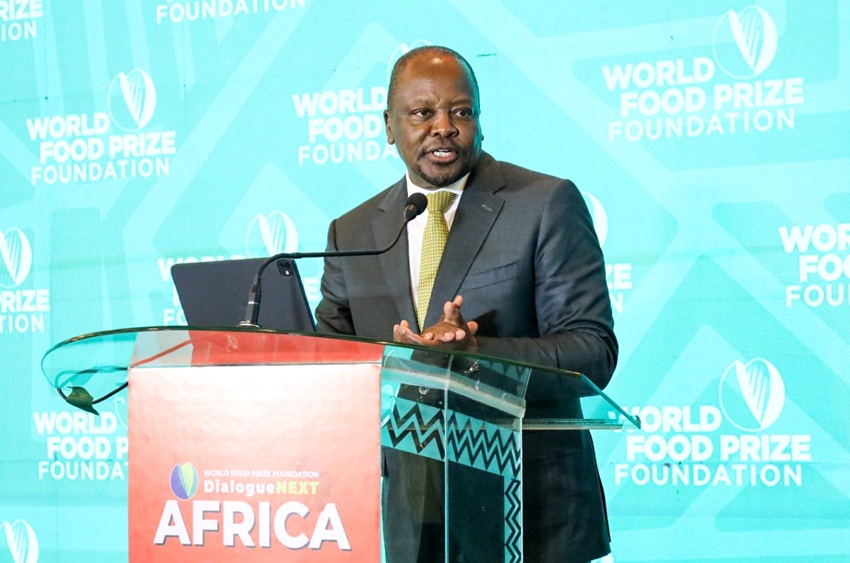
Speaking during the DialogueNext Forum convened by the World Food Prize Foundation, CS Kagwe told global agricultural leaders that the practice discourages industrialisation in producing countries, locks farmers into exporting cheap raw materials and shifts manufacturing jobs, wealth and investment to foreign economies.

“It is difficult to explain to an African farmer why it is acceptable to export raw coffee but prohibitively expensive to export roasted coffee,”CS Kagwe said.
The Cabinet Secretary argued that tariff escalation has for decades prevented Africa from climbing the global value chain, forcing countries that produce coffee, tea, cocoa, macadamia, cotton and hides to remain suppliers of raw materials while importing finished products manufactured from their own commodities at much higher prices.
He urged African countries to adopt policies that encourage local processing before export, saying Kenya’s ban on raw in-shell macadamia exports demonstrates the direction the continent should take.
According to CS Kagwe, the same value-addition philosophy should increasingly guide coffee and tea so that processing, branding and packaging are undertaken where the crops are grown.
“Every stage of processing completed within Africa creates jobs, increases farmers’ incomes and strengthens rural economies,” he said.
CS Kagwe argued that value addition is ultimately about creating opportunities for the next generation.
“The son and daughter of the farmer should find employment in coffee roasting plants, tea packaging factories, macadamia processing industries, food manufacturing, logistics and agricultural technology—not feel compelled to abandon farming communities in search of jobs elsewhere.”
He also criticised policies that tax agro-processing machinery and mechanisation equipment while governments simultaneously claim to support agricultural transformation.
“We cannot claim to support value addition while taxing the machinery needed to establish agro-processing industries. We cannot encourage mechanisation while making agricultural equipment prohibitively expensive,” he said, warning that such contradictions undermine subsidies and discourage investment.
The Cabinet Secretary further called for a new financing model for agriculture, saying banks and development finance institutions must move away from rigid commercial lending and adopt financing tailored to farming cycles through flexible repayments, grace periods, weather-indexed insurance and long-term affordable credit.
He maintained that reforming global trade, expanding local value addition, removing barriers to agro-industrial investment and improving agricultural finance are essential if farming is to become profitable enough to attract young people.
“If we truly believe in equitable global development, international trade rules must reward value addition—not punish it,” CS Kagwe said.
The World Food Prize Foundation’s DialogueNext Forum is being held in Nairobi under the theme “Born to Feed the Future.”
The high-level forum brought together agriculture ministers, policymakers, scientists, researchers, development partners, private sector leaders and farmer organisations from across Africa and beyond to deliberate on the future of food systems, agricultural innovation, trade and farmer prosperity.
Among those in attendance were Madagascar’s Minister of Livestock Riana Nantenaina Randrianomenjanahary, Senegal’s Minister Delegate in charge of Livestock Ousmane Diagne, and Dr. Akinwumi Adesina, the 2017 World Food Prize Laureate and member of the World Food Prize Foundation Council of Advisors, alongside representatives from international agricultural and development institutions