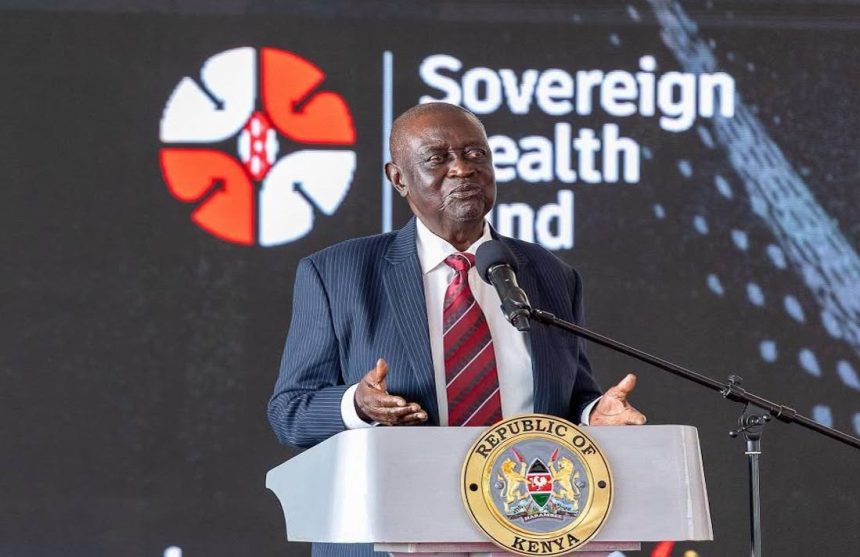
The Orange Democratic Movement leader Oburu Oginga has endorsed President William Ruto’s reform agenda, describing the newly enacted Sovereign Wealth Fund as a transformative initiative. He believes the fund will enable Kenya to finance its own development and reduce reliance on external funding.
Speaking at State House, Nairobi, during the presidential assent to the Sovereign Wealth Fund legislation, Oburu stated that the new law marks a crucial shift in the country’s development strategy by establishing a mechanism to invest national wealth for the benefit of future generations.

“The idea of establishing a sovereign wealth fund is a very progressive idea,” he remarked, citing Botswana as an example, highlighting its model of investing proceeds from natural resources through such a fund.
He noted that, rather than leaving national wealth dormant, Botswana has invested its fund in viable domestic and international projects, an approach that has allowed the country to finance development without depending on external lenders.
The ODM leader said the country should embrace a similar path by mobilising domestic resources to drive economic growth.
“We can use the sovereign wealth fund to develop our own country instead of going to foreign capitals to seek assistance. No country is obliged to develop another. Development is our responsibility alone, and partnerships should be built on sovereignty, equality, and mutual respect, not dependence or entitlement,” he said.
Oburu described the Sovereign Wealth Fund as part of President Ruto’s broader reform package, arguing that his administration has demonstrated the courage to pursue policies whose long-term benefits outweigh short-term political considerations.
“This idea is very transformative, just like the other ideas we have been trying around with, like the Affordable Housing Programme,” he stated, observing that previous administrations had struggled to implement similar reforms despite recognising their importance.
He also defended the Government’s health sector reforms, suggesting that criticism of the Social Health Authority (SHA) often overlooks the overarching objective of achieving universal healthcare.
“I think people who are criticising the Social Health Authority don’t go into details and don’t know exactly what is happening. It’s a very, very big transformation towards what we have been calling universal healthcare,” he explained.
According to Oburu, successive governments had attempted to establish a comprehensive universal healthcare system but made limited progress compared to the current reforms.
“Many governments have tried to introduce universal healthcare. There is no other move which is nearer to universal healthcare in this country than SHA. More than 30 million Kenyans have now registered for SHA,” he said.
Oburu observed that vested interests have historically hindered major development programmes by pressuring governments to abandon reforms that threaten established economic interests.
“We have tried to move, but private interests around want to benefit at the expense of the country. They always put pressure on government not to move,” he said.
While clarifying that he was not advocating authoritarianism, Oburu argued that excessive resistance to reform can impede national progress.
“Sometimes, there is too much democracy; there should be some little, benevolent dictatorship, so that some things can move,” he remarked.
The ODM leader defended President Ruto’s willingness to pursue difficult policy decisions, stating that history often vindicates leaders who prioritise national interests over immediate political popularity.
“Being bold and sometimes unpopular is not bad. It’s good. Being popular does not necessarily help the people. Sometimes you introduce things which appear unpopular, but people will soon realise that some of these moves by President Ruto are very, very helpful to our country,” he said.
Oburu also challenged Kenya to make better use of locally generated policy ideas, noting that many transformative proposals developed by Kenyan experts have remained unimplemented for years. He observed that while other countries have successfully adopted innovative ideas, Kenya has often allowed its own policy proposals to remain dormant.
“I’m very happy, Your Excellency, that you are now trying to remove some of them from the shelves and push them forward so that our country can develop,” he said.