Prime Cabinet Secretary Musalia Mudavadi has called on Kenyans to protect the nation’s democracy, electoral process, and constitutional order in the run-up to the August 2027 General Election.
Mudavadi emphasised that political leaders and citizens must respect electoral institutions, particularly the Independent Electoral and Boundaries Commission (IEBC), to safeguard peace and national unity both before and after the polls.

“We need to respect all our institutions, including the IEBC, especially as we approach the next general elections. When we protect our institutions, we strengthen our democracy, adhere to the rule of law, and unite the country,” he stated.
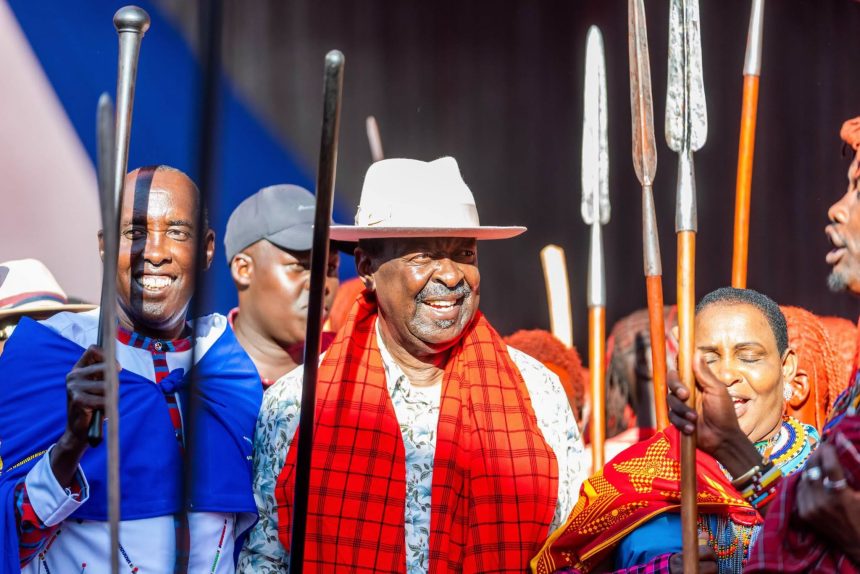
Mudavadi made these remarks on Saturday during the 10th Memorial Service for the late Maasai political leader William Ole Ntimama at Motonyi in Narok County.
He urged all political stakeholders to work towards a peaceful, free, and fair election, stressing that the electoral process should be conducted without interference or undue pressure.
At the same time, Mudavadi rallied the Maasai community behind President William Ruto, asserting that the broad-based government was striving for a decisive victory for the President in 2027.
He encouraged the community to protect its vote and actively participate in shaping the next government.
“President Ruto’s victory should be respected and not doubted. This is what we are working on. We want our petition-free victory to move Kenya forward as a united nation and one people,” Mudavadi said.
He challenged the Maasai community to ensure their vote is respected and counted, highlighting that electoral participation would be critical for advancing their interests.
“Kura yenu mtu asifikiri ni ya kuwindwa kama swara. Your vote is not for hunting. It must be respected, similar to the vote from other communities, for it to be meaningful and have value for the future of your community and region,” he explained.
Mudavadi also urged voters to elect leaders who would promote development and improve the lives of their communities.
The Prime Cabinet Secretary used the memorial service to underscore Ole Ntimama’s contributions to advancing Maasai land rights, recognising minorities, and promoting education.
He described Ntimama as an unwavering advocate for his community, who championed Maasai land rights and greater recognition for minority and pastoralist communities in national affairs.
“Ntimama was, without apology, a voice for his people. He fought for Maasai land rights, for recognition of minority and pastoralist communities in national conversations that too often left them out, and for a Kenya where being Maasai was not a disadvantage,” Mudavadi stated.
He added that Ntimama also viewed education as a crucial tool for empowering the Maasai community and fostering equality.
Mudavadi challenged the youth to build on Ntimama’s legacy by moving beyond the protection of community land towards economic value addition.
“Ntimama alitilia mkazo haki ya ardhi hasa kupigana na sheria zilizokuwa za mkoloni kuhusu haki na umiliki wa ardhi. For the youth, I challenge you to begin thinking about value addition. Protecting was phase one, now phase two is value addition,” he elaborated.
He urged Kenya and Africa to strengthen their participation in global value chains by focusing not only on protecting resources but also on creating greater economic value from them.
Mudavadi also launched Ntimama’s autobiography, which chronicles his journey from his early years and teaching career to his service as a government administrator, farmer, Member of Parliament, and Cabinet Minister under Presidents Daniel arap Moi and Mwai Kibaki.
He said Ntimama remains an important historical figure whose advocacy was driven by a desire to see his community participate equally in national affairs.
“He was not always a comfortable voice. He said hard things, and said them loudly. But history has been kinder to his intentions than some of his critics were in the moment. He wanted his community to stand at the table as equals, not to be spoken about, but to speak,” Mudavadi affirmed.