Planting a tree should not mark the end of an exercise but the beginning of a long-term responsibility to nurture, track, and protect it to maturity, ecopreneur Dr Isaac Kalua Green has said.
Dr Green asserts that Kenya must shift from celebrating the sheer number of trees planted to establishing how many survive, their specific locations, and whether they receive the care required to reach maturity.

Speaking during ‘Plant Your Age Day’, an annual event observed on 14 September, Dr Green challenged individuals, institutions, and governments to revisit the sites where they have planted trees and ascertain their fate.
“My own journey in environmental conservation has taught me that our responsibility does not end when the last tree is planted. Planting is, in fact, only the beginning,” he stated.
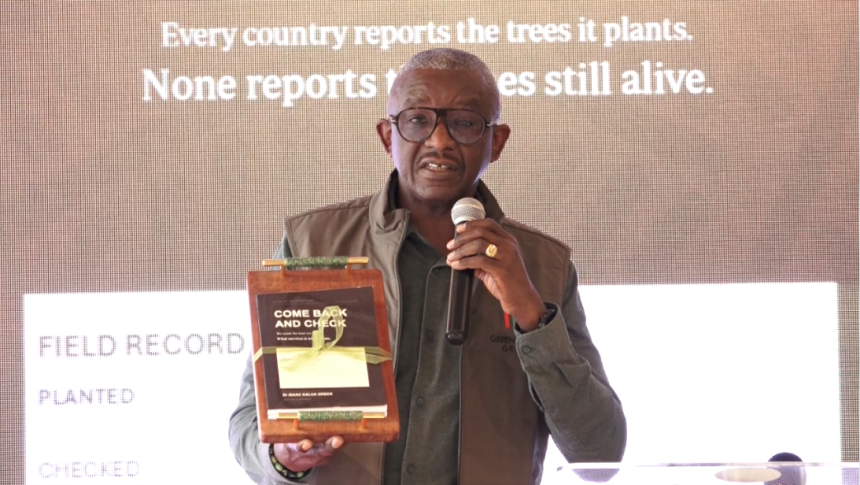
The message forms the basis of Dr Green’s new book, Come Back and Check, which chronicles his 50-year journey in environmental conservation and his efforts to track trees planted over the years.
He says 1.2 billion trees planted since 2011 have been recorded, with 981 million surviving trees currently traceable. His central message is summed up in the title of his new book: “Come back and check.”
“I have presented the 981 million trees, and I have placed it in a book. I want to be accountable to the world. ‘Come back and check.’ Do you go back to check your tree?” Dr Green queried.
He emphasised that the ability to trace these trees offers an opportunity to shift the conversation from planting targets to measurable environmental outcomes.
“I have visited institutions in this country where extensive tree planting was undertaken, yet when you go back, there is no accountability. If Kenyans understood the worth of trees, we would be very far,” he lamented.
Dr Green also linked tree tracking to the emerging carbon market, arguing that those who have invested time and resources in planting trees should ultimately be able to demonstrate the environmental value of their work.
“The people who have done those plantings have not earned. They keep asking, where is the carbon trading for these trees?” he noted.
To enhance accountability, the Green Africa Foundation has launched the Plant Your Age App, designed to enable individuals to record the trees they plant and monitor their progress.
The application provides information on when trees should be watered and pruned, as well as survival ratings and other data intended to help users track their trees as they grow.
Dr Green urged Kenyans to personalise the trees they plant by giving them names and taking direct responsibility for their survival.
He believes this initiative should help prevent resources from being wasted on trees that are planted but subsequently neglected, while also allowing communities to realise the environmental and economic benefits of mature trees.
The push for accountability also extends to the broader question of whether Kenya can accurately demonstrate the results of its ambitious tree-growing programmes.
Baraka Moruri, a 13-year-old environmentalist and Plant Your Age ambassador, challenged Kenyans to move beyond planting and actively care for the trees. Similarly, Hillary Kibiwott, ambassador for the Government’s 15 Billion Trees Campaign, called for greater attention to nurturing trees already planted.
Kibiwott, who holds the world record for the most trees planted in a single day, stated that he has focused on planting indigenous trees in areas requiring reforestation as part of his contribution to the national campaign.
Green Africa Foundation Executive Director John Kioli similarly urged Kenyans to plant and protect trees, highlighting the environmental benefits they provide, including oxygen.
For Dr Green, however, accountability remains the central issue.
“I have walked a lonely journey. The purpose of us being in the office today is to invite you so that you can walk with me,” he said.
He said the Plant Your Age App is not a mechanism for direct financial gain from trees but a tool for creating a credible record that could support future opportunities, including carbon-related benefits.
“We want to be open, and we want to be clear and set something that the world will be able to tell and understand,” he explained.
Dr Green said the broader objective is to cultivate a culture in which planting a tree comes with a continuing obligation to monitor its survival and protect it until it becomes an established environmental asset.
ENDS…