The international financial architecture has failed the welfare of the world’s children, President William Ruto has said.
The President regretted that public debt, as a result of an unfair global financial system, becomes a children’s rights issue when interest payments crowd out investment in classrooms, healthcare, nutrition and social protection.

He said fiscal responsibility must protect the foundations of future prosperity, arguing that developing countries face high borrowing costs and lack affordable long-term financing.
Debt vulnerability, President Ruto pointed out, is worsened by climate shocks, economic disruption and external crises.
“I have consistently argued that the global financial system must become fairer, more responsive and more inclusive,” the President stated.
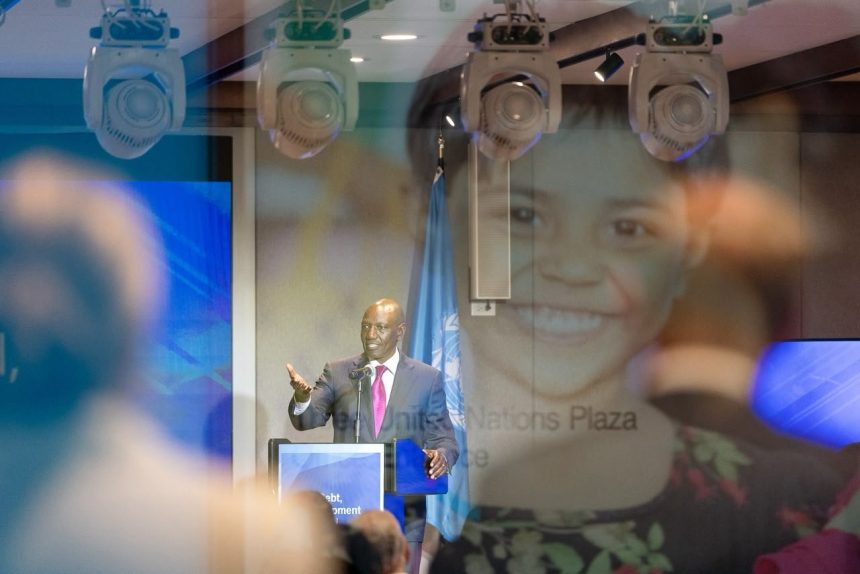
He made the remarks at the High-Level Dialogue – From Debt Service to Child Investment hosted by the United Nations Children’s Fund (UNICEF) on the sidelines of UN General Assembly in New York on Tuesday.
He said “real reform” gives every country an equal chance to finance growth, create jobs and build a resilient future, adding that it is a shared responsibility grounded in fairness and mutual prosperity.
“Budget discipline is necessary. But debt sustainability is also a moral responsibility. We must measure national solvency not only by balance sheets, but also by the health, safety and education of the next generation,” he said.
Additionally, President Ruto emphasised that no country should be compelled to trade its children’s future for the demands of the past.
He regretted that Kenya and many developing nations face a silent emergency, pointing out that rising debt service is squeezing the budgets that pay for health, education, nutrition and social protection.
“When budgets tighten, children pay the price first,” he said.
Saying global public debt reached $102 trillion in 2024, the President said developing countries paid an estimated $921 billion in net interest.
“In 46 developing countries, interest payments now exceed spending on health or education. These are not mere statistics. They are fewer classrooms. Fewer health workers. Fewer opportunities for millions of children,” he said.
The President explained that sovereign debt is no longer a line on a balance sheet,saying it is a development roadblock.
“The squeeze starts in the treasury. It lands in the classroom, the clinic and the nutrition programme,” he said.
He made it clear that Kenya will remain fiscally responsible, adding that the country will honour its obligations, and protect macroeconomic stability and budget discipline.
“No economy is sustainable if it undermines the very people who must run it in future,” he said.
Consequently, President Ruto noted, Kenya continues to invest in education, healthcare, nutrition, social protection, digital inclusion and opportunities for young people.
“These are vital investments in our future. Every investment in a child’s health, education, skills and protection returns as stronger economies, greater resilience and shared prosperity,” he pointed out.
For a child-responsive approach to debt and development finance, the President proposed that children be placed at the centre of debt sustainability.
“Do not ask only whether a country can pay its creditors. Ask whether it can still educate its children, run its health systems, feed its families and protect the vulnerable,” he said.
He called for ringfencing of essential social spending during fiscal adjustment and expansion of affordable, predictable and concessional financing and scaling up innovative financial instruments, including debt swaps for education, health, nutrition and climate resilience.
Additionally, the President called on the need to turn obligations into measurable investments in people and to build debt restructuring that is fair, timely and effective.
Likewise, President Ruto emphasised the need to strengthen public finance systems so that money meant for children reaches them on time.
“Governments, development banks, UNICEF and other partners should work together on child budget tagging, expenditure tracking and monitoring,” he said.
Meanwhile, President Ruto addressed the High-Level Reflection on the Pact for the Future, convened by Namibia, Zambia, the African Union and the Economic Commission for Africa.
Two years ago, the President explained, world leaders adopted the Pact for the Future, a global commitment to deliver a more inclusive and sustainable future.
“Africa helped shape that agreement. Now, its promises must translate into results,” he pointed out.
The President also chaired the meeting of the Committee of African Heads of State and Government on Climate Change.
As climate impacts intensify, President Ruto said Africa must turn climate action into investment, jobs, stronger economies and greater resilience.
“The greatest constraint remains finance. We need commitments on adaptation to be honoured, alongside affordable capital, guarantees and risk-sharing, instruments that can unlock investment in renewable energy, green industry and climate-resilient infrastructure,” he said.
President Ruto later co-hosted with Norway the first high-level event on clean cooking in Africa ahead of the Second Africa Clean Cooking Summit in Nairobi in January 2027.
He pointed out that clean cooking is crucial to public health and provides many economic opportunities to Africa’s green transition.
“We must mobilise capital through local-currency financing, guarantees and other instruments that turn demand into viable projects,” he said.
The President explained that Kenya has taken the lead with a $600 million investment opportunity across schools, healthcare facilities and correctional institutions.
Earlier, President Ruto held talks with Presidents John Mahama of Ghana, Joseph Nyuma Boakai of Liberia and Julius Maada Bio of Sierra Leone, and Pakistan Prime Minister Mian Muhammad Shehbaz Sharif, among others.