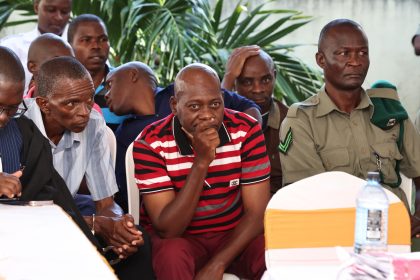
Inspector General of Police Douglas Kanja has assured residents of Moyale and the wider Marsabit County of enhanced security following escalating violence in neighbouring Moyale, Ethiopia, which has forced thousands of people to flee across the border into Kenya.
Speaking during a security assessment visit to Moyale, Kanja said the government had deployed security teams to the border area to monitor the situation, prevent criminal activities and protect residents from the spillover effects of the conflict.

He said fighting, which erupted on October 22, 2026,had resulted in daily gunfire, forcing thousands of Ethiopians nationals to seek refuge in Kenya, with some integrating into local communities while others were accommodated in schools and other public institutions.
Kanja disclosed that approximately displaced people were still living in temporary shelters and public institutions around Moyale, while humanitarian agencies continued providing emergency assistance.
He said a Kenyan had died after being struck by a stray bullet, while a woman from Ethiopia had also lost her life. Several other people had sustained injuries and were receiving treatment in various medical facilities in Kenya.
The police chief said the government was working closely with Ethiopia authorities to ensure the conflict was resolved and displaced families could safely return to their homes.
“One life has been lost on the Kenyan side after a woman was hit by a stray bullet on the neck. We have also recorded injuries arising from stray bullets. The best way to address this situation is to ensure the conflict is resolved quickly,” he said.
Kanja noted that the fighting had disrupted cross-border trade, leaving traders stranded and affecting the movement of goods and services between the two countries.
He further cited electricity shortages in Moyale, saying the area relied heavily on electricity supplied from Ethiopian, which had been disrupted by the ongoing conflict.
He assured residents that the security agencies were working around the clock to safeguard communities and called on residents to remain calm and cooperate with security officers.
The Inspector General commended the Moyale Sub-County Security Committee for its response since the outbreak of conflict, saying its collaboration with the county and regional security teams had helped maintain stability.
He was accompanied by Director of the DCI, Mr. Mohammed Amin, the Commandant of the General Service Unit, Mr. Johanna Tunoi, SAIG;and the Director of Operations,KPS,Mr. Philip Opiyo,SAIG, Eastern Regional Commissioner Jacob Ouma Muganda, Marsabit County Commissioner Stanley Kamande and other national security officials.
Kanja also called on humanitarian organisations to extend assistance beyond displaced people living in temporary camps to those hosted by local families, noting that many host households were struggling to meet their own basic needs.
He particularly urged development partners to provide additional food, water, shelter and medical supplies to vulnerable families hosting refugees.
“Some of these people hosted by local communities do not even have enough food and water. We must ensure that assistance reaches not only those in holding facilities but also those integrated into the host communities,” he said.
Kenya Red Cross representative Malik Adan said humanitarian agencies had mobilized resources to respond to the growing displacement crisis, working alongside the county and national government, UNHCR, IOM, other United Nations agencies, PACIDA, SND and other organisations.
Adan said local elders and the county government were among the first responders when the conflict erupted, helping coordinate the initial response as displaced families began crossing into Kenya.
He said the initial number of affected people, including those in camps and host communities, stood at approximately 36,000 but had since risen to more than 50,000 as the fighting continued.
According to Adan, the most urgent needs include food, shelters and medical assistance, particularly for vulnerable groups such as lactating mothers, children under five and elderly people.
He said the number of temporary settlements had continued to increase as existing facilities became overwhelmed by the growing population of displaced people.
The largest camp, he noted, was at OMC, with other settlements emerging around Moyale including the Odda area.
Adan appealed to the government to strengthen security around the camps, saying the increasing population required sustained protection and coordinated humanitarian intervention.
He commended the Inspector General’s visit, saying it demonstrated the government’s commitment to addressing the challenges facing displaced communities.
Moyale Township MCA Mohamed Issack Ibrahim said the situation in Moyale remained worrying, citing the security threats posed by stray bullets and the growing humanitarian burden on local communities.
He said residents were facing food insecurity as families hosting displaced Ethiopians continued sharing their limited food supplies with those fleeing the violence.
Ibrahim observed that most humanitarian interventions were concentrated in camps and learning institutions, leaving many displaced people hosted by relatives and friends without adequate assistance.
He appealed to humanitarian agencies and the government to broaden their support to include families hosting displaced persons in their homes.
He said these households were increasingly vulnerable and needed urgent assistance to avoid further deterioration of their living conditions.
Moyale Cross-Border committee Vice Chairman Mohamed Guyo said residents on the Kenyan side were bearing the consequences of the conflict through insecurity, disrupted businesses and displacement.
Guyo noted that the extensive and porous Kenyan-Ethiopian border made it difficult for security agencies to monitor every section effectively.
He said stray bullets had landed in residential areas, forcing some Kenyan families living close to the border to abandon their homes for safer locations.
He added that business activities had been severely affected, with communities on both sides of the border suffering economic losses.
Guyo said the peace committee, working closely with the Moyale Sub-County Security Committee and local elders, had intensified community sensitization to prevent the conflict from spilling over into Kenya.
He called for peaceful coexistence, noting that the communities involved in the fighting across the border also had relatives and close social ties on the Kenyan side.
He urged residents to resist any attempts to import the conflict into Kenya and called for assistance to all families affected by the violence, regardless of which side of the border they originated from.
Eastern regional commissioner Jacob Ouma Muganda commended the security teams, elders, humanitarian organisations and development partners for their coordinated response since displaced Ethiopians began arriving in Moyale.
Muganda said although the conflict was taking place in Ethiopia, Kenya had found itself at the centre of a humanitarian situation requiring urgent intervention.
He praised the Moyale Sub-County Security committee for maintaining security and supporting the affected communities while acknowledging the contribution of local elders in promoting peaceful coexistence.
He urged all humanitarian partners to operate under the established multi-agency coordination framework, warning against uncoordinated interventions that could create gaps in service delivery.
He said the Red Cross had an important coordinated role in ensuring that humanitarian assistance reached all those in need without duplication or exclusion.
Muganda called on all stakeholders to maintain a united front, saying cooperation between government agencies, humanitarian organisations and local communities remained critical in managing the crisis.
The leaders expressed optimism that ongoing diplomatic engagement between Kenya and Ethiopia would help restore peace, reopen the border and allow displaced families to return home once security conditions improved.