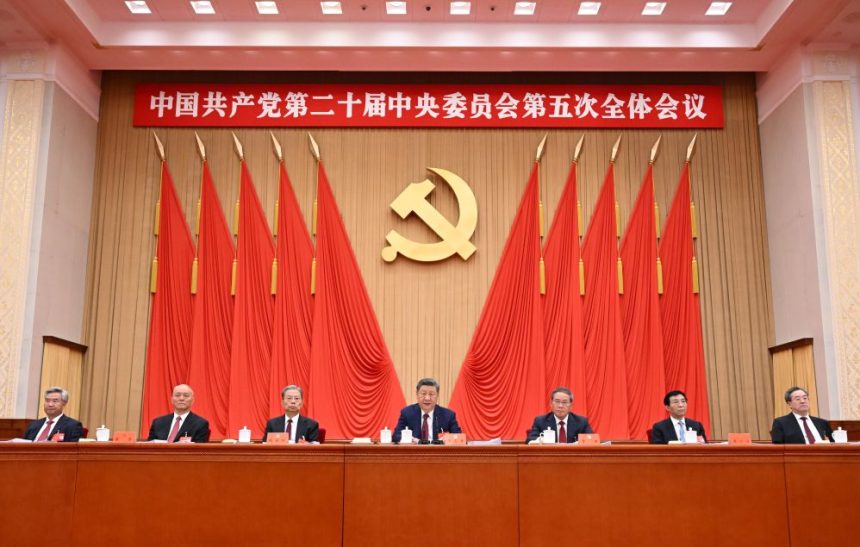
The Communist Party of China (CPC) has committed to a tougher crackdown in its fight against corruption, tightening oversight of its members and reinforcing internal discipline, in a renewed drive that aims to ensure accountability across all levels of the party.
The latest commitment is contained in a resolution adopted at the fifth plenary session of the 20th CPC Central Committee last month and made public on 1 November. It outlines an integrated approach combining stricter punishment, institutional reforms, ethical education, and preventive measures.

Titled the “Resolution of the Central Committee of the Communist Party of China on Certain Major Issues Concerning Persevering with Full and Rigorous Party Self-Governance,” the document identifies corruption as a serious threat to the party’s integrity and public confidence.
Section VII, which calls for firm and coordinated action against corruption, states that the party’s approach will be guided by the principle that officials should lack the boldness, opportunity, and desire to engage in corrupt practices.
“The Party tolerates no corruption, as it has no special interests of its own besides the interests of the working class and the greatest possible majority of the people,” the resolution declares.
The party affirmed its tough stance against corruption, acknowledging the complexity of the fight and the significant challenges in eliminating the conditions that allow corrupt practices to take root.
A central feature of the strategy, according to the document, is the commitment by the party to investigate and punish offenders regardless of their positions, reinforcing the message that seniority and political influence will not shield individuals from accountability.
The resolution commits the party to continuing its campaign to “take out tigers,” “swat flies,” and “hunt down foxes,” referring to the pursuit of high-ranking officials, lower-level corrupt officials, and fugitives seeking to evade justice, respectively.
The resolution confirms that particular attention will be directed at sectors where power, public funds, and resources are concentrated. Investigations will target collusion between government officials and businesspeople, political interference by capital, and corruption involving senior officials.
The party has also identified young officials, senior leaders, and the families and staff of leading officials as areas requiring closer scrutiny.
The measures signal an effort to extend internal discipline beyond ordinary party membership, ensuring that those in influential positions are also subject to rigorous oversight.
The resolution further recognises the increasing sophistication of corruption, necessitating investigators to adapt to emerging methods of concealing illicit wealth and abusing public office.
It identifies practices such as receiving financial benefits after leaving office, holding assets through third parties, using intermediaries known as “white gloves” to conceal illicit transactions, and maintaining business relationships with former officials through so-called “revolving doors.”
Corruption involving the internet, virtual currencies, blockchain technology, and cross-border financial transactions will also face intensified scrutiny.
Beyond its internal structures, the CPC intends to address misconduct that directly affects ordinary people, particularly in areas such as employment, social security, housing, education, healthcare, and agriculture.
“We will punish both bribe takers and givers, investigate and deal with bribe offering in accordance with Party regulations and discipline and the law, take joint punitive actions against key bribe givers, and guard against and crack down on attempts to tempt officials into corruption,” the committee stated
The resolution calls for tougher action against officials who divert public funds, manipulate beneficiary lists, make fraudulent claims, or exploit citizens through extortion and other abuses.
It also commits the party to strengthening international cooperation in pursuing fugitives, preventing their escape, and recovering stolen assets.
Another major component of the resolution concerns the exercise of public power, with the CPC seeking to strengthen systems that regulate how officials make decisions and discharge their responsibilities.
It calls for clearly defined powers, transparent procedures, and traceable records for official decisions, while introducing stronger checks on areas vulnerable to abuse.
Policy formulation, government procurement and approval processes, regulation, law enforcement, and the administration of justice are among the areas identified for closer supervision.
The party also plans to expand systems for recording and reporting attempts by senior officials to interfere in judicial activities or influence the handling of specific cases.
However, the CPC’s strategy extends beyond investigations and punishment, placing considerable emphasis on shaping the conduct and values of party members before wrongdoing occurs.
The resolution proposes a stronger culture of integrity through political education, ethical guidance, and stricter personal discipline, urging officials to examine their conduct and resist corruption even when not under supervision.
It calls on party members to maintain self-respect, conduct regular self-examination, and observe discipline even when handling seemingly minor matters.
Leading officials are also expected to set an example by maintaining clean relationships with businesses and ensuring that their family members and staff do not use their positions to pursue personal interests.
The party further intends to integrate integrity education into the national education system and use examples of exemplary conduct alongside disciplinary cases to promote ethical behaviour and deter violations.
To close loopholes that allow corruption to persist, the CPC plans to strengthen coordination between disciplinary inspection bodies and other institutions responsible for supervision and enforcement.
The resolution proposes a system in which investigations are followed by institutional reforms to address weaknesses exposed by major corruption cases. It also calls for greater use of digital systems and big data to monitor the exercise of public power and identify emerging corruption risks.
Through these measures, the CPC seeks to establish a more comprehensive system in which prevention, detection, punishment, and institutional correction reinforce one another.
The broader objective, according to the resolution, is to sustain full and rigorous party self-governance by ensuring that discipline is not only enforced when violations occur but also embedded in the conduct, values, and daily responsibilities of party officials.