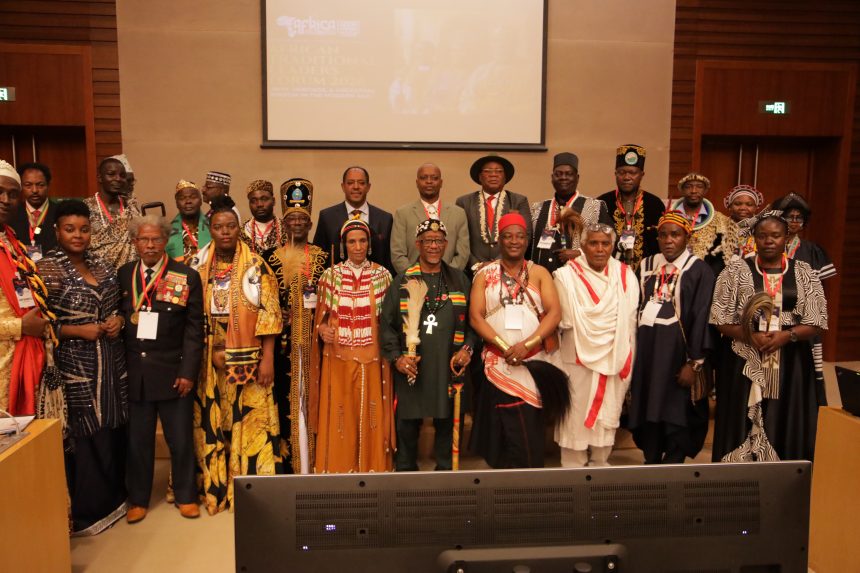
Traditional rulers from more than 46 African countries and the African diaspora have taken a historic step towards institutionalising indigenous leadership across the continent after unanimously adopting the Addis Ababa Declaration establishing the African Traditional Leaders Council (ATLC).
The landmark decision was reached on Thursday at the African Union Headquarters during the African Traditional Leaders Forum 2026, where kings, chiefs and other traditional leaders endorsed the creation of a continent-wide platform to champion indigenous governance, peacebuilding, cultural preservation and sustainable development.

The declaration was adopted by acclamation after deliberations under Thematic Area Four: Traditional Governance, Indigenous Economies and Sustainable Development.
The session opened with a keynote address by His Eminence Dr Eberechukwu Oji, Eze Aro IX of Nigeria, who presented the proposed Addis Ababa Declaration before delegates debated and endorsed it.
The discussions were moderated by His Royal Highness Chief Kyalo Muli I, leader of the Anzauni Clan of Kenya’s Akamba community and Party Leader of the National Liberal Party, alongside a panel comprising Kgosi Fredrick Mogane of South Africa, Prince Ajinga Justin Tanyi of Cameroon, Gen. Brigadier Wallace Williams, representing the African diaspora, and eSwatini Minister S’Khumbuzo Dlamini.
Following the presentations and debate, Chief Kyalo Muli put the proposal to the assembly.
“Those in favour of the formation of the African Traditional Leaders Council, say AYE,” he called.
The packed hall responded with a resounding “AYE”, prompting the moderator to declare: “The AYES have it. The AYES have it. By acclamation, we have adopted the formation of the African Traditional Leaders Council. History is made.”
There was no dissenting voice.
The declaration establishes the ATLC as an independent, voluntary and non-partisan continental platform bringing together natural and traditional rulers and representatives of indigenous institutions across Africa.
It states that the Council will complement, rather than replace, constitutionally established governments and will respect the sovereignty of African states, constitutional order, the rule of law, human rights, democratic governance, gender equality and the equal dignity of all people.
The Council will focus on promoting peacebuilding, conflict prevention, mediation, reconciliation, cultural heritage, indigenous economic development, reparatory justice and the implementation of the African Union’s Agenda 2063.
Among its first resolutions is the establishment of an African Traditional Leaders Working Group on Reparatory Justice, which will engage the African Union Commission and its relevant institutions, including the African Union Commission on Reparations (AUCER), on the continent’s reparations agenda.
Delegates also approved the formation of a 15-member Charter Drafting Committee tasked with preparing the Council’s Constitution or Charter within 90 days.
The committee will consist of five members drawn from the Thematic Area Four panel, including its moderator, and ten additional representatives, with two members each from North, West, Central, East and Southern Africa.
Once adopted, the Charter will be submitted to the African Union Commission with a request for observer status or another appropriate consultative relationship under AU procedures.
Earlier, Chief Kyalo Muli challenged African traditional leaders to move beyond preserving history and become active participants in shaping the continent’s future.
“Colonialism destroyed our institutions and, worst of all, created boundaries and walls that separated our families,” he said.
“But despite all that, we are still here. We are still serving our people. We are still surviving. But we need to do more than survive.”
The declaration was subsequently signed by the traditional rulers and representatives attending the forum, formally marking the birth of the African Traditional Leaders Council.