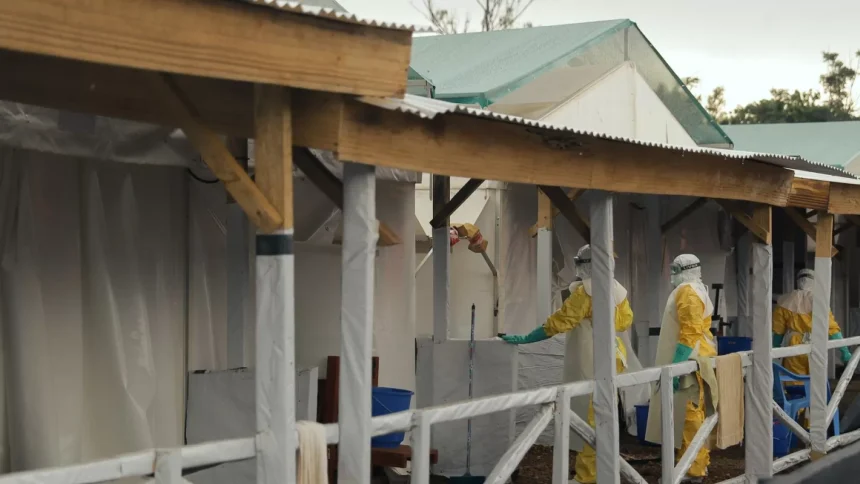
The World Health Organization (WHO) is calling for an immediate halt to hostilities in the Democratic Republic of the Congo (DRC), warning that insecurity threatens gains made in fighting the Ebola outbreak caused by the Bundibugyo virus.
In a statement Sunday, the organization regretted that attacks and threats against response teams were disrupting lifesaving operations, while ongoing conflict, displacement and movement restrictions continued to complicate response efforts.

WHO cited a recent armed attack in the Cantine-Aloya locality that resulted in 66 civilian deaths, including three health workers.
“A halt in hostilities is urgently needed to protect communities and health workers, and to safeguard the progress made over the past six months,” it appealed.
The organization reported that three health facilities had been looted, more than 1,000 contacts had been lost to follow-up, while three confirmed cases remained unaccounted for.
“Insecurity remains one of the greatest obstacles to the response. A second attack on the town was reported early on November 11. There have been over 80 attacks on healthcare since the outbreak was declared,” WHO said.
Meanwhile, since the start of the outbreak six months ago, more than 11,000 cases and 5,400 deaths have been reported.
WHO noted that children account for more than a quarter of confirmed cases and one-third of all deaths, with seven in 10 children under the age of five who contract Ebola succumbing to the disease.
Although the response has slowed transmission in the initial epicentres, between 400 and 500 new cases continue to be reported each week, with the outbreak spreading to 67 health zones across eight provinces.
The organization further noted that contact tracing remained below target, while two-thirds of confirmed deaths were occurring in communities, indicating that infections were still being detected too late.
“Recent imported cases in Kenya and Nigeria underscore the continuing risk of spread beyond national borders. Delays in paying frontline health workers and responders create tension and slow the response,” it said.
Payment delays
Delays in paying frontline health workers and responders is another challenge that is creating tension and slowing the response.
WHO, however, assures that the United Nations, Africa Centres for Disease Control and Prevention, regional economic bodies and humanitarian partners are fully mobilized behind government leadership.
Consequently, WHO is directing the technical health response, and the wider humanitarian system is helping enable access, logistics, protection, and continuity of essential services.
Nearly 100 health and humanitarian partners are present across the affected areas, providing essential health services, including treatment for acute malnutrition.