Kenya’s dairy sector is facing a significant feed and fodder deficit, with an estimated 30 million tonnes of annual feed dry matter unavailable to meet livestock requirements, raising concerns over milk productivity, farmers’ incomes and the sustainability of the country’s dairy industry.
A Dairy Value Chain Gap Analysis by Heifer International Kenya identifies high feed costs, seasonal shortages, poor feed quality and limited access to mechanisation as some of the persistent challenges undermining dairy production.

The assessment indicates that Kenya requires approximately 55 million tonnes of feed dry matter annually against an estimated availability of 25 million tonnes, leaving a deficit that continues to constrain livestock productivity.
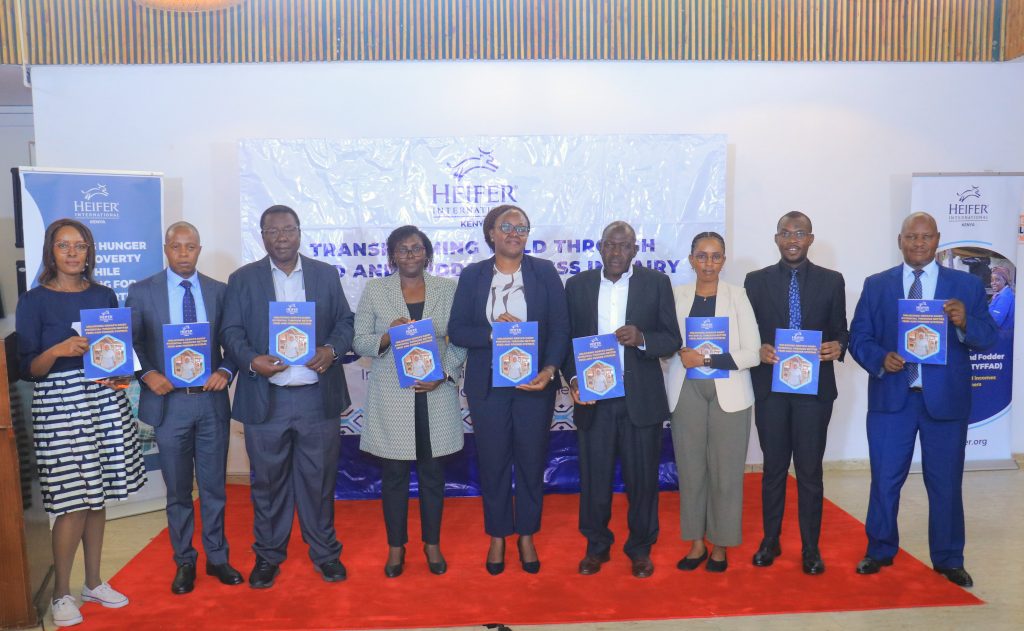
Speaking during a media breakfast engagement in Nairobi, Heifer International Kenya Country Director Wairimu Munyinyi said recent milk shortages had drawn attention to underlying weaknesses in the country’s feed and fodder systems.
Munyinyi noted that access to adequate, affordable and quality animal feed was critical to improving milk production, profitability and resilience among livestock farmers.
She said the consequences of feed shortages extend beyond individual farms, affecting milk supply, household incomes and national food security.
” When feed becomes scarce or expensive, the effects extend beyond the farm, affecting market supply, household incomes and ultimately food security,” said Munyinyi.
She observed that the challenge was particularly pronounced in arid and semi-arid areas, where recurring droughts and pasture shortages threaten livestock production and pastoral livelihoods.
Munyinyi pointed to community-led initiatives in areas such as Isiolo, Laikipia and other livestock-producing regions, where farmers are adopting innovative approaches to improve pasture availability, conserve water and restore degraded rangelands.
She cited the use of half-moon-shaped earth structures to harvest rainwater and retain soil moisture, creating favourable conditions for pasture regeneration.
According to the assessment, Kenya’s dairy industry supports approximately 1.8 million smallholder households and contributes an estimated 4.5 per cent of the country’s Gross Domestic Product and 14 per cent of agricultural GDP.
Annual milk production is estimated at between 5.2 billion and 5.76 billion litres against domestic demand estimated at 12.76 billion litres, highlighting the need to address productivity constraints across the value chain.
The study, which examined dairy interventions across 11 counties, conducted deeper assessments in Nyandarua, Embu and Elgeyo Marakwet to establish the underlying challenges affecting different dairy production systems.
It found that despite investments in improved animal breeds, farmer training, veterinary services, milk cooling infrastructure and cooperative development, productivity and commercialisation remain below potential.
In Nyandarua, farmers continue to grapple with feed availability, cold-chain infrastructure and cooperative business constraints, while in Embu, high feed costs and weak integration of support services undermine profitability.
In Elgeyo Marakwet, the assessment identified gaps in feed availability, breeding services, veterinary support and market infrastructure, compounded by climate-related vulnerabilities.
The findings further point to limited access to finance, inadequate mechanisation and insufficient farmer knowledge on suitable fodder varieties for different agro-ecological conditions.
Representatives from the Kenya Dairy Board and other dairy sector stakeholders called for stronger coordination among government agencies, research institutions, financial institutions and private sector players to address the challenges.
They noted that improved access to financing would enable farmers to invest in mechanisation and modern feed production technologies, while stronger partnerships would support the dissemination of research findings and improved farming practices.
The assessment recommends developing commercially viable feed and fodder enterprises, strengthening cooperatives as service delivery hubs, expanding access to dairy-responsive financing and improving market linkages.
It also calls for greater investment in climate-resilient feed production, quality assurance and integrated livestock services to support sustainable dairy farming.
Heifer International Kenya says its Transforming Youth in Dairy Through Feed and Fodder Access in Dairy (TYFFAD) initiative is among the interventions aimed at addressing feed and fodder challenges while creating economic opportunities for young people in the dairy value chain.
Munyinyi urged the media to play a greater role in informing public discussions on agricultural challenges and solutions, particularly through community-level reporting in local languages to ensure farmers can access and engage with relevant information.
She said addressing the challenges facing the dairy sector would require coordinated investment, research, innovation and policies that strengthen the entire livestock production ecosystem.